


Hammering Bronze Sheet from a Cast Ingot — Raising and Planishing
Sheet bronze was the material behind Bronze Age armour, vessels, mirrors, and decorative work. Unlike casting which produces a fixed shape, sheet-working starts with a flat ingot and transforms it through repeated cycles of hammering and annealing into sheets as thin as 0.5 mm — thinner than modern cardboard.
The process exploits a fundamental property of bronze: cold-hammering compresses the crystal grains, making the metal harder and thinner with each blow. But this work-hardening also makes the bronze brittle. Before it cracks, the smith heats it to dull red (annealing), which recrystallises the grain structure and restores ductility. A single ingot may go through 10-15 anneal-hammer cycles to reach usable sheet thickness.
The finished sheet can then be cut, bent, raised into vessels, riveted, engraved, or embossed — opening the full range of Bronze Age metalcraft.
Instructions
Cast a flat ingot
Cast a flat ingot
Materials for this step:
 Copper Sheet (0.5-1mm)500 g
Set up the anvil stone
Set up the anvil stone
Tools needed:
 Flat Stone Slab
First hammering pass — rough thinning
First hammering pass — rough thinning
Tools needed:
 Hammerstone
First anneal
First anneal
Materials for this step:
 Charcoal2 kg
Tools needed:
 Long-Handled Tongs
Continue hammer-anneal cycles
Continue hammer-anneal cycles
Detect and prevent edge cracking
Detect and prevent edge cracking
Final thinning to usable sheet
Final thinning to usable sheet
Planish the surface
Planish the surface
Tools needed:
 Smooth Stone
Polish (optional)
Polish (optional)
Materials for this step:
 Fine Sand100 g
Materials
3- Placeholder
- 2 kgPlaceholder
- 100 gPlaceholder
Tools Required
4- Placeholder
- Placeholder
- Placeholder
- Placeholder
Connected Blueprint Materials
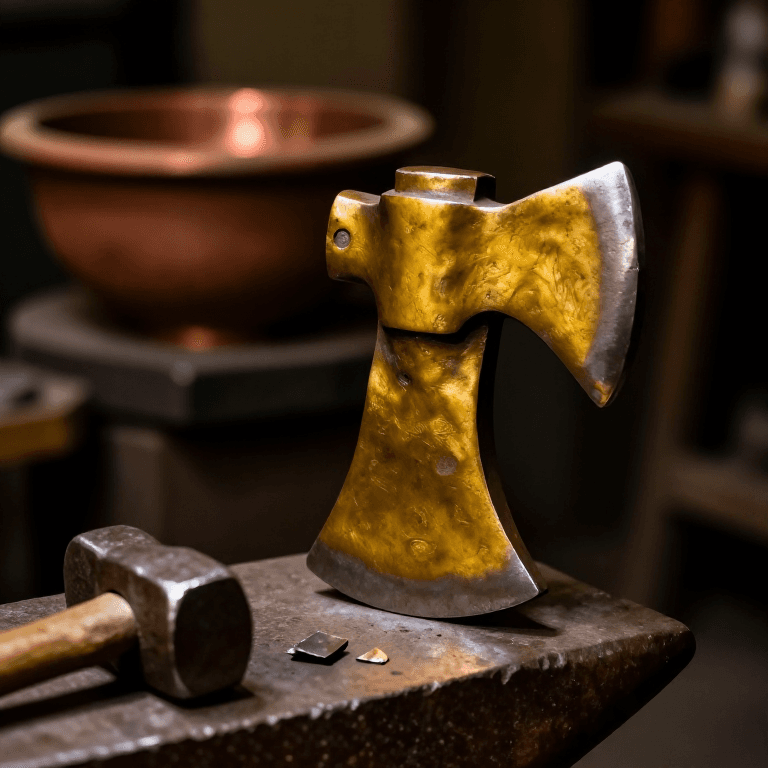
This blueprint makes

Related Blueprints
These blueprints share knowledge with this one — techniques, materials, or principles that connect them in the learning graph.
CC0 Public Domain
This blueprint is released under CC0. You are free to copy, modify, distribute, and use this work for any purpose, without asking permission.
Support the Maker by purchasing products through their Blueprint where they earn a Maker Commission set by Vendors, or create a new iteration of this Blueprint and include it as a connection in your own Blueprint to share revenue.