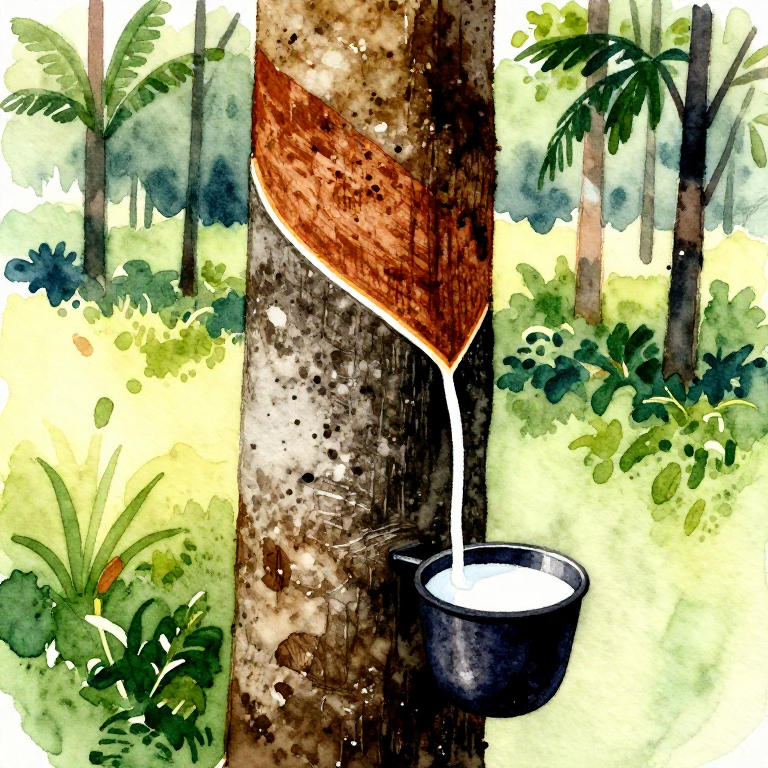


Rubber Tapping — Technique of Tapping and Harvesting Latex
Instructions
Check rubber tree age for tapping readiness
Check rubber tree age for tapping readiness
Rubber trees grown from seeds need 6-7 years to reach tapping age (grafted trees are faster: 5-6 years). Measure trunk circumference at 1 meter height from the ground: trees meet the standard when circumference ≥ 50 cm. Tree bark must be thick, smooth, and free from old wounds.
Prepare the tapping knife
Prepare the tapping knife
The rubber tapping knife has a curved, short blade, sharpened on one side. Sharpen the knife on a whetstone until the blade cuts cleanly without pulling the bark. A dull knife is the main cause of damage to the wood-forming layer — if the bark is scratched or torn instead of making a clean cut, the knife needs to be resharpened.
Tools needed:
 Knife
KnifeClean the tree trunk before scraping
Clean the tree trunk before scraping
Use a brush or damp cloth to clean dust, moss, and loose bark pieces on the area to be scraped. A clean surface helps see the scraping line clearly and prevents debris from falling into the sap. Especially during the rainy season, tree trunks often have mold attached.
Materials for this step:
 Water0.5 liters
Determine the scraping surface location
Determine the scraping surface location
The first scraping surface starts at a height of 1.3 meters from the ground (chest level). According to the S/2 scraping system (half trunk circumference), the scraping line extends exactly 1/2 of the trunk circumference, slanting from left to right, at a 30° angle to the horizontal direction. The slanting angle helps latex flow concentrate into the collection channel.
Line scraping guide
Line scraping guide
Use a ruler and chalk to mark the first scraping line on the tree bark. The scraping line is angled 30° from high on the left to low on the right. Mark both the starting point and ending point. An incorrectly angled scraping line will cause latex to flow out instead of concentrating in the trough.
Attach the latex collection trough and collection cup
Attach the latex collection trough and collection cup
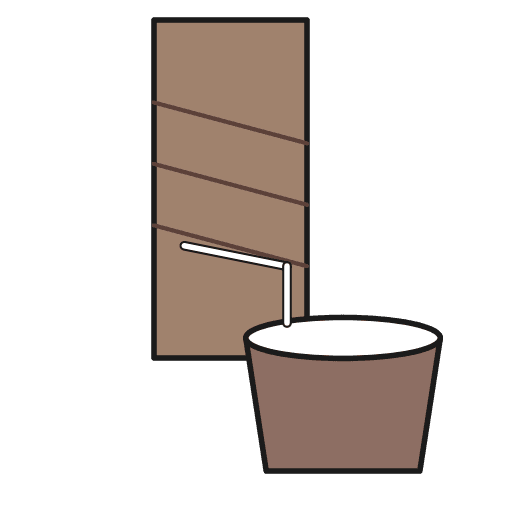
At the lowest point of the tapping cut (right end), attach a metal or plastic trough to the tree trunk. Place a ceramic cup or plastic cup below the trough to collect the latex flowing down. The trough must fit snugly against the tree trunk — gaps will cause latex to flow down the trunk instead of into the cup.
Materials for this step:
 Container1 piece
Tapping — bark scraping technique
Tapping — bark scraping technique
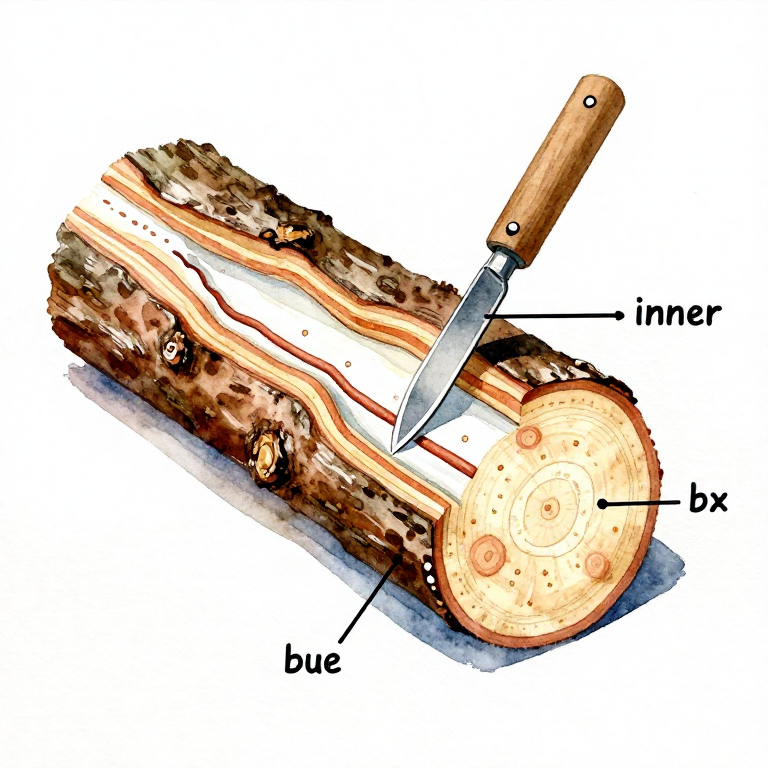
Hold the scraping knife with your dominant hand, place the blade at the left end of the scraping line. Pull the knife along the scraping line from left to right, cutting deep into the bark 1.5-2 mm — just enough to reach the latex vessels (inner bark layer) but NOT touching the cambium layer (light green wood-forming layer below). Each scraping removes a layer of bark 1.5-2 mm thick.
Tools needed:
KnifeRecognizing the correct depth
Recognizing the correct depth
When cutting at the correct depth, milky white latex begins to ooze out immediately from the cut line. If you see light yellow wood exposed — you've cut too deep, stop and adjust. If you don't see latex oozing — you've cut too shallow, you need to scrape a bit deeper. Practice on old trees before tapping productive trees.
Optimal tapping time
Optimal tapping time
Tap rubber in the early morning (3-6 AM) when temperature is low and latex pressure in the tree is highest. Latex flows most abundantly in the first 2-3 hours after tapping. Do not tap when it rains — rainwater dilutes latex and causes infection of the tapping wound.
Wait for sap to flow (2-3 hours)
Wait for sap to flow (2-3 hours)
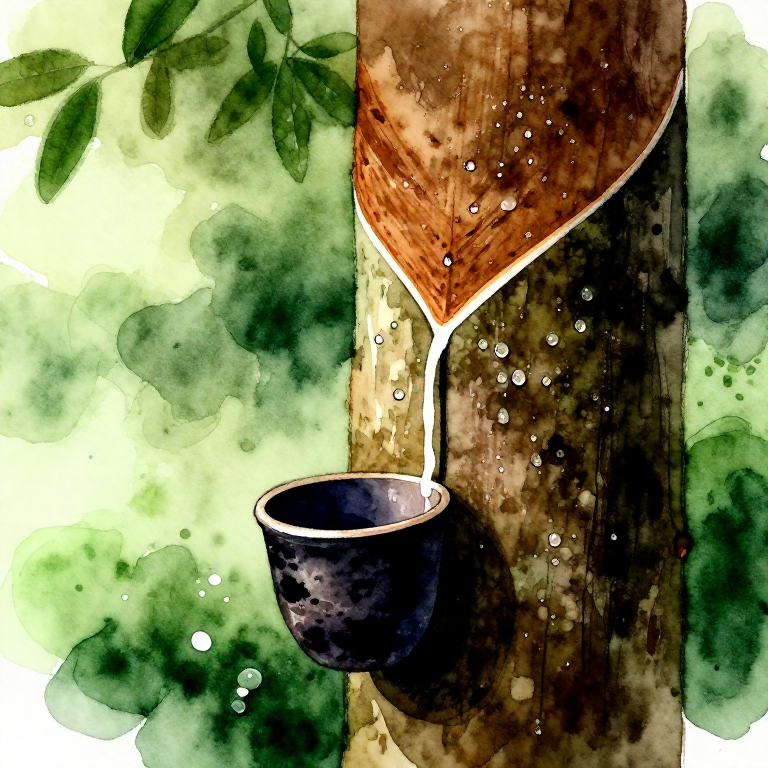
After tapping, sap flows slowly along the tapping line down into the gutter and then into the collection cup. A healthy tree yields 40-80 ml of latex per tapping. Sap stops flowing when protein in the latex coagulates and seals the latex vessel — this process takes 2-3 hours.
Pour latex into the container
Pour latex into the container
After 2-3 hours, remove the collection cup and pour into the collection container. Discard the coagulated latex (latex that has dried on the tapping cut) — this is lower grade latex, collected separately. Rinse the cup thoroughly with water before reusing. Latex needs to be processed within 4-6 hours before it self-coagulates.
Materials for this step:
Water2 litersTools needed:
ContainerTemporary latex preservation
Temporary latex preservation
Add 1-2% ammonia solution (NH₃) to the latex container to prevent early coagulation — ratio of 10 ml ammonia/liter of latex. Stir gently. Keep the latex container in shade, avoid direct sunlight. Latex with ammonia can be kept for 6-8 hours at room temperature before processing is needed.
Tapping frequency and bark rest
Tapping frequency and bark rest
S/2 d/3 tapping system (common in Vietnam): tapping half the circumference, 3 days/time (10 times/month). Each tapping consumes 1.5-2 mm of bark. Tree bark regenerates 2-3 cm/year — if tapping too deeply or too frequently, the bark does not have time to recover and yield gradually decreases.
Move the scraping surface downward
Move the scraping surface downward
After each scraping, the next scraping line is located directly below the old line (1.5-2 mm apart). When the scraping surface descends to a height of 50 cm from the ground, open a new scraping surface on the opposite side of the tree trunk (moving up to a height of 1.3 meters). The old bark needs 5-7 years to regenerate thick enough for the next scraping.
Treatment of overly deep scraping wounds
Treatment of overly deep scraping wounds
If you accidentally scrape and touch the wood cambium layer (see yellow wood exposed), stop scraping at that location. Apply a mixture of clay and water to the wound for protection. Deep scraping wounds cause tumors on the tree trunk and permanently reduce productivity at that location. This is the most serious mistake in the tapping profession.
Rest from tapping during leaf fall season
Rest from tapping during leaf fall season
Rubber trees naturally shed leaves every year (January-March in Vietnam). During this period, tapping MUST be completely stopped — the tree needs all nutrients to produce new leaves. Tapping latex during leaf fall season causes tree depletion, makes it susceptible to powdery mildew (Oidium heveae), and reduces productivity in subsequent years.
This blueprint makes
CC0 Public Domain
This blueprint is released under CC0. You are free to copy, modify, distribute, and use this work for any purpose, without asking permission.
Support the Maker by purchasing products through their Blueprint where they earn a Maker Commission set by Vendors, or create a new iteration of this Blueprint and include it as a connection in your own Blueprint to share revenue.