ART
BEAUTY & WELLNESS
CRAFT
CULTURE & HISTORY
ENTERTAINMENT
ENVIRONMENT
FOOD & DRINKS
REVERSE ENGINEERING
SCIENCES
SPORTS
TECHNOLOGY
WEARABLES
Hazardous


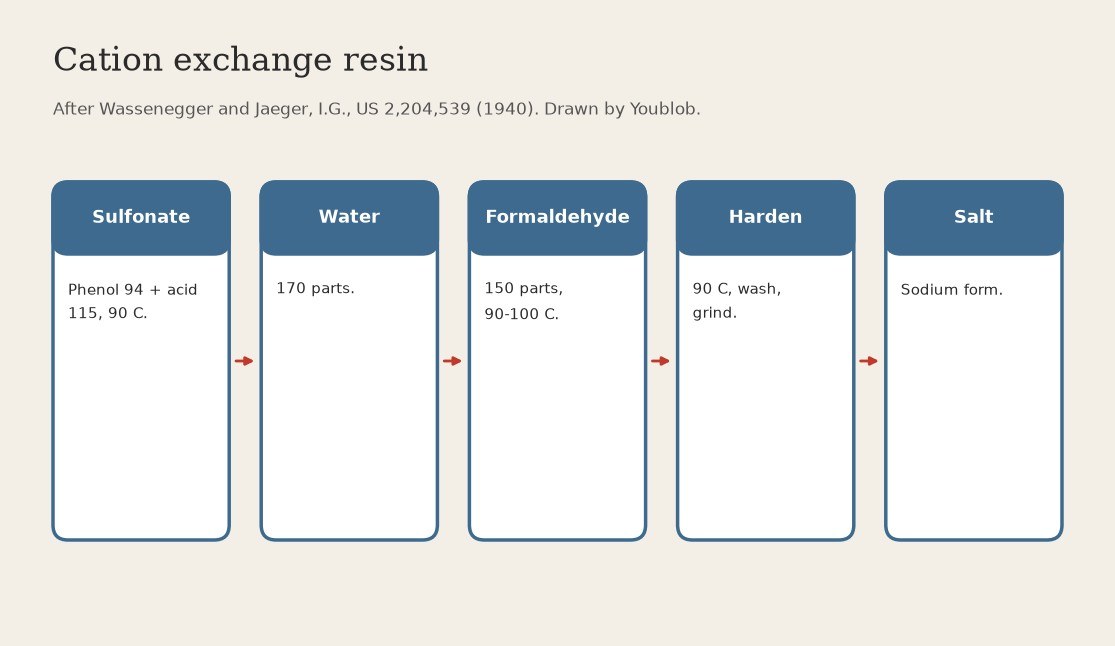
Cation Exchange Resin: Phenol Sulfonated and Cured with Formaldehyde (Wassenegger and Jaeger, I.G., US 2,204,539)
A water softener needs a solid that holds sodium loosely and calcium tightly. Wassenegger and Jaeger put sulfonic acid groups on phenol first and then cured it with formaldehyde into a hard resin, so every unit of the resin carries an exchange site. Charged with salt water it holds sodium, and gives it up for calcium.
Result: a dark, hard cation exchange resin in the sodium form; Example 1's resin takes up to 5 % of its weight of lime.
Source: Wassenegger and Jaeger, US 2,204,539 (I.G. Farben, 1940), Examples 1-2. Not given: formaldehyde strength in Example 2. Picture drawn by Youblob.
Intermediate
2 days
Hazardous content
This blueprint contains hazardous procedures. Log in and enable hazardous content in your account settings to view the step-by-step instructions.
Sign inThis blueprint makes
CC0 Public Domain
This blueprint is released under CC0. You are free to copy, modify, distribute, and use this work for any purpose, without asking permission.
Support the Maker by purchasing products through their Blueprint where they earn a Maker Commission set by Vendors, or create a new iteration of this Blueprint and include it as a connection in your own Blueprint to share revenue.