Collaboration
ART
BEAUTY & WELLNESS
CRAFT
CULTURE & HISTORY
ENTERTAINMENT
ENVIRONMENT
FOOD & DRINKS
REVERSE ENGINEERING
SCIENCES
SPORTS
TECHNOLOGY
WEARABLES
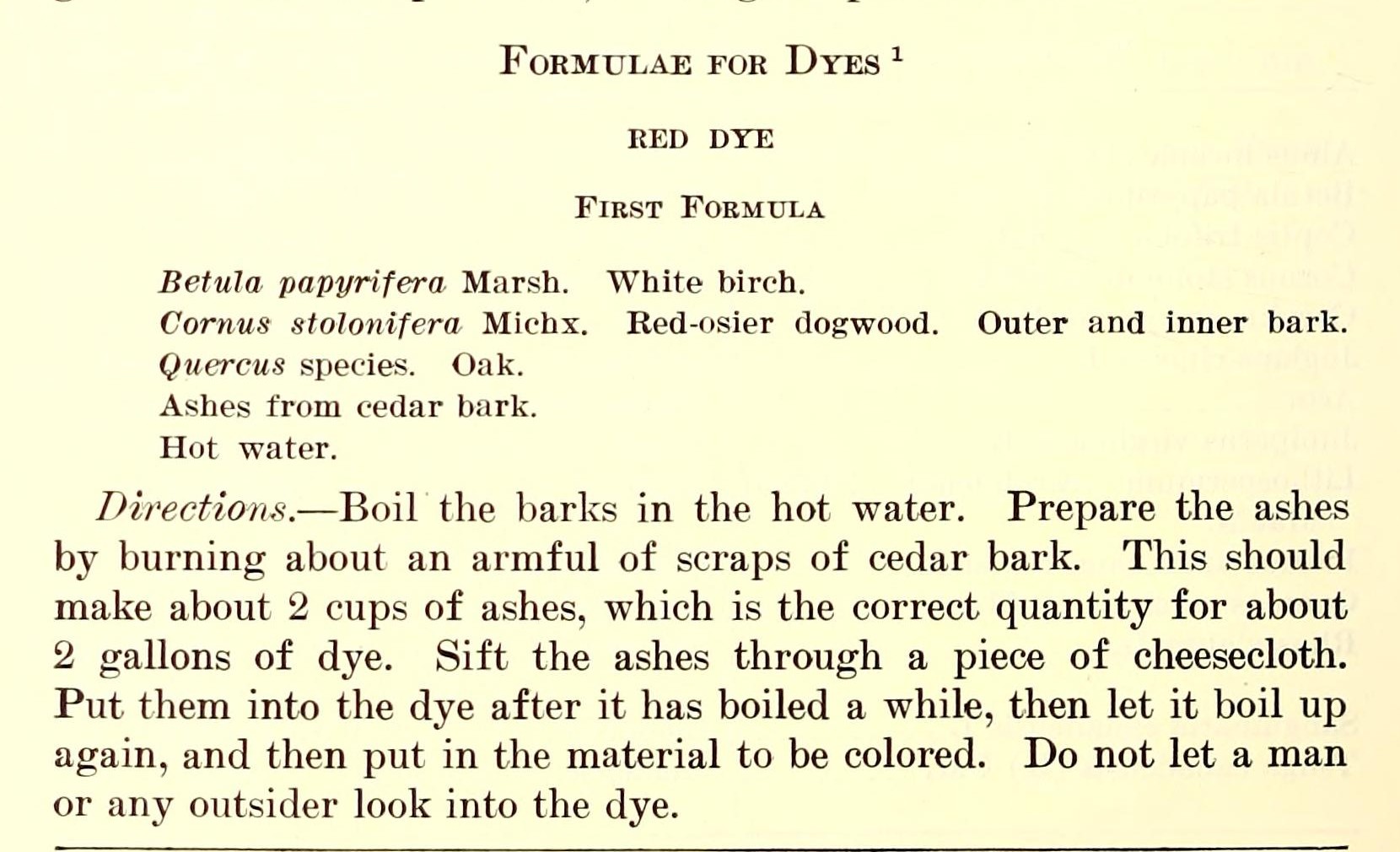


Chippewa Red Dyes: Seven Formulae from Dogwood, Puccoon, Bloodroot, Hemlock and Red Cedar Bark (Densmore, 1928)
The seven Chippewa (Ojibwe) red dyes Frances Densmore recorded: barks boiled with sifted cedar-bark ash; puccoon root with a spoon of ochre; bloodroot with wild plum for scarlet and dark red; hemlock with grindstone dust or red cedar inner bark for mahogany; dogwood and alder for a light red. The material is boiled in the dye.
Beginner
Half a day
Instructions
1
1
Her measures
Her measures
Loading Jupyter Notebook...
2
2
Read Densmore
Read Densmore
"Unless otherwise stated, the portion of the tree used in dye was the inner bark." Grindstone dust, the usual thing "to set the color", was silt with iron in it.
3
3
Formula 1: barks with cedar-bark ash
Formula 1: barks with cedar-bark ash
Boil white birch, red-osier dogwood (outer and inner bark) and oak bark in hot water (amounts not given). Burn about an armful of cedar-bark scraps: about 2 cups of ash, right for about 2 gallons (7.6 L) of dye. Sift the ash through cheesecloth, add it after the dye has boiled a while, let it boil up again, then put in the yarn. She records the rule: do not let a man or any outsider look into the dye.
Materials for this step:
 Birch Bark Sheets1 piece
 Red-osier Dogwood Bark1 piece
 Dried Oak Bark1 piece
 Cedar Bark Ash1 piece
 Water1 piece
 Undyed Wool Yarn1 piece
Tools needed:
 Fire Pit
 Large Dye Pot
 Cheesecloth
4
4
Formula 2: puccoon
Formula 2: puccoon
Nine inches (23 cm) of dried puccoon root, or as much pulverised, 1 quart (0.95 L) hot water and 1 teaspoon of ochre. Let it boil up a little, put in the material after it has stood a while in hot water, boil half an hour to an hour with the kettle covered, then take it off the fire and leave it in the dye several hours. Not bright enough: dye again the same way. She gives it for porcupine quills, "substantially the same" for other materials.
Materials for this step:
 Puccoon Root1 piece
 Raw Ochre1 pieceWater1 pieceUndyed Wool Yarn1 piece
Tools needed:
 Stone Mortar and PestleFire PitLarge Dye Pot
5
5
Formulae 3 and 4: bloodroot with wild plum
Formulae 3 and 4: bloodroot with wild plum
Scarlet (3): 2 handfuls bloodroot root, 1 handful each of wild plum, red-osier dogwood and alder inner bark, 1 quart hot water; boil all before the material goes in. Mrs. Razer dyed quills a brilliant scarlet with it. Dark red (4): 1 handful bloodroot root, 1 handful wild plum, 1 quart hot water.
Materials for this step:
 Bloodroot Rhizome (Dried)1 piece
 Wild Plum Bark1 pieceRed-osier Dogwood Bark1 piece
 Alder Bark (Dried)1 pieceWater1 pieceUndyed Wool Yarn1 piece
Tools needed:
 HammerstoneFire PitLarge Dye Pot
6
6
Formulae 5 and 6: mahogany
Formulae 5 and 6: mahogany
(5) Hemlock bark with a little grindstone dust in hot water. (6) A decoction of the dark red inner bark of red cedar; Chippewa women in Ontario boiled the cedar strips for their mats in it.
Materials for this step:
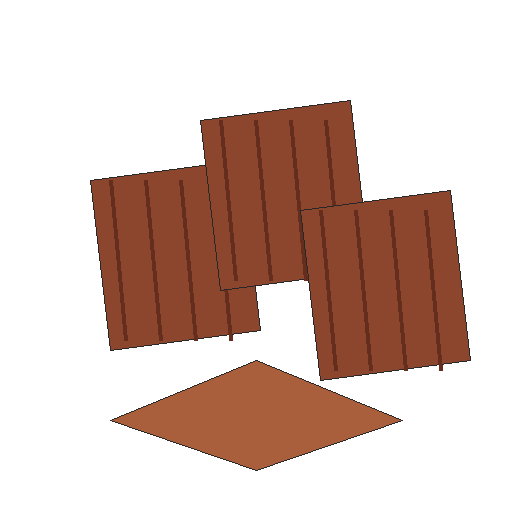 Hemlock Bark1 piece
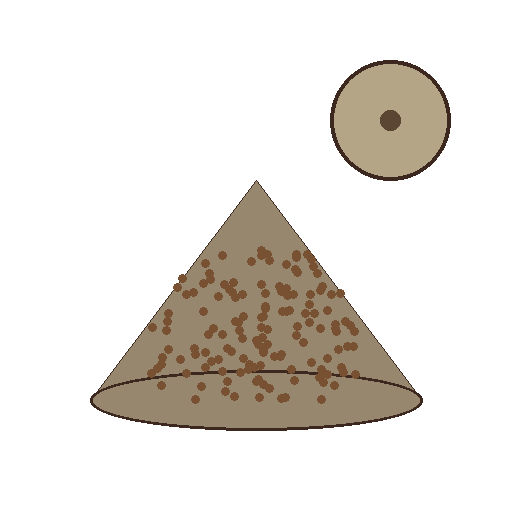 Grindstone Dust1 piece
 Red Cedar Inner Bark1 pieceWater1 pieceUndyed Wool Yarn1 piece
Tools needed:
HammerstoneFire PitLarge Dye Pot7
7
Formula 7: light red
Formula 7: light red
Red-osier dogwood and alder bark in equal parts, boiled in hot water. Mrs. Razer dyed white blanket a pretty light red with it; left out in the weather for several weeks it changed only slightly. Rinse and dry (ours).
Materials for this step:
Red-osier Dogwood Bark1 pieceAlder Bark (Dried)1 pieceWater1 pieceUndyed Wool Yarn1 pieceTools needed:
HammerstoneFire PitLarge Dye Pot8
8
Troubleshooting
Troubleshooting
Red dye troubleshooting.
Flow
Loading...
9
9
History and honest limits
History and honest limits
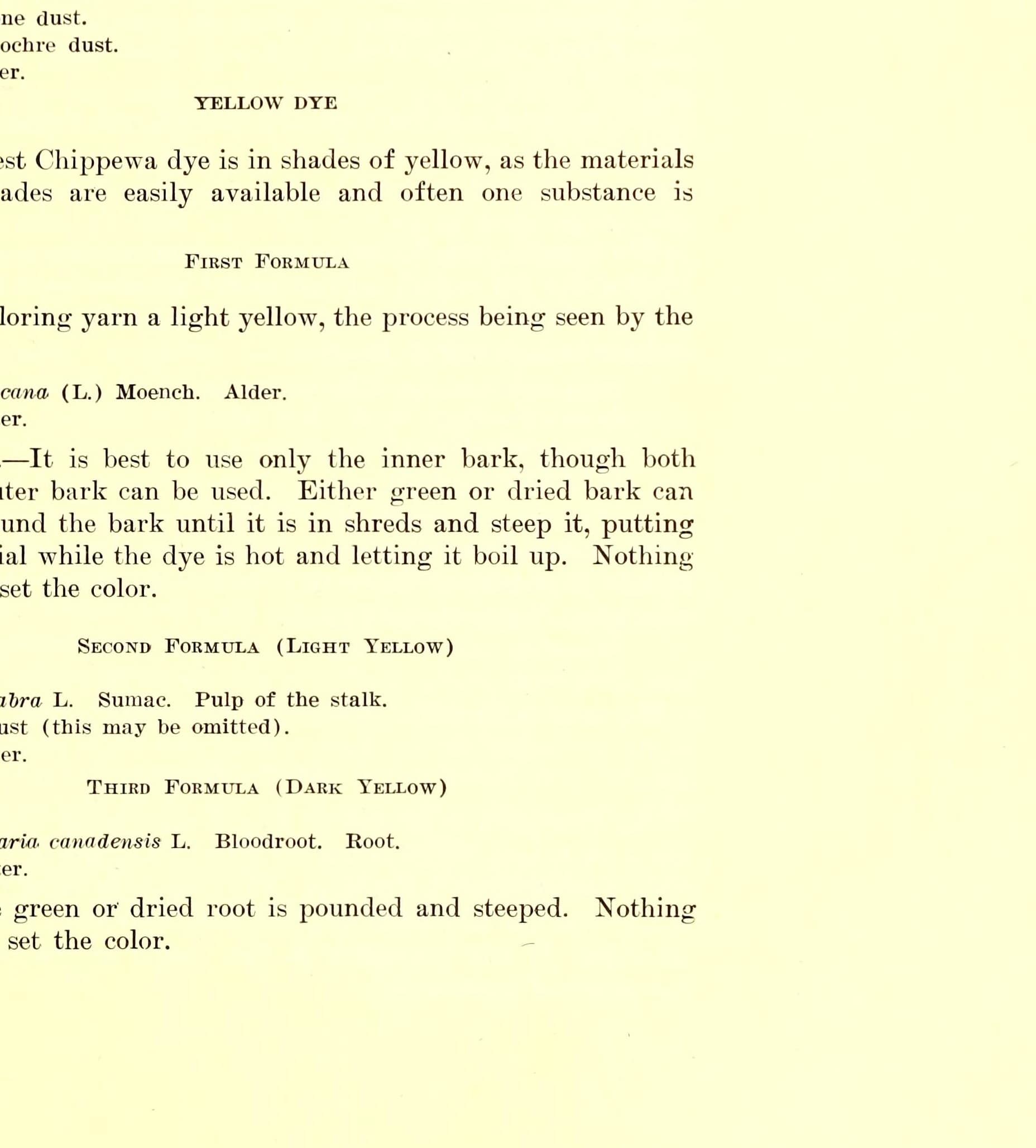
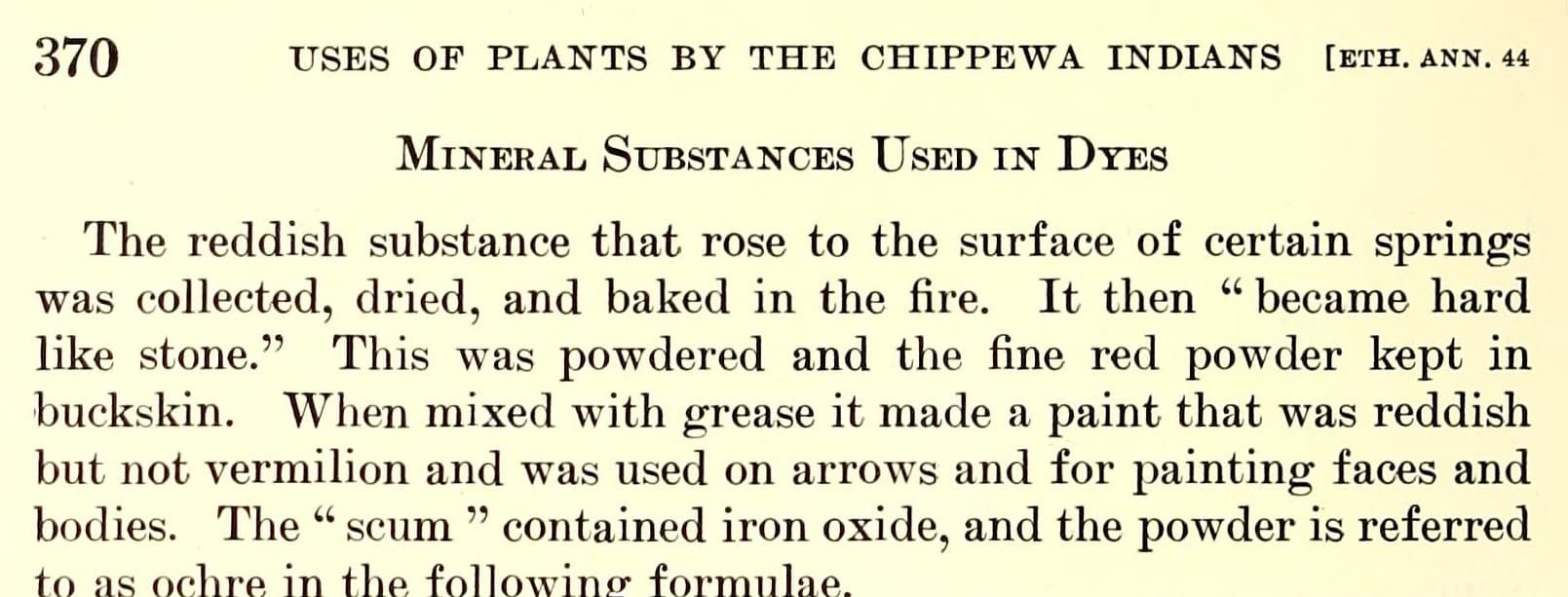
From Frances Densmore, *Uses of Plants by the Chippewa Indians*, **44th Annual Report of the Bureau of American Ethnology** (1928), pp. 370-372 (checked on the archive.org scan usesofplantsbych00dens). Mrs. Razer made formulae 3 and 7 for her. Bark amounts in formulae 1 and 5-7 are not given; using yarn throughout, metric figures and rinsing are ours.
Materials
14- 1 piecePlaceholder
- 1 piecePlaceholder
- 1 piecePlaceholder
- 1 piecePlaceholder
- 5 piecesPlaceholder
- 5 piecesPlaceholder
- 1 piecePlaceholder
- 1 piecePlaceholder
- 1 piecePlaceholder
- 1 piecePlaceholder
- 1 piecePlaceholder
- 1 piecePlaceholder
- 1 piecePlaceholder
- 1 piecePlaceholder
This blueprint makes

Related Blueprints
These blueprints share knowledge with this one — techniques, materials, or principles that connect them in the learning graph.
CC0 Public Domain
This blueprint is released under CC0. You are free to copy, modify, distribute, and use this work for any purpose, without asking permission.
Support the Maker by purchasing products through their Blueprint where they earn a Maker Commission set by Vendors, or create a new iteration of this Blueprint and include it as a connection in your own Blueprint to share revenue.