ART
BEAUTY & WELLNESS
CRAFT
CULTURE & HISTORY
ENTERTAINMENT
ENVIRONMENT
FOOD & DRINKS
REVERSE ENGINEERING
SCIENCES
SPORTS
TECHNOLOGY
WEARABLES
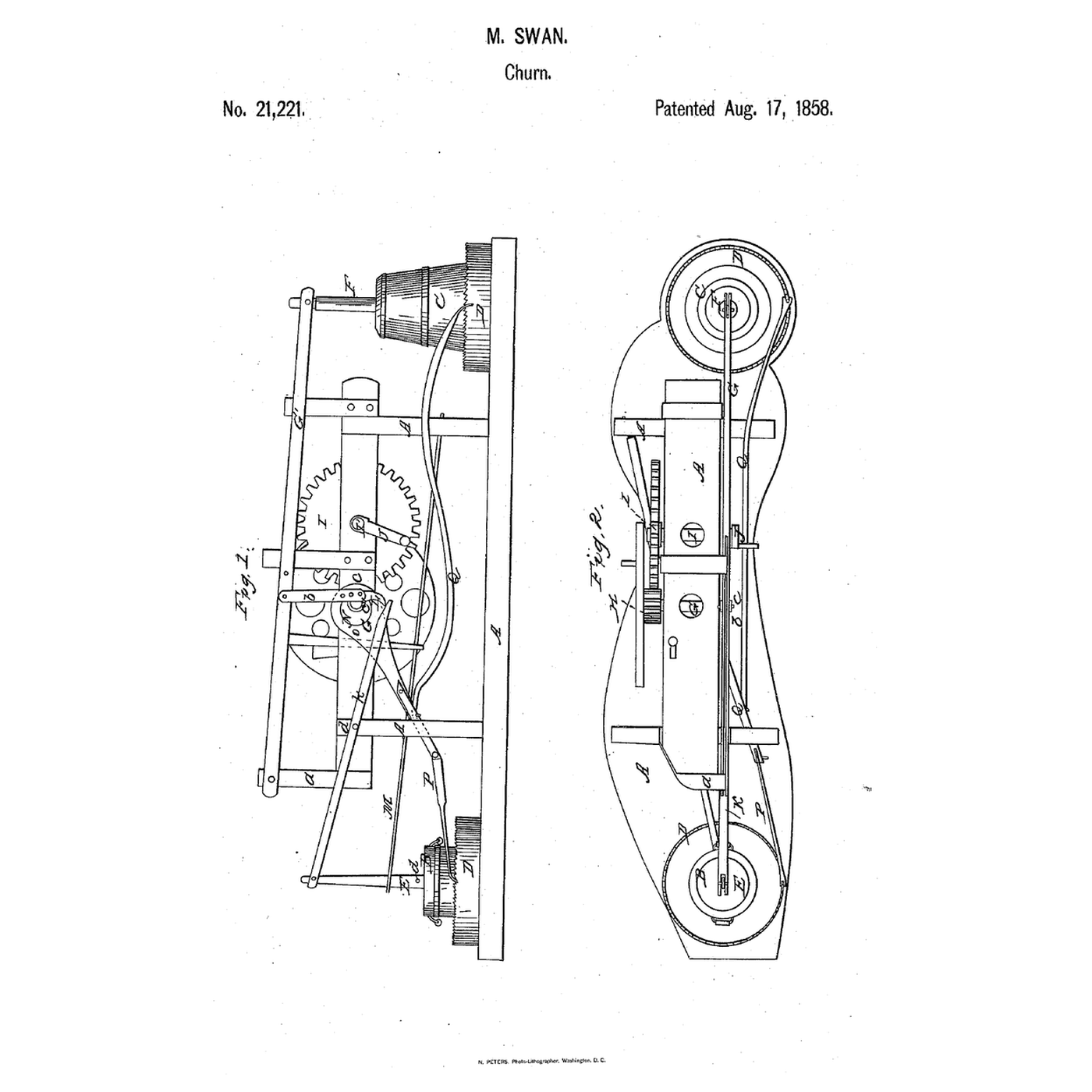


Churn-and-Washtub Mechanism: One Crank Works a Dasher and a Plunger and Turns Both Tubs
Moses Swan of Potter Hill, New York, received US 21,221, dated 17 August 1858, for one mechanism that works a churn and a washtub together: a crank and spur gears turn a shaft whose eccentric lifts the churn's dasher by a lever, whose cam lifts the washtub's plunger against a flat spring, and whose second eccentric drives pawls that turn both tubs a little at each stroke, so one person does both jobs.
This rung builds the base and posts in pine and prints the tubs, ratchet rims and gearing at tabletop scale.
Advanced
About 9 hours, plus printing
Instructions
1
1
One crank, three motions
One crank, three motions
Loading Jupyter Notebook...
2
2
Lever-worked dashers, before it
Lever-worked dashers, before it
There a lever was swung by hand; Swan's is worked by an eccentric, which also works a washtub beside it.
3
3
Read US 21,221
Read US 21,221
"It is advantageous to rotate the tubs, for by so doing if churning is being performed, the whole body of the cream will be more perfectly subjected to the action of the dasher, and if washing is being performed, the plunger will be brought in contact with every portion of the clothes."
4
4
Print the parts
Print the parts
Print two ratchet rims (/uploads/blueprints/churn-and-washtub-mechanism-ratchet-rim.stl), the churn tub (/uploads/blueprints/churn-and-washtub-mechanism-churn-tub.stl), the washtub (/uploads/blueprints/churn-and-washtub-mechanism-washtub.stl), pinion H (/uploads/blueprints/churn-and-washtub-mechanism-pinion-h.stl), wheel I (/uploads/blueprints/churn-and-washtub-mechanism-wheel-i.stl), the eccentric c (/uploads/blueprints/churn-and-washtub-mechanism-eccentric-c.stl), the cam L (/uploads/blueprints/churn-and-washtub-mechanism-cam-l.stl), the eccentric N (/uploads/blueprints/churn-and-washtub-mechanism-eccentric-n.stl), the strap O (/uploads/blueprints/churn-and-washtub-mechanism-strap-o.stl), two pawls (/uploads/blueprints/churn-and-washtub-mechanism-pawl.stl), the link b (/uploads/blueprints/churn-and-washtub-mechanism-link-b.stl), the dash (/uploads/blueprints/churn-and-washtub-mechanism-dash.stl), the dasher head (/uploads/blueprints/churn-and-washtub-mechanism-dasher-head.stl), the plunger (/uploads/blueprints/churn-and-washtub-mechanism-plunger.stl) and the crank (/uploads/blueprints/churn-and-washtub-mechanism-crank.stl). The rims need a 220 mm print bed. Print in PETG at 0.2 mm layers, 30 % infill, 4 walls; wash before first use.
Materials for this step:
 PETG Filament1 piece
Tools needed:
 FDM 3D Printer
5
5
Base and posts
Base and posts
Cut a pine base 560 by 240 mm. Glue and screw two posts 40 by 18 mm and 180 mm tall in its middle, 100 mm apart inside, with a block 30 mm thick on the front post's inner face; drill 10.5 mm holes through both posts 102 mm above the base for shaft G, and through the front post and its block 150 mm up for shaft I'. Stand an 18 mm square standard a 254 mm tall 55 mm left of the middle, a post d 122 mm tall behind it, and a post 232 mm tall at the back left for the spring. Screw an M6 screw up through the base 170 mm each side of the middle as the rims' pins.
Materials for this step:
 Pine Board1 piece
 Wood Glue1 piece
 Wood Screws1 piece
 Machine Screws1 piece
Tools needed:
 Hand Saw
 Cordless Drill
 Sandpaper
 Screwdriver Set
 Tape Measure
6
6
Shafts, gears and tubs
Shafts, gears and tubs
Drop a ratchet rim on each pin and stand the washtub on the left rim, the churn tub on the right. Cut 10 mm dowels 202 mm for shaft G and 148 mm for shaft I'. Thread G through the posts with pinion H, the eccentric c behind it, the cam L further back and the eccentric N on its front end; thread I' through the front post with wheel I on its inner end meshing H and the crank on its front end. Fix each with an M3 screw drilled through the dowel.
Materials for this step:
 Hardwood Dowels1 pieceMachine Screws1 piece
Tools needed:
Hand SawCordless DrillScrewdriver Set7
7
Dasher, plunger and pawls
Dasher, plunger and pawls
Pivot an 18 mm square pine lever G1, 243 mm long, on the standard a with an M6 screw, the link b from the eccentric's pin to its middle hole, and pin the dasher's head into its fork over the churn: a 10 mm dowel 155 mm long with the dash on its foot. Pivot the lever K on post d, its short end under the cam, and hang the plunger beside its long end on a 10 mm dowel 153 mm long, with an M3 screw through the dowel's top as the pin d. Screw a spring steel strip to the back left post, reaching over the pin. Hang the strap O on the eccentric N and pin both pawls to its foot with one M6 screw, resting on the rims' teeth at their front points.
Materials for this step:
Pine Board1 pieceHardwood Dowels1 pieceMachine Screws1 piece Nylon Insert Lock Nut1 piece
 Flat Washer1 piece
 Spring Steel Strip1 piece
Tools needed:
Hand SawCordless DrillScrewdriver Set8
8
The build in 3D
The build in 3D
FreeCAD model of this build: the pine base and posts, the washtub and churn tub on their ratchet rims, the crank and spur gears, shaft G with its eccentric, cam and second eccentric, the lever G1 and dasher, the lever K, plunger and flat spring, and the strap and pawls on the rims.
9
9
Churn, or wash
Churn, or wash
Pour 1.2 litres of heavy cream at about 15 °C, checked with the thermometer, into the churn tub, and warm soapy water and a cloth into the washtub. Turn the crank steadily and time it with the stopwatch: the dasher and plunger rise and fall and both tubs creep round. When the butter comes, lift the dasher out, pour off the buttermilk, wash the butter in cold water until it runs clear, work in a pinch of salt and weigh it.
Materials for this step:
 Heavy Cream1.2 l
 Coarse Sea Salt1 piece
 Water1 piece
 Bar Soap1 piece
Tools needed:
 Leave-In Probe Thermometer
 Stopwatch
 Digital Kitchen Scale
 Stainless Steel Mixing Bowl (Large)
10
10
Troubleshooting
Troubleshooting
Churn-and-washtub troubleshooting.
Flow
Loading...
11
11
History and honest limits
History and honest limits
**Moses Swan** of Potter Hill, Rensselaer County, New York, US 21,221, 17 August 1858, "Operating Churns, &c." He combined the two tubs so that neither two systems of gearing nor two persons are needed, and claimed the arrangement of mechanism that gives the plunger and dasher their up and down motion and both tubs their rotary motion. Our crown ratchets, sizes, pine frame and printed tubs are ours. FDM prints hold food in their layer lines, so wash well and replace when worn.
Materials
13- 1 piecePlaceholder
- 1 piecePlaceholder
- 1 piecePlaceholder
- 1 piecePlaceholder
- 3 piecesPlaceholder
- 1 piecePlaceholder
- 1 piecePlaceholder
- 1 piecePlaceholder
- 1 piecePlaceholder
- 1.2 lPlaceholder
- 1 piecePlaceholder
- 1 piecePlaceholder
- 1 piecePlaceholder
Tools Required
10- Placeholder
- Placeholder
- 1 vendor sell this, none ship to you yetPlaceholder
- Placeholder
- Placeholder
- 1 vendor sell this, none ship to you yetPlaceholder
- Placeholder
- Placeholder
- Placeholder
- Placeholder
Design Files
1Related Blueprints
These blueprints share knowledge with this one — techniques, materials, or principles that connect them in the learning graph.


CC0 Public Domain
This blueprint is released under CC0. You are free to copy, modify, distribute, and use this work for any purpose, without asking permission.
Support the Maker by purchasing products through their Blueprint where they earn a Maker Commission set by Vendors, or create a new iteration of this Blueprint and include it as a connection in your own Blueprint to share revenue.