Collaboration
ART
BEAUTY & WELLNESS
CRAFT
CULTURE & HISTORY
ENTERTAINMENT
ENVIRONMENT
FOOD & DRINKS
REVERSE ENGINEERING
SCIENCES
SPORTS
TECHNOLOGY
WEARABLES
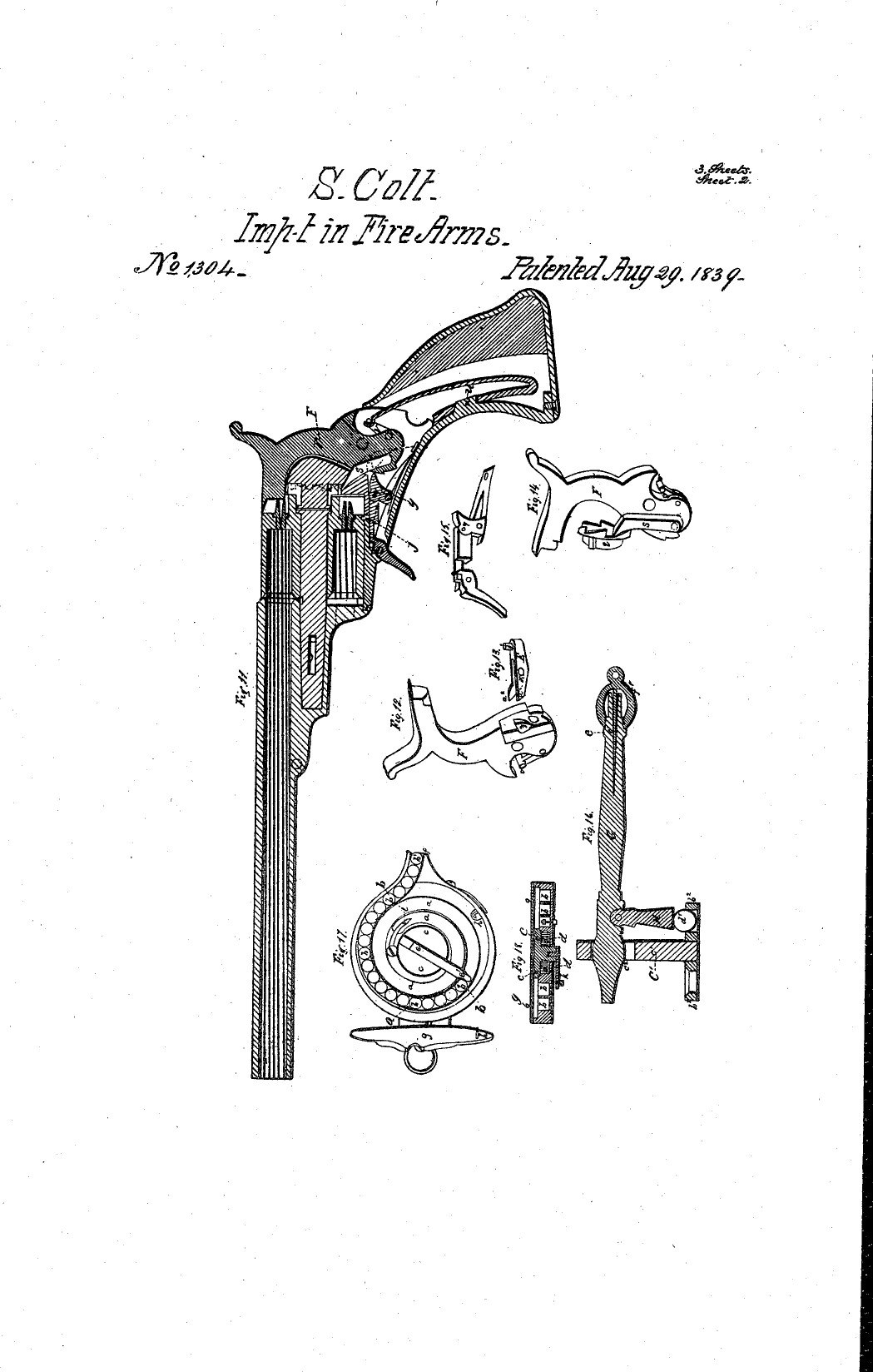


The Revolver: Several Chambers Turning Behind One Barrel (Colt, 1836 and 1839) - History and How It Works
Beginner
About 15 minutes
Instructions
1
1
Read Colt's 1839 patent
Read Colt's 1839 patent
"Be it known that I, Samuel Colt, of Paterson, in the county of Passaic and State of New Jersey, did obtain Letters Patent of the United States for an Improvement in Fire Arms, which Letters Patent bear date on the 25th day of February, in the year 1836." (US 1,304, dated 29 August 1839.)
2
2
The problem it solved
The problem it solved
A muzzle-loading gun had to be loaded down the barrel after every shot. Colt kept one barrel and put the several charges in a separate turning part behind it, which his patent calls the receiver.
3
3
How it works, in principle
How it works, in principle
The receiver is bored with several chambers and turns on a central arbor. Each chamber holds its own charge and has its own percussion cap at the back. Working the lock turns the receiver so the next chamber comes into line with the barrel and holds it there; the hammer then fires that chamber only. His 1839 patent also covers a lever rammer fixed under the barrel, a groove to carry smoke away from the arbor, and a magazine primer for caps.
4
4
Why it mattered
Why it mattered
Several shots from one hand-held arm, without reloading between them, changed what one person could do. Colt's plan of one barrel with a turning chambered cylinder remains the basic plan of the revolver.
5
5
Honest limits
Honest limits
From the text of US 1,304 (1839), which refers back to Colt's patent of 25 February 1836 (issued before the US numbering began). This page describes how the mechanism works in general terms only; it gives no dimensions, materials, charges or making steps, by design.
Related Blueprints
These blueprints share knowledge with this one — techniques, materials, or principles that connect them in the learning graph.
CC0 Public Domain
This blueprint is released under CC0. You are free to copy, modify, distribute, and use this work for any purpose, without asking permission.
Support the Maker by purchasing products through their Blueprint where they earn a Maker Commission set by Vendors, or create a new iteration of this Blueprint and include it as a connection in your own Blueprint to share revenue.