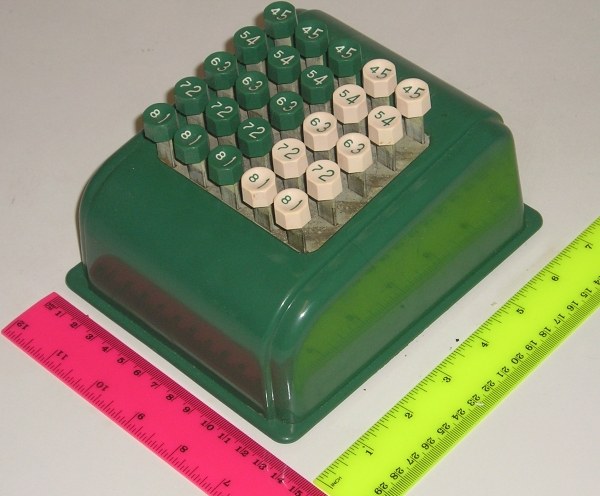


Comptometer
Instructions
Build one counting wheel
Build one counting wheel
Start with a single digit position and get it turning reliably.
- Mark a disc 0 to 9 evenly around its edge.
- Mount it so it turns freely on a shaft.
- Add a light spring detent that clicks into each of the ten positions.
Materials for this step:
 Plywood Sheet (1/8 inch, 12x12)1 pack
 Pine Dowel Rod Set1 set
Make the key stroke do the adding
Make the key stroke do the adding
This is Felt's actual idea, and it is worth building rather than reading.
- Fit a set of keys whose travel is proportional to their digit — the 9 key moves furthest, the 1 key least.
- Link each key to a pawl that advances the wheel by that many teeth.
- Press a key: the wheel steps that many positions and stops.
Carry to the next column
Carry to the next column
Carrying is where every calculating machine gets difficult.
- Fit a pin to the units wheel that engages only as it passes 9 to 0.
- Let that pin advance the tens wheel by exactly one step.
- Test by adding 1 repeatedly through 9, 10, 11.
Subtract by complements
Subtract by complements
The machine only adds. Subtraction is arithmetic, not extra hardware.
- To compute 528 − 176, add the nines complement of 176, which is 823.
- 528 + 823 = 1351.
- Drop the leading 1 and add it back to the units: 351 + 1 = 352.
- Check: 528 − 176 = 352.
Time it against a person
Time it against a person
Speed was the selling point, so measure it.
- Write out a column of twenty two-digit numbers.
- Add them mentally, timed, and record any error.
- Add them again on the mechanism, timed.
Tools needed:
 Stopwatch
History and context
History and context
Dorr Eugene Felt was a machinist in Chicago in his twenties when he built the first model over the winter of 1884-85. The prototype — a wooden macaroni box, meat skewers for the key rods, staples and rubber bands — survives and is known as the Macaroni Box. US patent 366,945, titled simply Adding machine, was granted on 19 July 1887. With Robert Tarrant he formed Felt and Tarrant to manufacture it.
What made it different from its rivals: it was key-driven. Thomas de Colmar's Arithmometer (1820) and Willgodt Odhner's pinwheel machines were set-and-crank designs, and William Burroughs's 1888 machine printed its results but needed a pull of the handle for each entry. Only the key-driven machine let one motion both enter and accumulate, and for adding long columns nothing else came close until electronics.
An honest limitation: the Comptometer had no printed record. An operator could add a column at speed and not be able to prove afterwards what had been entered, which is why Burroughs's slower printing machines held the accounting market where an audit trail mattered. Different jobs, different machines.
How it ended: electronic calculators from the mid 1960s did the same work silently, more cheaply, and without training. Felt and Tarrant's successor stopped making mechanical comptometers in the 1970s. The profession of comptometer operator, which had employed very large numbers of women for decades, disappeared with the machines.
Materials
2- 1 packPlaceholder
- Placeholder
CC0 Public Domain
This blueprint is released under CC0. You are free to copy, modify, distribute, and use this work for any purpose, without asking permission.
Support the Maker by purchasing products through their Blueprint where they earn a Maker Commission set by Vendors, or create a new iteration of this Blueprint and include it as a connection in your own Blueprint to share revenue.