ART
BEAUTY & WELLNESS
CRAFT
CULTURE & HISTORY
ENTERTAINMENT
ENVIRONMENT
FOOD & DRINKS
REVERSE ENGINEERING
SCIENCES
SPORTS
TECHNOLOGY
WEARABLES
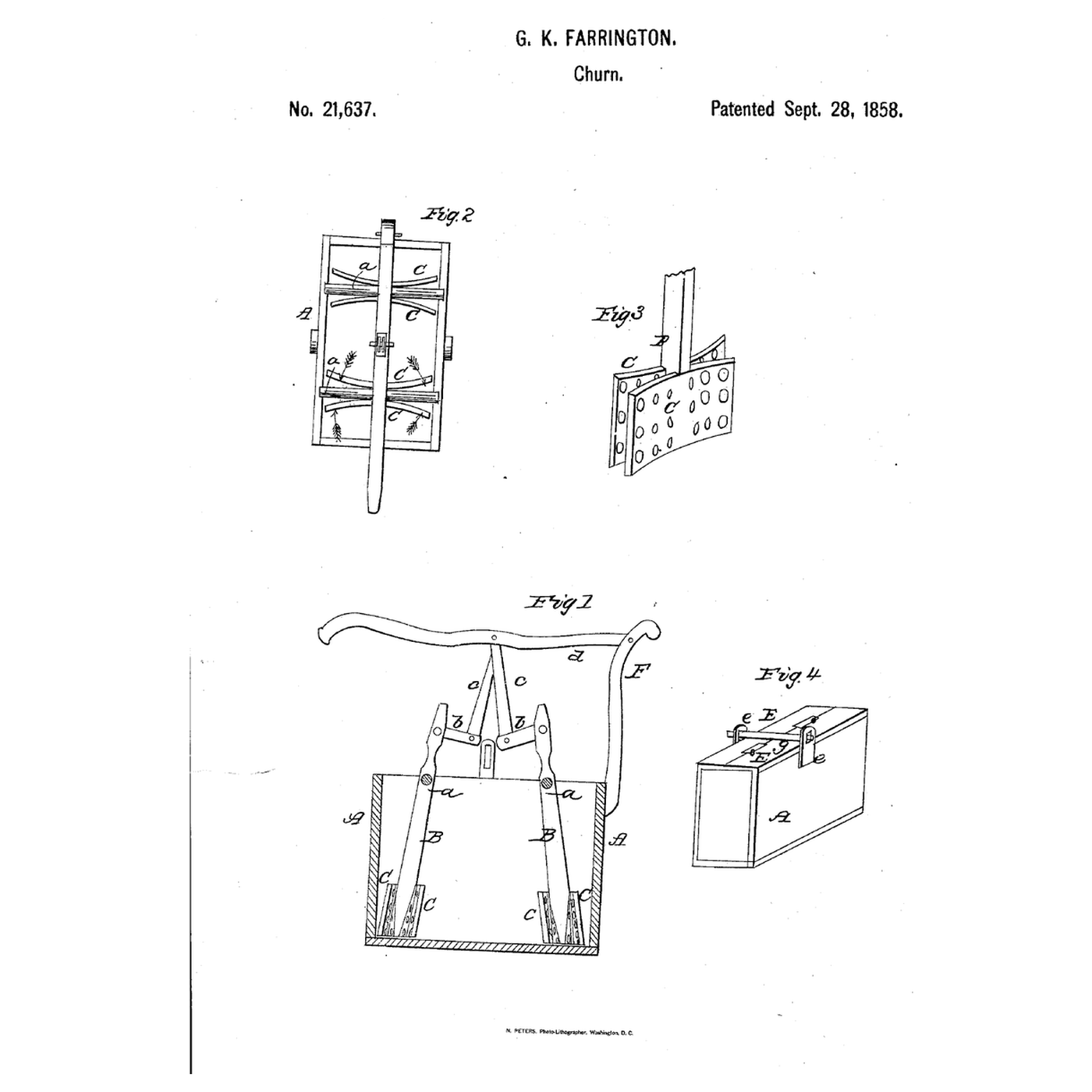


Concavo-Convex Swing-Dasher Churn: One Lever Swings Two Curved, Pierced Double Dashers
George K. Farrington of Xenia, Ohio, received US 21,637, dated 28 September 1858, for a churn of two swinging bearers, each carrying a double dasher of two curved plates fixed back to back and pierced straight through, worked to and fro by one lever, so the cream crosses the box and breaks on the holes' sharp edges.
This rung prints the bearers, dashers and fittings at tabletop scale, in a storage container.
Intermediate
About 4 hours, plus printing
Instructions
1
1
The dashers' curve and swing
The dashers' curve and swing
Loading Jupyter Notebook...
2
2
Lever-worked double dashers, before it
Lever-worked double dashers, before it
Those dashers rose and fell; Farrington's swing to and fro, through curved plates pierced straight through.
3
3
Read US 21,637
Read US 21,637
"The cream is thus made to move backward and forward in the box and must in passing from one side to the other (a greater portion of it) pass through the holes in the dashers in a zigzag manner, breaking constantly on the sharp edges of the holes in the dasher which set at angles to each other…"
4
4
Print the parts
Print the parts
Print two bearers (/uploads/blueprints/concavo-convex-swing-dasher-churn-bearer.stl), two dashers (/uploads/blueprints/concavo-convex-swing-dasher-churn-dasher.stl) standing, two top pieces (/uploads/blueprints/concavo-convex-swing-dasher-churn-top-piece.stl), two side pieces (/uploads/blueprints/concavo-convex-swing-dasher-churn-side-piece.stl) and two bars (/uploads/blueprints/concavo-convex-swing-dasher-churn-bar-c.stl). The top pieces need a 220 mm print bed. Print in PETG at 0.2 mm layers, 30 % infill, 4 walls; wash before first use.
Materials for this step:
 PETG Filament1 piece
Tools needed:
 FDM 3D Printer
5
5
Bearers and dashers
Bearers and dashers
Use a container about 280 by 190 mm inside and 170 mm deep. Drill 10.5 mm holes through both long sides, 70 mm each side of the middle and 140 mm above the floor. Screw a dasher onto each bearer's foot with two M3 screws, the arms pointing inward, and hang each bearer on a 10 mm dowel 212 mm long through the container's sides.
Materials for this step:
 Food-Grade Storage Container1 piece
 Hardwood Dowels1 piece
 Machine Screws1 piece
Tools needed:
 Cordless Drill
 Hand Saw
 Sandpaper
 Screwdriver Set
6
6
Top, lever and bars
Top, lever and bars
Bolt a side piece to each end of the container with two M4 screws. Lay the top pieces across the rim, the bearers through their slots, and push a 10 mm dowel 310 mm long through the side pieces over them as the bar g. Cut a pine upright 18 by 30 mm and 272 mm tall and bolt it to one end; pin a pine lever 18 mm square and 364 mm long to its top with an M6 screw. Join the lever's middle to each bearer's arm with a bar, M6 screws and lock nuts at every joint.
Materials for this step:
 Pine Board1 pieceHardwood Dowels1 pieceMachine Screws1 piece
 Nylon Insert Lock Nut1 piece
 Flat Washer1 piece
Tools needed:
Hand SawCordless DrillScrewdriver Set7
7
The build in 3D
The build in 3D
FreeCAD model of this build: the container with its near wall left off, the two bearers on their shafts with the double curved dashers at their feet, the top pieces and bar, the upright and lever, and the bars from the lever's middle to the bearers' arms.
8
8
Churn
Churn
Pour in 2 litres of heavy cream at about 15 °C, checked with the thermometer, and set the top on. Work the lever up and down steadily and time it with the stopwatch: the dashers swing to and fro and the cream crosses through their holes. When the butter comes, lift the top and bearers out, pour off the buttermilk, wash the butter in cold water until it runs clear, work in a pinch of salt and weigh it.
Materials for this step:
 Heavy Cream2 l
 Coarse Sea Salt1 piece
 Water1 piece
Tools needed:
 Leave-In Probe Thermometer
 Stopwatch
 Digital Kitchen Scale
 Stainless Steel Mixing Bowl (Large)
9
9
Troubleshooting
Troubleshooting
Swing-dasher churn troubleshooting.
Flow
Loading...
10
10
History and honest limits
History and honest limits
**George K. Farrington** of Xenia, Greene County, Ohio, US 21,637, 28 September 1858, assigned to D. B. Tiffany of Xenia. His connecting bars were pinned to the lever's middle so they could follow the bearers' swing, and the top bore on the shafts and kept them in place. He claimed the double concavo-convex dashers, made and worked as described. Our container, sizes and printed parts are ours. FDM prints hold food in their layer lines, so wash well and replace when worn.
Materials
10- 1 piecePlaceholder
- 1 piecePlaceholder
- 1 piecePlaceholder
- 2 piecesPlaceholder
- 1 piecePlaceholder
- 1 piecePlaceholder
- 1 piecePlaceholder
- 2 lPlaceholder
- 1 piecePlaceholder
- 1 piecePlaceholder
Tools Required
9- Placeholder
- 1 vendor sell this, none ship to you yetPlaceholder
- Placeholder
- Placeholder
- Placeholder
- Placeholder
- Placeholder
- Placeholder
- Placeholder
Design Files
1Related Blueprints
These blueprints share knowledge with this one — techniques, materials, or principles that connect them in the learning graph.
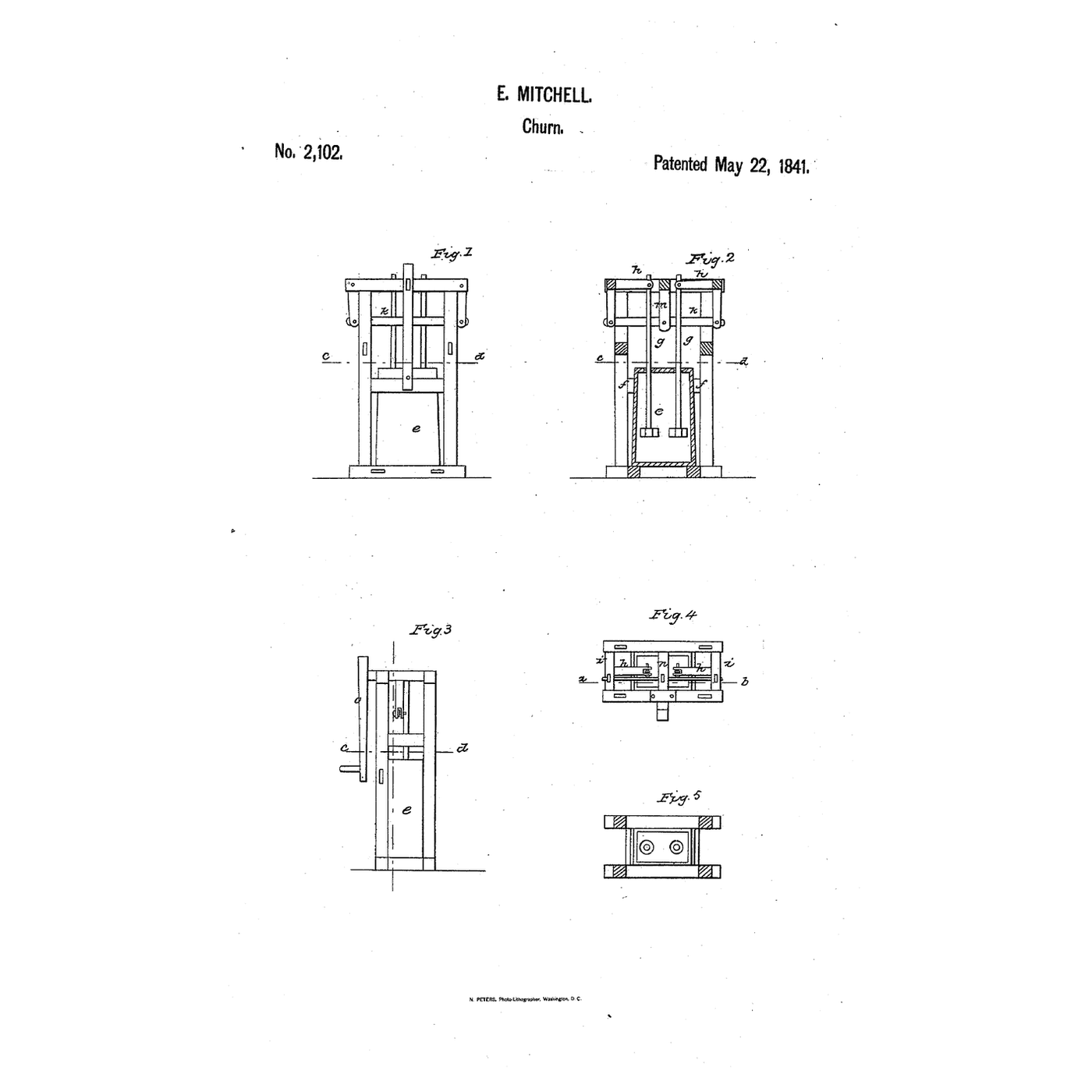


CC0 Public Domain
This blueprint is released under CC0. You are free to copy, modify, distribute, and use this work for any purpose, without asking permission.
Support the Maker by purchasing products through their Blueprint where they earn a Maker Commission set by Vendors, or create a new iteration of this Blueprint and include it as a connection in your own Blueprint to share revenue.