ART
BEAUTY & WELLNESS
CRAFT
CULTURE & HISTORY
ENTERTAINMENT
ENVIRONMENT
FOOD & DRINKS
REVERSE ENGINEERING
SCIENCES
SPORTS
TECHNOLOGY
WEARABLES


Contact Cement: Crude Rubber Dissolved in Benzine
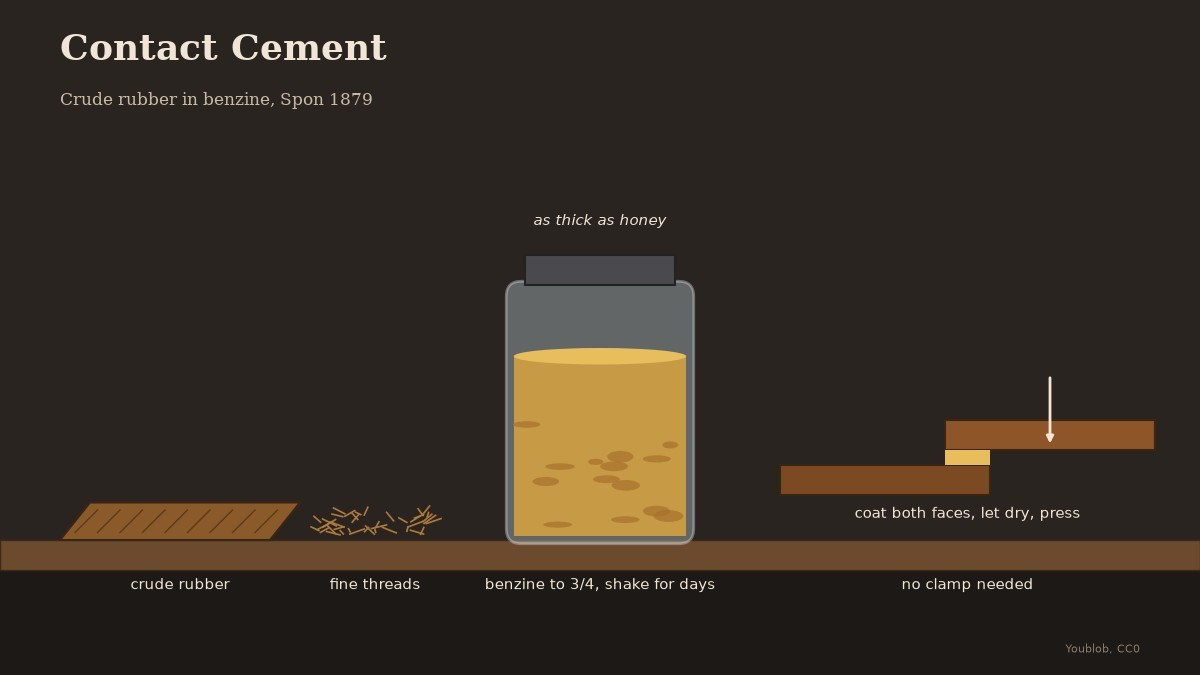
Crude rubber cut into fine threads swells and dissolves in benzine (light naphtha) to a cement as thick as honey (Spon, Workshop Receipts, 1879). Coat both surfaces, let them dry, and press them together: the bond forms at once, with no clamping. It joins leather straps, patches and rubber soles.
The picture: our drawing of the bottle, the shreds and a glued strap.
Beginner
A few days
Instructions
1
1
Cut the rubber fine
Cut the rubber fine
With a wet knife, cut the crude rubber into the thinnest possible slices. With shears, divide them into threads as fine as yarn.
Materials for this step:
 Smoked Rubber Sheet13 g
Tools needed:
 Craft Knife
 Shears
 Digital Kitchen Scale
2
2
Fill the bottle
Fill the bottle
Put the shreds in a wide-mouthed bottle, a tenth of its space or less. Fill it three-quarters full with good benzine, free from oil. Keep it away from flames.
Materials for this step:
 Naphtha425 ml
Tools needed:
 Glass Jar
 Measuring Jug
3
3
Let it swell and dissolve
Let it swell and dissolve
The rubber swells at once. Shake it often; in a few days it is as thick as honey. Lumps left: add benzine. Too thin: add rubber.
Tools needed:
Glass Jar4
4
Glue by contact
Glue by contact
Brush cement on both surfaces and let it dry a few minutes. Give three coats in all, then press the two faces together; no clamp is needed.
Tools needed:
 Glue Brush
5
5
Rubber per pint
Rubber per pint
Loading Jupyter Notebook...
Tools Required
6- Placeholder
- Placeholder
- Placeholder
- Placeholder
- Placeholder
- Placeholder
This blueprint makes

Related Blueprints
These blueprints share knowledge with this one — techniques, materials, or principles that connect them in the learning graph.



CC0 Public Domain
This blueprint is released under CC0. You are free to copy, modify, distribute, and use this work for any purpose, without asking permission.
Support the Maker by purchasing products through their Blueprint where they earn a Maker Commission set by Vendors, or create a new iteration of this Blueprint and include it as a connection in your own Blueprint to share revenue.