ART
BEAUTY & WELLNESS
CRAFT
CULTURE & HISTORY
ENTERTAINMENT
ENVIRONMENT
FOOD & DRINKS
REVERSE ENGINEERING
SCIENCES
SPORTS
TECHNOLOGY
WEARABLES
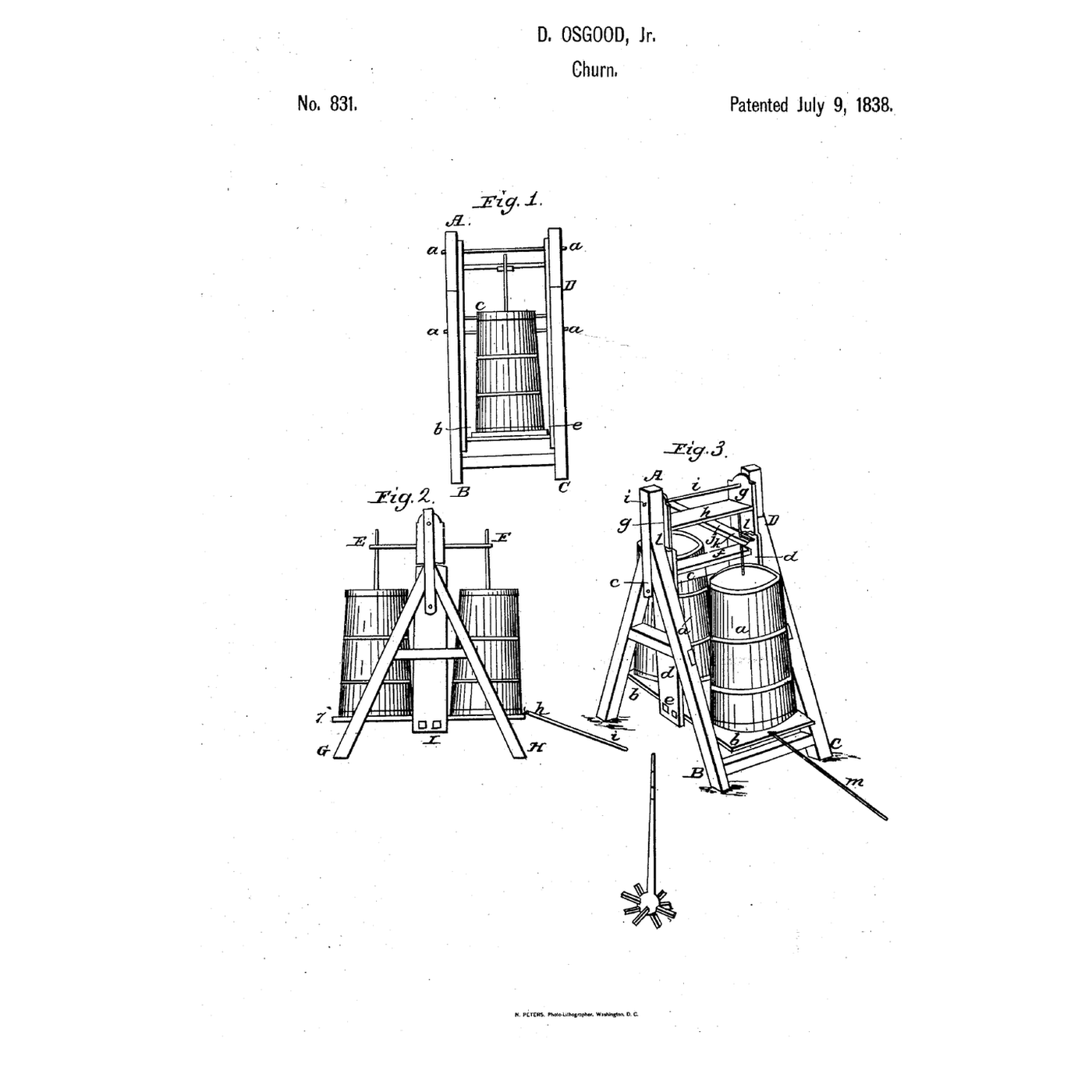


Double-Swing Churn: Swing the Platform, the Toothed Pieces Work Both Dashers
Working a dash churn means lifting the dasher, again and again.
Daniel Osgood, Jr., of Bluehill, Maine, received US 831, dated 9 July 1838, for what he called "Osgood's Double-Swing Churn": two common churns on a platform swinging in a frame. The side pieces rising from the platform are cut into teeth that mesh with the teeth of two pieces hung above, so as the platform swings backward and forward a lever is alternately raised and depressed, "giving the downward and upward motion to the dashers." The power required, he wrote, "is nearly in proportion to the power required to draw a pendulum in its lateral motion compared with that of raising its weight."
This rung compares the swing of his platform and ours, then prints the toothed sectors, builds a tabletop frame for two jars, and makes butter.
Intermediate
About 6 hours, plus printing
Instructions
1
1
Swing period and dasher stroke
Swing period and dasher stroke
Loading Jupyter Notebook...
2
2
One load balancing another on a lever
One load balancing another on a lever
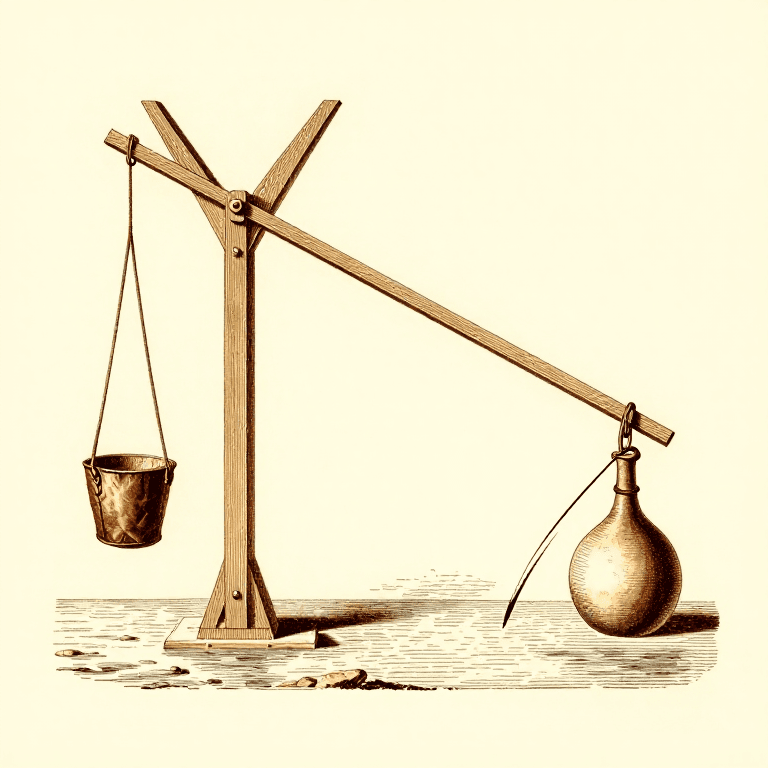
The embedded blueprint lifts water with a counterweighted beam. Osgood's beam balances one churn's dasher against the other's, and he says to balance a single churn with a weight.
3
3
Read US 831
Read US 831
"This saving of labor is acquired by placing two common churns, Figure 3 (a a) on a swinging platform (b). This platform is made to swing by being suspended in the frame A, B, C, D, by a rod passing through the frame and two pieces (d d) rising from the sides of the platform (b)... The ends of the side pieces (d, d,) and the corresponding upper, pieces (g, g,) are cut into teeth or cogs (l l,) and mesh into each other."
4
4
Print four toothed sectors
Print four toothed sectors
Print four identical sectors (/uploads/blueprints/double-swing-churn-sector.stl), flat. Each has a 6.6 mm pivot hole at the centre of its teeth and two screw holes in its tail. Print in PLA at 0.2 mm layers, 30 % infill, 4 walls; wash before first use.
Materials for this step:
 PLA Filament1 piece
Tools needed:
 FDM 3D Printer
5
5
Build the frame and platform
Build the frame and platform
Make two A-frames of pine about 420 mm tall, joined at the top by a cross bar. Drill both for two 6 mm steel rods 60 mm apart, one above the other: the lower rod carries the platform and the upper carries the beam. Cut a plywood platform 280 × 130 mm. Screw an upright pine strip to each side of the platform, reaching up to the lower rod, and screw a sector to the top of each strip, teeth up and pivot on the rod.
Materials for this step:
 Pine Board1 piece
 Plywood Sheet1 piece
 Mild Steel Rod1 piece
 #8 x 1" Wood Screw1 piece
 Wood Glue1 piece
Tools needed:
 Hand Saw
 Hacksaw
 Cordless Drill
 Drill Bit Set
 Clamps
 Tape Measure
6
6
Hang the beam and dashers
Hang the beam and dashers
Screw the other two sectors to two short pine pieces hung on the upper rod, teeth down, meshing with the lower ones. Join the hung pieces with a cross bar and fix a beam across it at right angles, 200 mm long. Hang a dowel dasher with a plywood disc from each end on a loose screw, through a hole in each jar's lid. Fit a long handle to the platform.
Materials for this step:
Pine Board1 piece Hardwood Dowels1 piecePlywood Sheet1 piece
 Glass Jar2 pieces#8 x 1" Wood Screw1 piece
Tools needed:
Hand SawCordless DrillDrill Bit Set Screwdriver Set
7
7
The build in 3D
The build in 3D
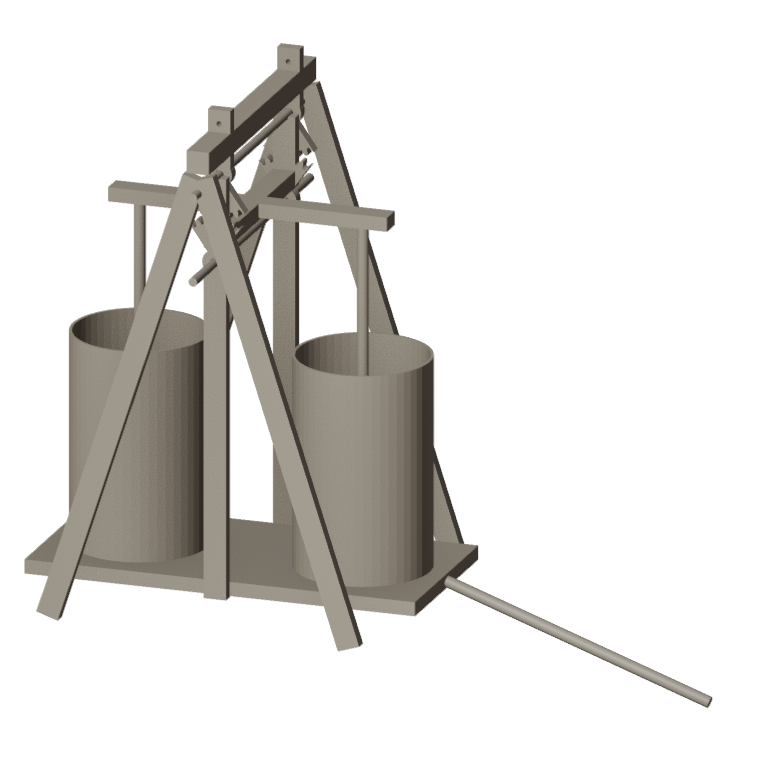
FreeCAD model of this build, not of the patent: two jars on the swinging platform, the side pieces with their toothed sectors on the lower rod, the hung pieces meshing above them on the upper rod, the beam carrying the two dashers, the A-frames and the handle.
8
8
Swing and make butter
Swing and make butter
Let the heavy cream stand until it reaches about 15 °C, checked with the thermometer. Pour half into each jar, no more than a third full, and fit the lids. Swing the platform steadily by the handle; the dashers rise and fall in turn. Time until the butter comes. Pour off the buttermilk, add cold water, churn a little and pour off again until it runs clear; work in a pinch of salt and weigh the butter.
Materials for this step:
 Heavy Cream500 ml
 Coarse Sea Salt1 piece
 Water1 piece
Tools needed:
 Leave-In Probe Thermometer
 Stopwatch
 Digital Kitchen Scale
 Stainless Steel Mixing Bowl (Large)
9
9
Teeth that slip, a swing that dies
Teeth that slip, a swing that dies
Double-swing churn troubleshooting.
Flow
Loading...
10
10
History and honest limits
History and honest limits
**Daniel Osgood, Jr.** of Bluehill, Hancock County, Maine, received US 831, dated 9 July 1838. He gave the dimensions for common use: a frame 3 ft 1 in high, churns 1 ft 7 in high, 14 inches across at the bottom and 12 at the top, a platform 2 ft 6 in by 1 ft, and the pendulum 1 ft 4 in from its rod to the platform. "When but one churn is necessary, the other may be dispensed with by substituting any other weight in its stead to balance the one that is used." He claimed "the manner in which the dashers are worked by the pendulous motion of the churn."
**Honest limits.** Jars on a tabletop frame stand in for his two churns, and printed sectors for his wooden teeth. FDM prints hold food in their layer lines, so wash well and replace when worn. Your times and weights are the result.
Materials
11- 1 piecePlaceholder
- 1 piecePlaceholder
- 1 piecePlaceholder
- 1 piecePlaceholder
- 2 piecesPlaceholder
- 1 piecePlaceholder
- 1 piecePlaceholder
- 2 piecesPlaceholder
- 500 mlPlaceholder
- 1 piecePlaceholder
- 1 piecePlaceholder
Tools Required
12- Placeholder
- Placeholder
- Placeholder
- 1 vendor sell this, none ship to you yetPlaceholder
- Placeholder
- Placeholder
- 1 vendor sell this, none ship to you yetPlaceholder
- Placeholder
- Placeholder
- Placeholder
- Placeholder
- Placeholder
Design Files
1Related Blueprints
These blueprints share knowledge with this one — techniques, materials, or principles that connect them in the learning graph.
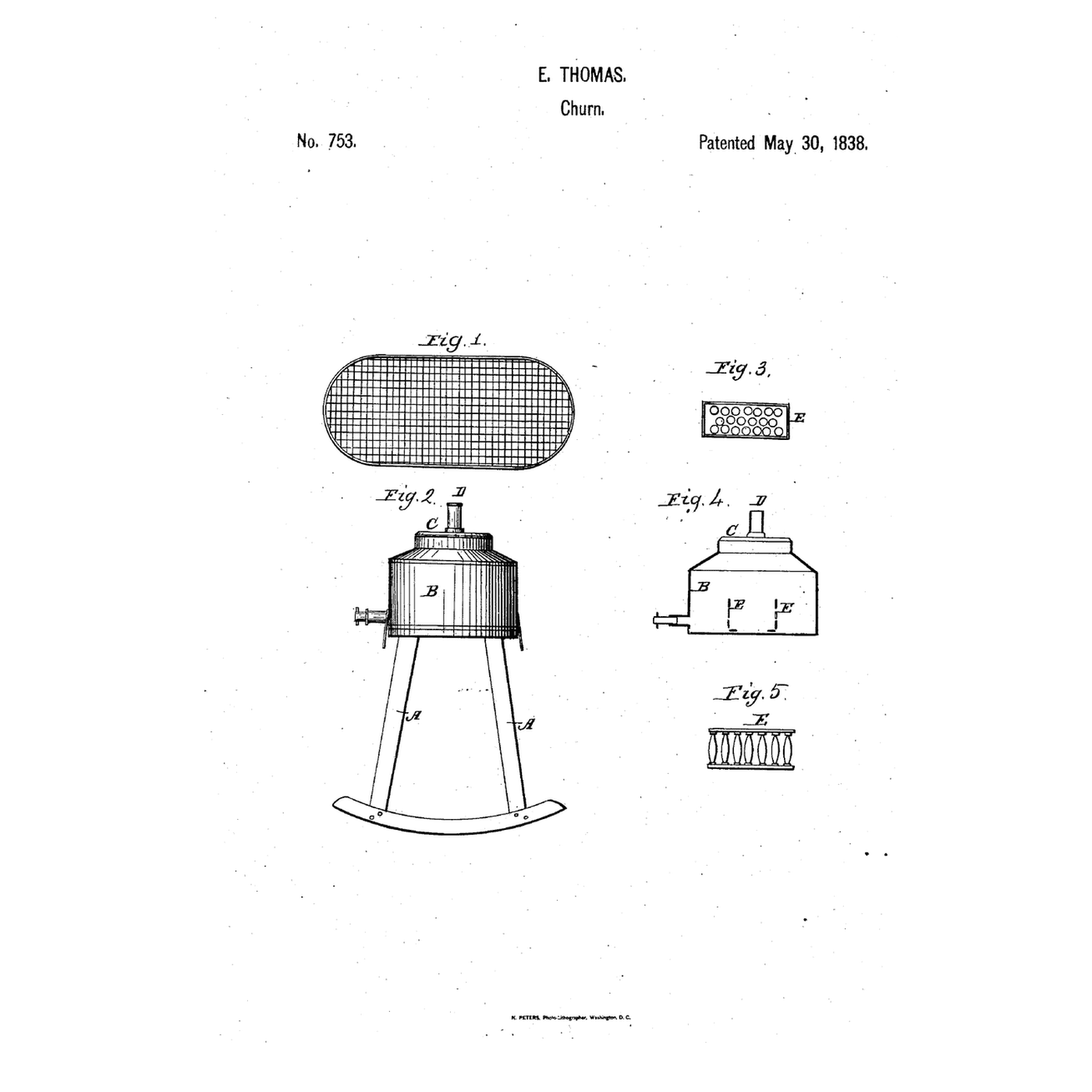



CC0 Public Domain
This blueprint is released under CC0. You are free to copy, modify, distribute, and use this work for any purpose, without asking permission.
Support the Maker by purchasing products through their Blueprint where they earn a Maker Commission set by Vendors, or create a new iteration of this Blueprint and include it as a connection in your own Blueprint to share revenue.