Collaboration
ART
BEAUTY & WELLNESS
CRAFT
CULTURE & HISTORY
ENTERTAINMENT
ENVIRONMENT
FOOD & DRINKS
REVERSE ENGINEERING
SCIENCES
SPORTS
TECHNOLOGY
WEARABLES

Nested Hollow-Dasher Churn: Two Dasher Frames Turn Contrary Ways, Their Hollowed Side Pieces Driving Cream at Webs
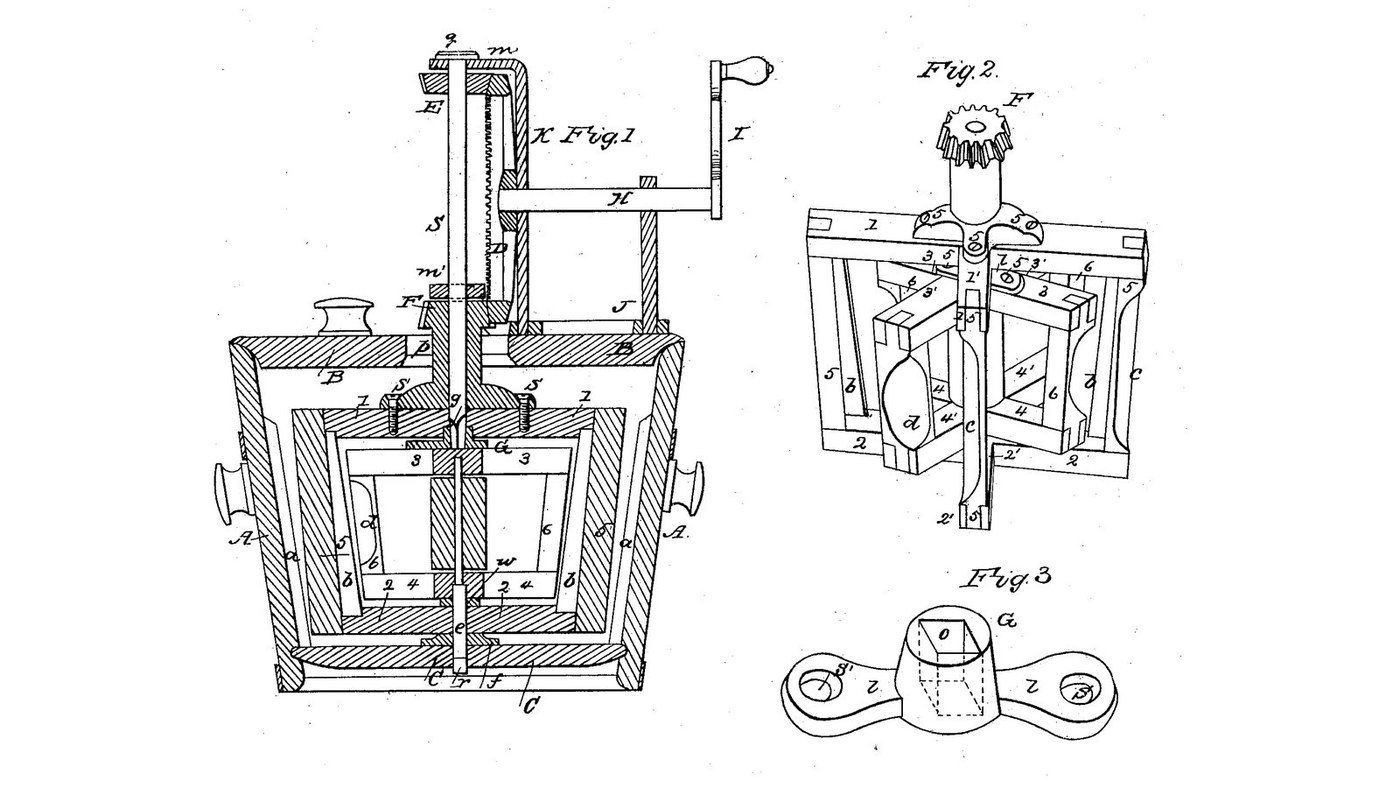
Stephen P. Dunham and Austin Hipple of Kilbourne, Ohio, received US 27,894, dated 17 April 1860, for a churn. One dasher frame turns inside another, the two driven contrary ways by one winch through a face-toothed wheel and two pinions. The side pieces of each frame are hollowed on their leading edges and throw the cream at thin webs: the outer frame's at webs on the vessel's wall, the inner frame's at webs on the outer frame.
The patent gives no sizes; every size here is ours.
Advanced
About 3 days, plus printing
Instructions
1
1
One wheel, two pinions, two directions
One wheel, two pinions, two directions
Loading Jupyter Notebook...
2
2
Contrary turning from toothed faces, two months before
Contrary turning from toothed faces, two months before
Ward turns a cylinder against its dashers. Dunham and Hipple turn one dasher frame inside another.
3
3
Read US 27,894
Read US 27,894
"The cream is projected by the surfaces of the hollow s, c, onto the wall of the vessel, by which it is constrained to take up a circular motion till obstructed by the webs, a, and reflected by them in currents, toward the middle of the vessel, and with a velocity increasing as the distances between these hollows and webs diminish."
4
4
Print the driving wheel D
Print the driving wheel D
Face-toothed wheel, 36 teeth, module 2, with a hub; bored 12.4 mm. PETG, 0.2 mm layers, 40 % infill, 4 walls.
5
5
Print the pinion F
Print the pinion F
Spur pinion, 16 teeth, module 2, with a hub; bored 18.4 mm for the hollow arbor. PETG, 0.2 mm layers, 40 % infill, 4 walls.
6
6
Print the pinion E
Print the pinion E
Spur pinion, 16 teeth, module 2, with a hub; bored 12.4 mm for the shaft S. PETG, 0.2 mm layers, 40 % infill, 4 walls.
7
7
Webs a, step r and pivot bolt e
Webs a, step r and pivot bolt e
Screw four hardwood webs 4 mm thick and 10 deep upright inside the bucket a quarter turn apart, from the floor to 310 mm up, sealing the screw holes outside with silicone. Screw a hardwood block 50 x 50 x 8 mm to the floor's centre as the step r and bore it 12.6 mm, 6 deep. Cut a 12 mm stainless rod 60 mm long as the pivot bolt e.
Materials for this step:
 20-Liter Bucket1 piece
 Hardwood Board1 piece
 Hardwood Block1 piece
 Wood Screws10 pieces
 Silicone Sealant1 piece
 Stainless Steel Rod1 piece
Tools needed:
 Table Saw
 Cordless Drill
 Drill Bit Set
 Hacksaw
 Files (Hand File)
 Screwdriver Set
8
8
Outer dasher with hollows c and webs b
Outer dasher with hollows c and webs b
Halve together two hardwood arms 30 x 30 mm, 240 long, for the top and two for the bottom, crossed. Cut four side pieces 20 x 42 mm, 295 long, and join the arms' ends top and bottom with them, 310 mm overall. Hollow each side piece's outer edge on the same side, 12 mm deep at the middle and running out near the ends. Glue a hardwood web b, 4 x 11 mm, along each side piece's inner face. Bore the lower arms' crossing 12.6 mm for the pivot bolt and the upper arms' crossing 33 mm for the journal; fix an 18 mm stainless tube 102 mm long upright over the upper crossing as the hollow arbor.
Materials for this step:
Hardwood Board2 pieces Wood Glue1 pieceWood Screws16 pieces
 Stainless Steel Tube1 piece
Tools needed:
Table Saw Chisel Set - Wood
 Jigsaw
 SandpaperCordless DrillDrill Bit Set
 Spade Bit SetHacksaw
 Bar Clamp
9
9
Inner dasher with hollows d and journal G
Inner dasher with hollows d and journal G
Make the inner dasher the same way from 25 mm hardwood: arms 164 mm long, four side pieces 18 x 34 mm, 195 overall, hollowed 10 mm deep on the opposite edge from the outer dasher's, no webs. Bore the lower arms' crossing 13 mm, 12 deep, for the pivot bolt. Turn a hardwood journal G 32 mm across and 55 tall with two lugs, cut a 12.4 mm square socket in its top, and screw it to the upper arms' crossing.
Materials for this step:
Hardwood Board1 pieceHardwood Block1 pieceWood Glue1 pieceWood Screws12 piecesTools needed:
Table SawChisel Set - WoodJigsawSandpaperCordless DrillDrill Bit SetBar ClampScrewdriver Set10
10
Cover B, shaft S and gearing
Cover B, shaft S and gearing
Set the inner dasher inside the outer, its journal up through the outer's upper arms, and stand both on the pivot bolt in the step. Cut a hardwood cover in two halves, 350 x 330 x 15 mm overall, with a 24 mm hole for the arbor; slide pinion F onto the arbor above it. File the bottom 40 mm of a 12 mm stainless shaft square to fit the journal's socket, pass it down through the arbor, and key pinion E on its top. On one half of the cover screw two hardwood standards carrying a 12 mm shaft H with wheel D meshing E above and F below, a hardwood winch I with a dowel handle, and a bracket over E holding the shaft's top.
Materials for this step:
Hardwood Board2 piecesStainless Steel Rod2 pieces PETG Filament1 piece
 Hardwood Dowels1 pieceWood Glue1 pieceWood Screws12 pieces
 Shaft Collar2 pieces
 Split Pin1 piece
Tools needed:
 FDM 3D PrinterTable SawJigsawSpade Bit SetCordless DrillDrill Bit SetHacksawFiles (Hand File)
 Bench Vise
11
11
The build in 3D
The build in 3D
FreeCAD model of this build, the bucket cut open: the webs a, the outer dasher with hollowed side pieces and webs b, the inner dasher with its hollows and journal, the pivot bolt in its step, and the cover with the wheel D meshing pinion E above and pinion F below.
12
12
Churn
Churn
Pour about 8 litres of heavy cream at about 15 °C, checked with the thermometer, into the bucket, set the dashers and the gearing in place, and turn the winch steadily, timing it, the way that brings each frame's hollows toward the webs ahead of them. When the butter comes, lift off the cover and gearing, lift out the dashers, take out the butter, pour the buttermilk into a bowl, wash the butter in cold water until it runs clear, salt and weigh it.
Materials for this step:
 Heavy Cream8 l
 Coarse Sea Salt1 piece
 Water1 piece
Tools needed:
 Leave-In Probe Thermometer
 Stopwatch
 Digital Kitchen Scale
 Stainless Steel Mixing Bowl (Large)
13
13
Troubleshooting
Troubleshooting
Nested-dasher churn troubleshooting.
Flow
Loading...
14
14
History and honest limits
History and honest limits
**Stephen P. Dunham** and **Austin Hipple** of Kilbourne, Delaware County, Ohio, US 27,894, 17 April 1860, "Churn". They did not claim a wheel geared with two pinions to turn dashers contrary ways, but the hollowed side pieces working with the webs on the vessel and on the outer dasher. Their vessel is conical, wider at the bottom; ours is a bucket. Every size here is ours, and our gears are printed.
Materials
15- 1 piecePlaceholder
- 2 piecesPlaceholder
- 1 piecePlaceholder
- 50 piecesPlaceholder
- 1 piecePlaceholder
- 2 piecesPlaceholder
- 3 piecesPlaceholder
- 1 piecePlaceholder
- 1 piecePlaceholder
- 1 piecePlaceholder
- 2 piecesPlaceholder
- 1 piecePlaceholder
- 8 lPlaceholder
- 1 piecePlaceholder
- 1 piecePlaceholder
Tools Required
17- 1 vendor sell this, none ship to you yetPlaceholder
- 1 vendor sell this, none ship to you yetPlaceholder
- Placeholder
- Placeholder
- Placeholder
- Placeholder
- Placeholder
- 1 vendor sell this, none ship to you yetPlaceholder
- Placeholder
- Placeholder
- Placeholder
- Placeholder
- Placeholder
- Placeholder
- Placeholder
- Placeholder
- Placeholder
Design Files
4This blueprint makes

Related Blueprints
These blueprints share knowledge with this one — techniques, materials, or principles that connect them in the learning graph.
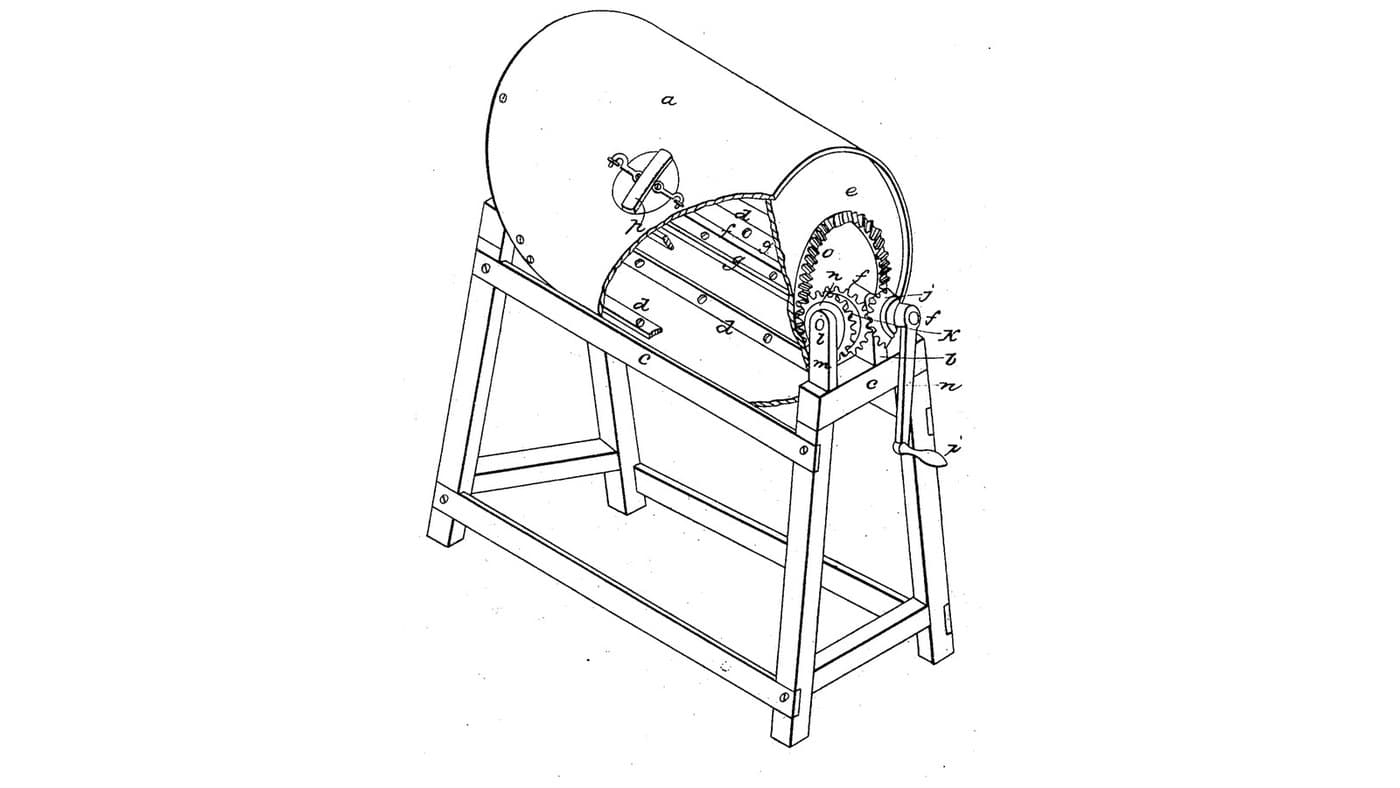
Counter-Turning Cylinder Churn: The Ribbed Cylinder Turns One Way While the Dashers Inside Turn the Other
by Buttercup
Woodworking
0
0
0
0
0
0
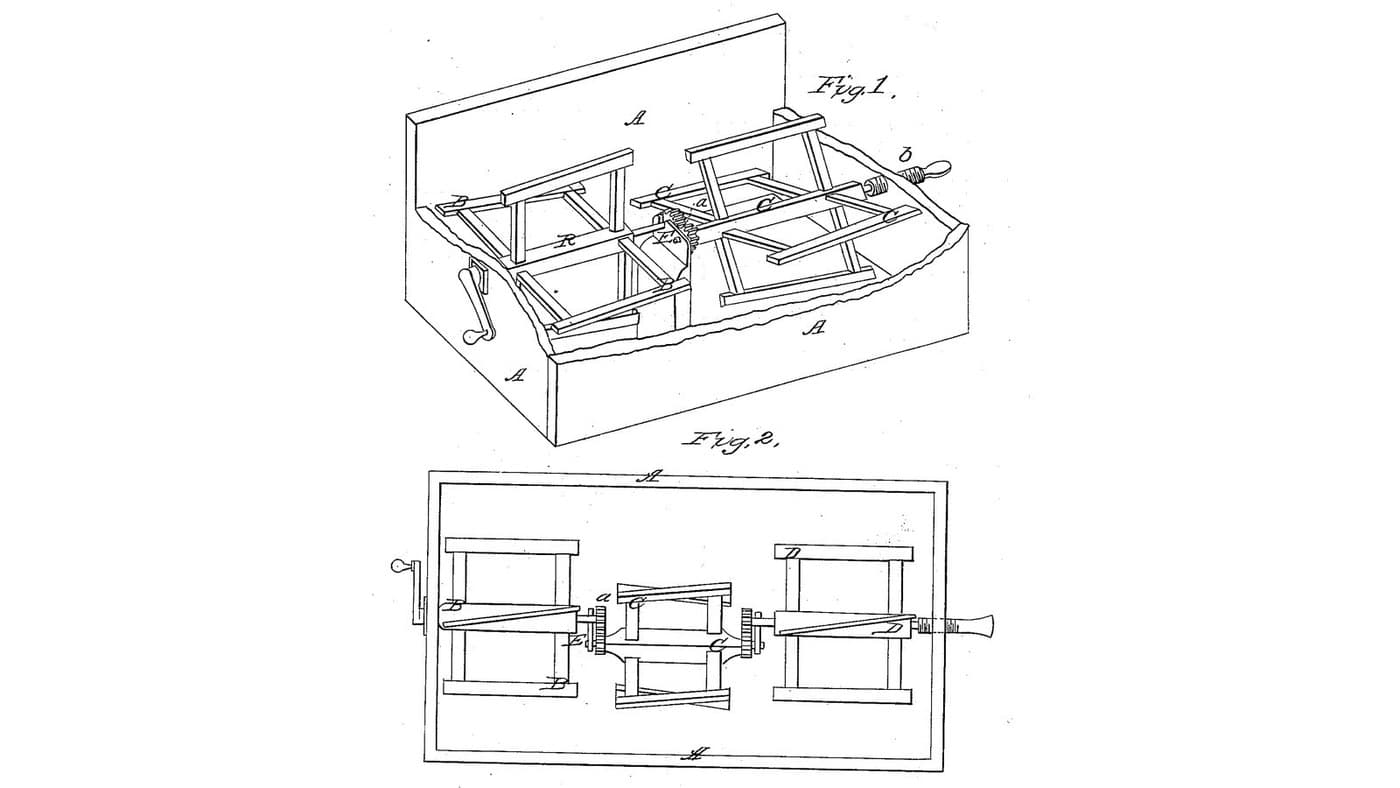
Counter-Revolving Dasher Churn: Geared Dashers on Offset Shafts Turn Contrary Ways, Their Blades Skewed Contrary Ways
by Buttercup
Woodworking
0
0
0
0
0
0

Churning Butter from Cream — The 5,000-Year-Old Fat Separation
by TheChef
CRAFT
60
0
0
0
0
0
CC0 Public Domain
This blueprint is released under CC0. You are free to copy, modify, distribute, and use this work for any purpose, without asking permission.
Support the Maker by purchasing products through their Blueprint where they earn a Maker Commission set by Vendors, or create a new iteration of this Blueprint and include it as a connection in your own Blueprint to share revenue.