ART
BEAUTY & WELLNESS
CRAFT
CULTURE & HISTORY
ENTERTAINMENT
ENVIRONMENT
FOOD & DRINKS
REVERSE ENGINEERING
SCIENCES
SPORTS
TECHNOLOGY
WEARABLES
Hazardous


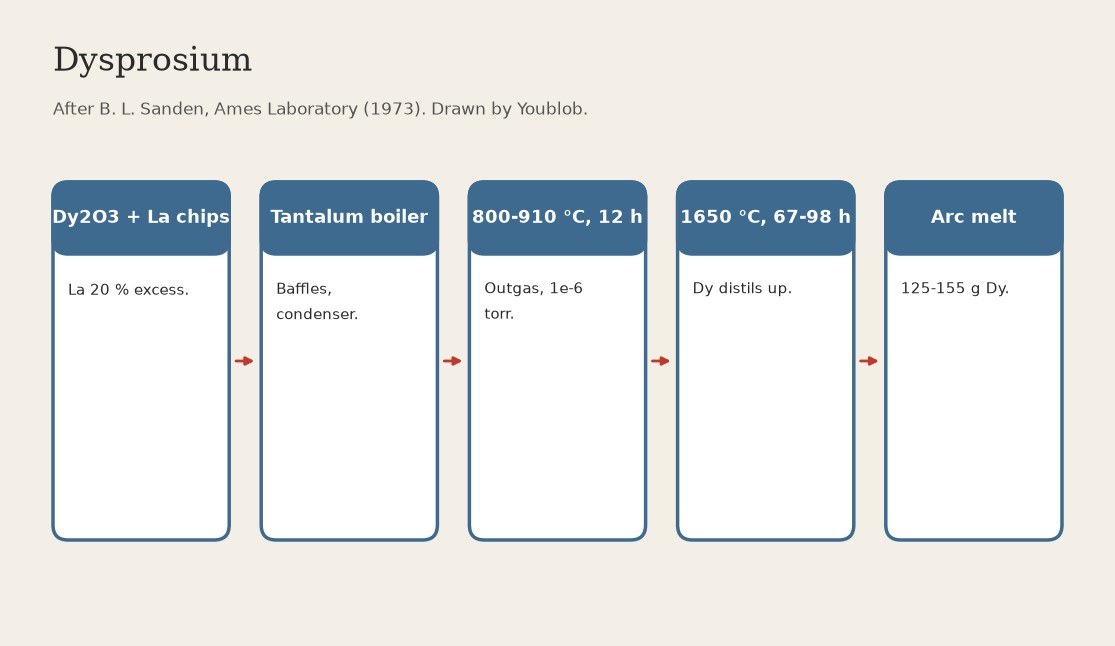
Dysprosium: Oxide Reduced with Lanthanum Turnings at 1650 °C in High Vacuum, Metal Distilled Off (Sanden, Ames 1973)
Lanthanum holds oxygen more tightly than dysprosium does and is much less volatile. Heated together in a tantalum boiler under high vacuum, lanthanum takes the oxygen and dysprosium vapour rises through baffles onto a condenser, leaving lanthanum oxide behind.
Result: 125-155 g of dysprosium per run, 56-81 % yield.
Source: B. L. Sanden, A study of the reduction of dysprosium oxide with lanthanum (Iowa State University / Ames Laboratory, 1973), pp. 12-27. Work at 1650 °C in high vacuum; hot hydrochloric acid for cleaning. Picture drawn by Youblob.
Advanced
1 week
Hazardous content
This blueprint contains hazardous procedures. Log in and enable hazardous content in your account settings to view the step-by-step instructions.
Sign inThis blueprint makes

Related Blueprints
These blueprints share knowledge with this one — techniques, materials, or principles that connect them in the learning graph.
CC0 Public Domain
This blueprint is released under CC0. You are free to copy, modify, distribute, and use this work for any purpose, without asking permission.
Support the Maker by purchasing products through their Blueprint where they earn a Maker Commission set by Vendors, or create a new iteration of this Blueprint and include it as a connection in your own Blueprint to share revenue.