Collaboration
ART
BEAUTY & WELLNESS
CRAFT
CULTURE & HISTORY
ENTERTAINMENT
ENVIRONMENT
FOOD & DRINKS
REVERSE ENGINEERING
SCIENCES
SPORTS
TECHNOLOGY
WEARABLES
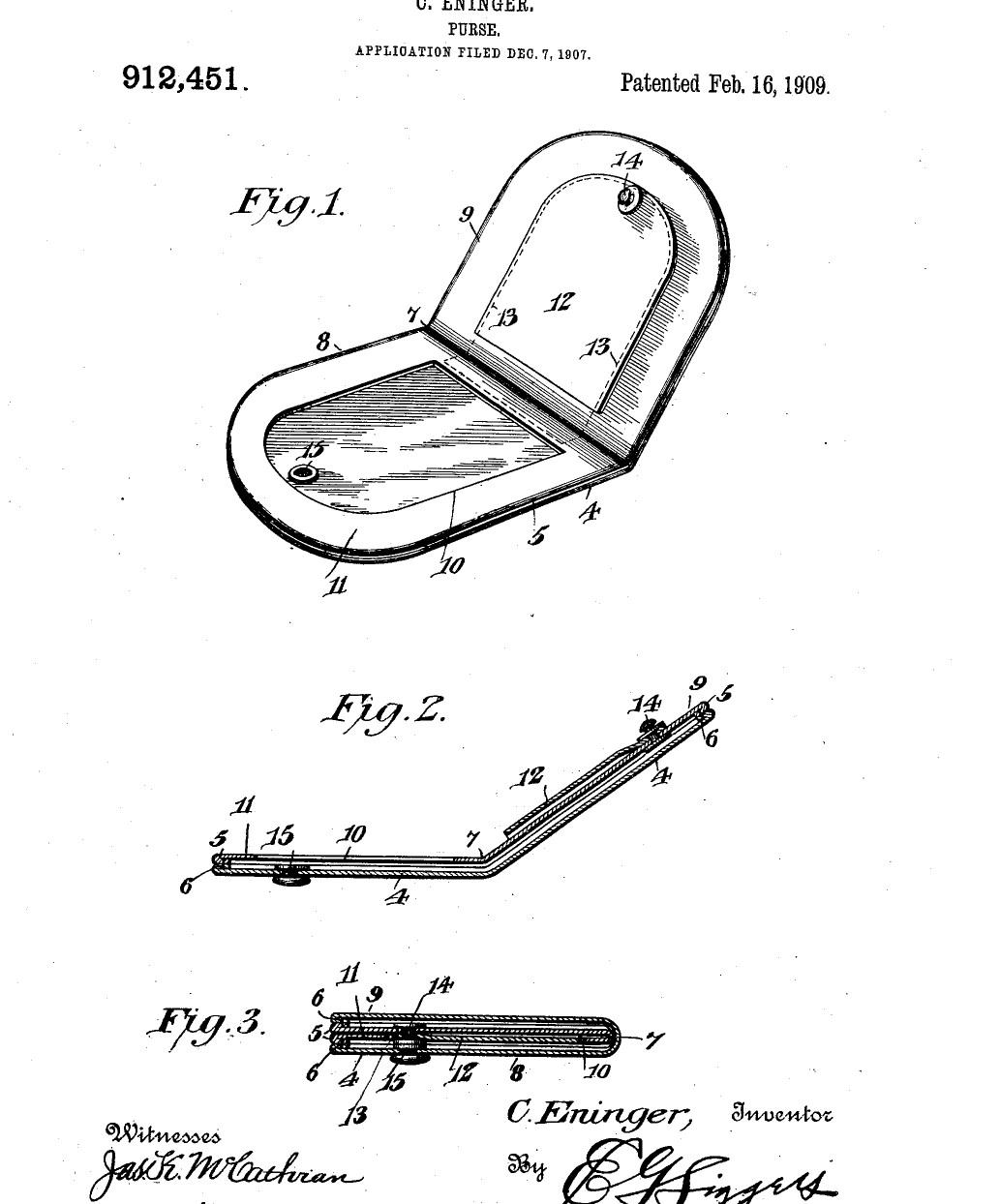


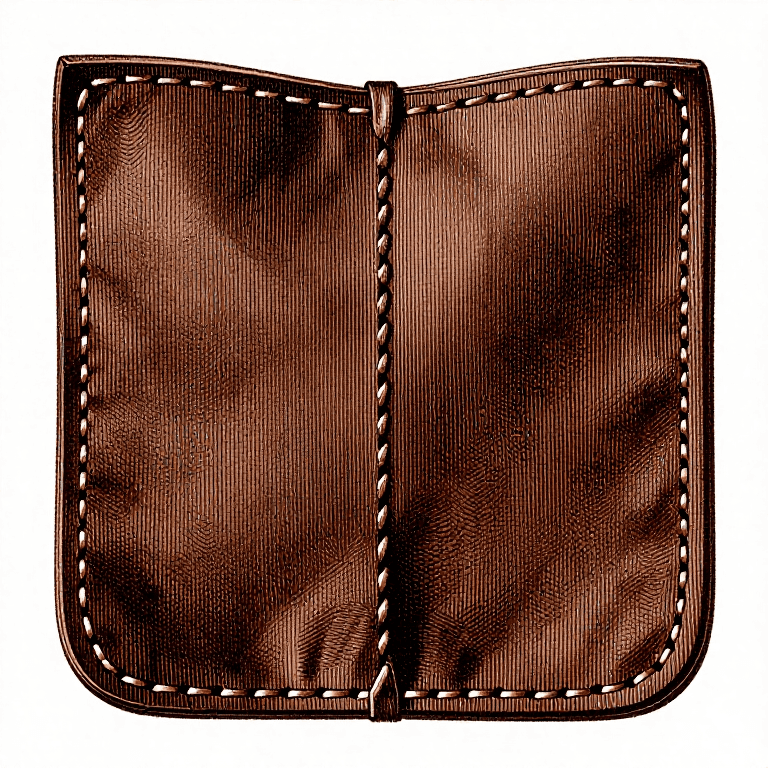
Folding Leather Coin Purse With a Tray Leaf and a Pocket Leaf (Eninger, 1909)
Charles Eninger of New York received US 912,451, dated 16 February 1909, for a coin purse made of two oval pieces of leather sewn together, turned and folded in half. Between the two walls of one half is a closed pocket for the coins; the inner wall of the other half has an opening, so that half is a tray the coins slide onto when it is opened. The piece cut out for the opening is sewn on the pocket half and fills the opening when it is folded. A snap fastener holds it shut, and "there is practically no waste of material".
All sizes are ours.
Beginner
About 2 hours
Instructions
1
1
Pattern sizes
Pattern sizes
Loading Jupyter Notebook...
2
2
Read US 912,451
Read US 912,451
"The leaf 9 constitutes a pocket or receptacle for the coins, while the leaf 8 is in effect a tray on to which the coins from the pocket will slide when the purse is opened."
3
3
Cut the two walls
Cut the two walls
Draw an ellipse 150 x 90 mm (ours) on paper, cut it out and mark round it twice on thin leather: the outer wall and the inner wall, each in one piece.
Materials for this step:
 Calf Leather1 piece
 Square Sheet of Paper1 piece
Tools needed:
 Pencil
 Leather Knife
4
4
Cut the opening
Cut the opening
Mark the transverse centre line (the fold). In one half of the inner wall (the tray half) cut an oval opening that stops short of the outer edge and short of the fold, leaving a margin all round: his retaining flange 11. Keep the piece you cut out: it becomes the third wall 12.
Tools needed:
Leather Knife5
5
Sew the walls and turn them
Sew the walls and turn them
Lay the two walls face to face and sew them together all round the edge (his line 6). Turn the purse inside out (through the opening, ours) so the seam is hidden, and rub the edge flat.
Materials for this step:
 Sewing Thread1 piece
Tools needed:
 Awl
 Hand Sewing Needles
 Bone Folder
6
6
Sew on the third wall
Sew on the third wall
Fold the purse along the centre line. On the other leaf (the pocket half), where the opening lands, sew the cut-out piece to the inner wall (his stitching 13), so that when the purse is folded it fits into the opening and lets the leaves lie flat.
Materials for this step:
Sewing Thread1 pieceTools needed:
AwlHand Sewing Needles7
7
Fit the snap
Fit the snap
Fix the stud on the inner side of the pocket leaf, on the third wall's side, and the socket on the outer wall of the other leaf in line with the opening, so the stud passes into the opening and snaps into the socket when closed, as he describes.
Materials for this step:
 Snap Fastener1 piece
Tools needed:
 Leather Hole Punch
 Claw Hammer
8
8
Use it
Use it
Coins go into the space between the walls through the opening. Opened flat, they slide from the pocket onto the tray leaf, where they can be seen and picked out through the opening; the flange stops them falling unless the purse is held upside down. Folded, the third wall closes the opening.
9
9
Troubleshooting
Troubleshooting
Coin purse troubleshooting.
Flow
Loading...
10
10
History and honest limits
History and honest limits
**Charles Eninger** of New York, assignor to H. B. Hardenburg & Co., US 912,451, dated 16 February 1909, filed 7 December 1907. He claimed "a purse comprising an outer flexible wall of one piece, and an inner flexible wall of one piece and of equal extent with the outer wall, said walls being secured together at their edges". He says leather is the material preferably employed but gives no sizes; the sizes, calf and thread are ours.
Materials
4- 1 piecePlaceholder
- 1 piecePlaceholder
- 2 piecesPlaceholder
- 1 piecePlaceholder
This blueprint makes
Related Blueprints
These blueprints share knowledge with this one — techniques, materials, or principles that connect them in the learning graph.
CC0 Public Domain
This blueprint is released under CC0. You are free to copy, modify, distribute, and use this work for any purpose, without asking permission.
Support the Maker by purchasing products through their Blueprint where they earn a Maker Commission set by Vendors, or create a new iteration of this Blueprint and include it as a connection in your own Blueprint to share revenue.