Extracting Lead from Galena — Humanity's Oldest Smelted Metal
Instructions
Understand lead and galena chemistry
SAFETY WARNING: Lead is a cumulative neurotoxin. Lead accumulates in bones and organs and causes irreversible damage to the nervous system, kidneys, and brain. There is NO safe blood lead level according to the WHO and CDC. Children and pregnant women must NEVER be present during any lead work. All lead smelting must be done outdoors with full respiratory and skin protection.
Galena (PbS) is lead sulfide, containing 86.6% lead by mass. It is the most important lead ore worldwide. Smelting involves two stages: (1) roasting to convert PbS to lead oxide PbO, and (2) reducing PbO with carbon to yield metallic lead. Lead melts at 327.5 degrees C — one of the lowest melting points of any metal, which is why it was among the first metals smelted by ancient peoples.
Identify galena in the field
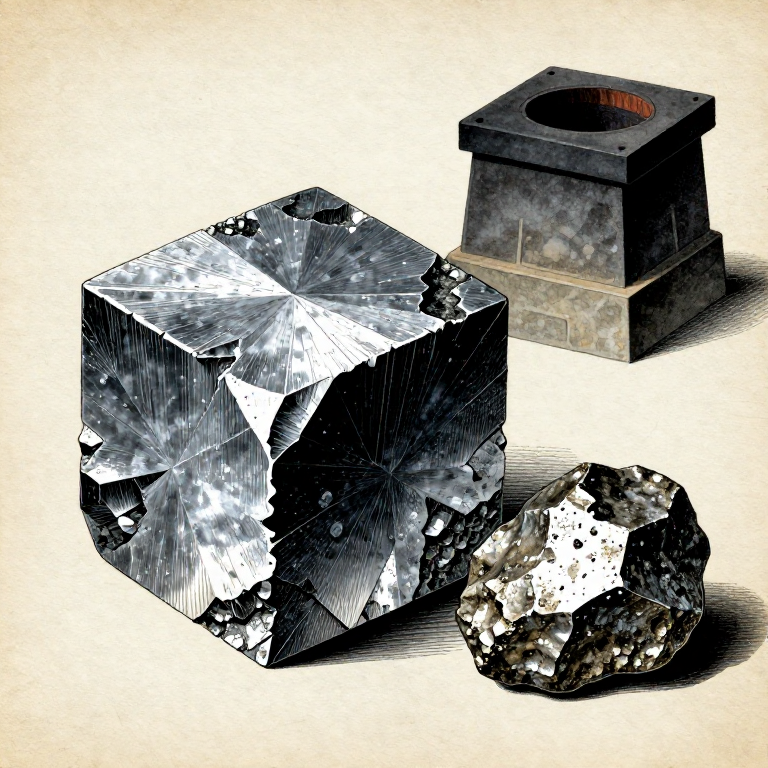
Galena is easily recognized by its distinctive properties: bright metallic (silver-gray) luster, perfect cubic cleavage (breaks into cube-shaped fragments), and exceptional heaviness. Specific gravity is 7.4-7.6, making it noticeably heavier than most rocks. Hardness is 2.5 on the Mohs scale — it can be scratched with a fingernail pressed hard or a copper coin. Streak on unglazed porcelain is lead-gray to black. Galena often occurs in hydrothermal veins associated with quartz, calcite, fluorite, sphalerite (zinc sulfide), and pyrite.
Tools needed:
Geological Hammer
Hand Lens (10x)
Streak Plate (unglazed porcelain)Collect galena specimens
Collect galena specimens
Collect galena-bearing rock from exposed veins or mine tailings. Look for the characteristic cubic crystals and metallic gleam. Select pieces with the brightest luster and heaviest feel — these have the highest lead content. Avoid specimens with heavy quartz or calcite gangue (waste rock). Collect 3-5 kg of ore for a meaningful smelt. Wear gloves during collection — galena dust should not contact skin.
Materials for this step:
Galena Ore5 kilogramTools needed:
Geological Hammer
Heavy-Duty Gloves
Collection Bags (sealed)Crush and sort the ore
Crush and sort the ore
Break galena ore into pieces no larger than 1-2 cm using a hammer on a flat stone or iron plate. Galena's perfect cubic cleavage causes it to fracture into neat cubic fragments. Separate the bright metallic galena fragments from gangue material (quartz, calcite, country rock). The density difference makes hand-sorting effective — galena pieces feel markedly heavier. Wear a P100/FFP3 respirator during crushing to avoid inhaling lead dust.
Tools needed:
Geological Hammer
Iron Plate
P100/FFP3 Respirator
Heavy-Duty Gloves
Safety GogglesWash the crushed ore
Wash the crushed ore
Place crushed galena in a bucket of water and agitate. Lighter gangue particles float or suspend while the heavy galena (SG 7.5) sinks rapidly. Pour off muddy water and repeat 2-3 times. This gravity separation concentrates the ore. Collect wash water in a separate container — do NOT pour lead-contaminated water onto soil or into drains. Allow wash water to settle, collect sediment, and dispose of responsibly.
Materials for this step:
Clean Water20 litersTools needed:
Metal Bucket
Waste Water Collection ContainerPut on full safety equipment
Put on full safety equipment
MANDATORY SAFETY STEP — DO NOT SKIP. Lead smelting produces toxic lead fumes, lead oxide dust, and sulfur dioxide gas. You MUST wear: (1) P100/FFP3 respirator with acid gas cartridge (for SO2), (2) chemical splash goggles, (3) leather gauntlet gloves, (4) leather apron, (5) long-sleeved clothing fully covering skin, (6) closed-toe leather boots. Work ONLY outdoors with wind blowing fumes away from you. Position yourself upwind at all times. Keep a bucket of dry sand nearby for spill containment. No food, drink, or smoking anywhere near the work area. Wash hands and face thoroughly with soap before eating or drinking after any session.
Tools needed:
P100/FFP3 Respirator with Acid Gas Cartridge
Chemical Splash Goggles
Leather Gauntlet Gloves
Leather Apron
Leather Boots
Dry Sand BucketBuild the roasting hearth
Build the roasting hearth
Construct a flat, open hearth from firebricks or flat stones, approximately 60 x 60 cm. The hearth should be slightly concave (dished) to contain the ore. Place it in an open, well-ventilated location — roasting produces large quantities of sulfur dioxide (SO2), which is a toxic irritant gas. A slight natural draft helps carry fumes away. Ancient smelters sometimes used hillside locations to catch the wind.
Materials for this step:
Firebricks8 piecesRoast the galena to remove sulfur
Roast the galena to remove sulfur
Spread crushed galena in a thin layer (2-3 cm) on the hearth. Light a charcoal fire beneath and around the ore. The roasting reaction begins at approximately 450-500 degrees C: 2PbS + 3O2 -> 2PbO + 2SO2. The ore changes from metallic silver to a dull yellowish-gray (lead oxide, PbO, also called litharge). Stir the ore every 15-20 minutes with a long iron rod to expose fresh surfaces to air. Roasting takes 2-3 hours. The sulfur dioxide released smells like burnt matches — stay upwind and wear your respirator.
Materials for this step:
Hardwood Charcoal (for roasting)10 kilogramTools needed:
Long Iron Stirring Rod (1.5 m)
Fire Lighting ToolsCheck for complete roasting
Check for complete roasting
Roasting is complete when the ore has lost its metallic luster entirely and appears uniformite dull yellow-gray. Break open a few larger pieces — the interior should also be converted, with no remaining silver-metallic galena core. If metallic cores remain, continue roasting for another 30-60 minutes with more stirring. Incompletely roasted ore produces sulfur-contaminated lead with poor quality.
Tools needed:
Long-Handled TongsPrepare the reduction crucible
Prepare the reduction crucible
Use a clay or graphite-clay crucible rated to at least 600 degrees C (well above lead's 327.5 degrees C melting point). A crucible holding 1-2 liters is suitable. If using a homemade clay crucible, ensure it has been pre-fired to at least 800 degrees C to burn out moisture. Lead oxide (PbO) is corrosive to some ceramics, so graphite-clay crucibles are preferred.
Materials for this step:
Graphite-Clay Crucible1 pieceLayer roasted ore and charcoal for reduction
Layer roasted ore and charcoal for reduction
Place a 2 cm layer of crushed charcoal in the bottom of the crucible. Add a layer of roasted lead oxide (3-4 cm). Top with another layer of charcoal. The reduction reaction is: PbO + C -> Pb + CO (at temperatures above 500 degrees C). Some reduction also occurs via carbon monoxide: PbO + CO -> Pb + CO2. Fill the crucible to about two-thirds full, alternating layers. Lead's low melting point (327.5 degrees C) means the metal becomes liquid well before the charcoal is consumed.
Materials for this step:
Hardwood Charcoal (crushed, for reduction)3 kilogramHeat the crucible to reduce lead oxide
Heat the crucible to reduce lead oxide
Place the loaded crucible in a charcoal forge or fire pit. Bring the temperature to 500-700 degrees C using bellows or forced air. The reduction is relatively low-temperature compared to copper or iron smelting. Within 1-2 hours, you will see molten lead pooling at the bottom of the crucible — it appears as a bright, shiny liquid. Continue heating until all the lead oxide has been consumed and the charcoal layer above the molten lead is largely ash and slag.
Materials for this step:
Charcoal for Forge15 kilogramTools needed:
BellowsPour the molten lead
Pour the molten lead
CAUTION: Molten lead splatters violently on contact with moisture. Ensure the ingot mold is completely dry — even a single drop of water causes explosive steam splattering. Use a preheated, dry sand mold or a carved stone mold. Using crucible tongs, carefully lift the crucible and pour the molten lead slowly into the mold. The slag (lighter gray material) floats on top and can be held back. Molten lead at 327-400 degrees C appears mirror-bright.
Tools needed:
Crucible Tongs
Ingot MoldCool and remove the lead ingot
Cool and remove the lead ingot
Allow the ingot to cool in the mold for at least 20 minutes. Lead solidifies quickly due to its low melting point. The surface develops a dull gray oxide layer within minutes of solidifying. Once cool enough to handle (use gloves — ALWAYS), remove the ingot from the mold. A 5 kg galena charge should yield approximately 3-3.5 kg of lead (accounting for gangue, incomplete roasting, and slag losses). Pure galena would theoretically yield 4.3 kg (86.6% lead content).
Tools needed:
Heavy-Duty GlovesTest the lead quality
Test the lead quality
Lead is extremely soft — it can be scratched with a fingernail (Mohs hardness 1.5). It is also very heavy (density 11.34 g/cm3). Cut a small notch with a knife — fresh-cut lead is bright and shiny but tarnishes to dull gray within minutes from oxidation. Lead is highly malleable and can be hammered into thin sheets without cracking. If the ingot is brittle or contains hard inclusions, it has excessive slag contamination and should be re-melted and poured through a filter of charcoal.
Tools needed:
KnifeClean up and safe disposal
Clean up and safe disposal
CRITICAL: Lead contamination cleanup. All surfaces, tools, and clothing exposed to lead dust or fumes must be cleaned. Sweep (do not blow) all dust and ash into sealed containers. Lead-contaminated ash and slag must be disposed of as hazardous waste — never scatter on soil or dump in waterways. Wash all tools with soap and water. Remove work clothing before entering living spaces. Shower thoroughly. Lead dust on clothing can contaminate homes and poison family members through secondary exposure. Store the lead ingot in a sealed container, clearly labeled.
Tools needed:
Sealed Hazardous Waste Container
Broom and DustpanMaterials
7- 5 kilogramPlaceholder
- 20 litersPlaceholder
- 8 piecesPlaceholder
- 10 kilogramPlaceholder
- 1 piecePlaceholder
- Placeholder
- 15 kilogramPlaceholder
Tools Required
25- Placeholder
- Placeholder
- Placeholder
- Placeholder
- Placeholder
- Placeholder
- Placeholder
- Placeholder
- Placeholder
- Placeholder
- Placeholder
- Placeholder
- Placeholder
- Placeholder
- Placeholder
- Placeholder
- Placeholder
- Placeholder
- Placeholder
- Placeholder
- Placeholder
- Placeholder
CC0 Public Domain
This blueprint is released under CC0. You are free to copy, modify, distribute, and use this work for any purpose, without asking permission.
Support the Maker by purchasing products through their Blueprint where they earn a Maker Commission set by Vendors, or create a new iteration of this Blueprint and include it as a connection in your own Blueprint to share revenue.