

Extracting Molybdenum from Molybdenite — The Slippery Lead That Strengthens Steel
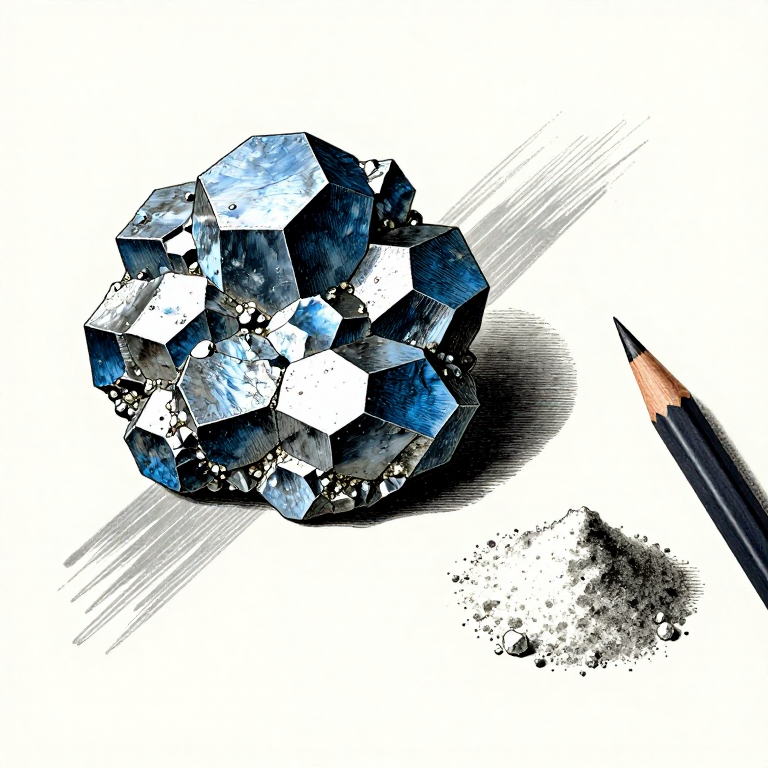
Molybdenum (Mo, element 42) was confused with lead and graphite for centuries. Its primary ore, molybdenite (MoS₂), is a soft, grey, slippery mineral that looks and feels almost identical to graphite — both leave dark marks on paper, both have a greasy feel, and both occur as grey metallic flakes. The name molybdenum comes from the Greek molybdos ('lead'), reflecting this ancient confusion. It was Carl Wilhelm Scheele who first distinguished molybdenite from graphite in 1778 by treating it with nitric acid and observing a white residite (molybdic acid, H₂MoO₄) that graphite did not produce.
Peter Jacob Hjelm, working at Scheele's suggestion, first isolated metallic molybdenum in 1781 by reducing molybdic acid with carbon. The metal was impure (contaminated with molybdenum carbide and oxide), and truly pure molybdenum was not produced until 1893 when Henri Moissan used an electric furnace.
Molybdenite (MoS₂) contains 60% molybdenum by mass. It has a layered crystal structure identical in principle to graphite — sheets of molybdenum atoms sandwiched between sheets of sulfur atoms, with weak van der Waals forces between the layers. This explains its slipperiness and its use as a solid lubricant (molybdenum disulfide grease). The extraction involves roasting to molybdenum trioxide (MoO₃) followed by carbon reduction.
HAZARD: Roasting molybdenite produces sulfur dioxide (SO₂), a toxic, choking gas. Molybdenum trioxide (MoO₃) dust is irritating to mucous membranes and causes a condition called molybdenosis in livestock grazing on molybdenum-rich soils. Use respiratory protection throughout. Work outdoors during roasting.
Hazardous content
This blueprint contains hazardous procedures. Log in and enable hazardous content in your account settings to view the step-by-step instructions.
Sign inCC0 Public Domain
This blueprint is released under CC0. You are free to copy, modify, distribute, and use this work for any purpose, without asking permission.
Support the Maker by purchasing products through their Blueprint where they earn a Maker Commission set by Vendors, or create a new iteration of this Blueprint and include it as a connection in your own Blueprint to share revenue.