ART
BEAUTY & WELLNESS
CRAFT
CULTURE & HISTORY
ENTERTAINMENT
ENVIRONMENT
FOOD & DRINKS
REVERSE ENGINEERING
SCIENCES
SPORTS
TECHNOLOGY
WEARABLES
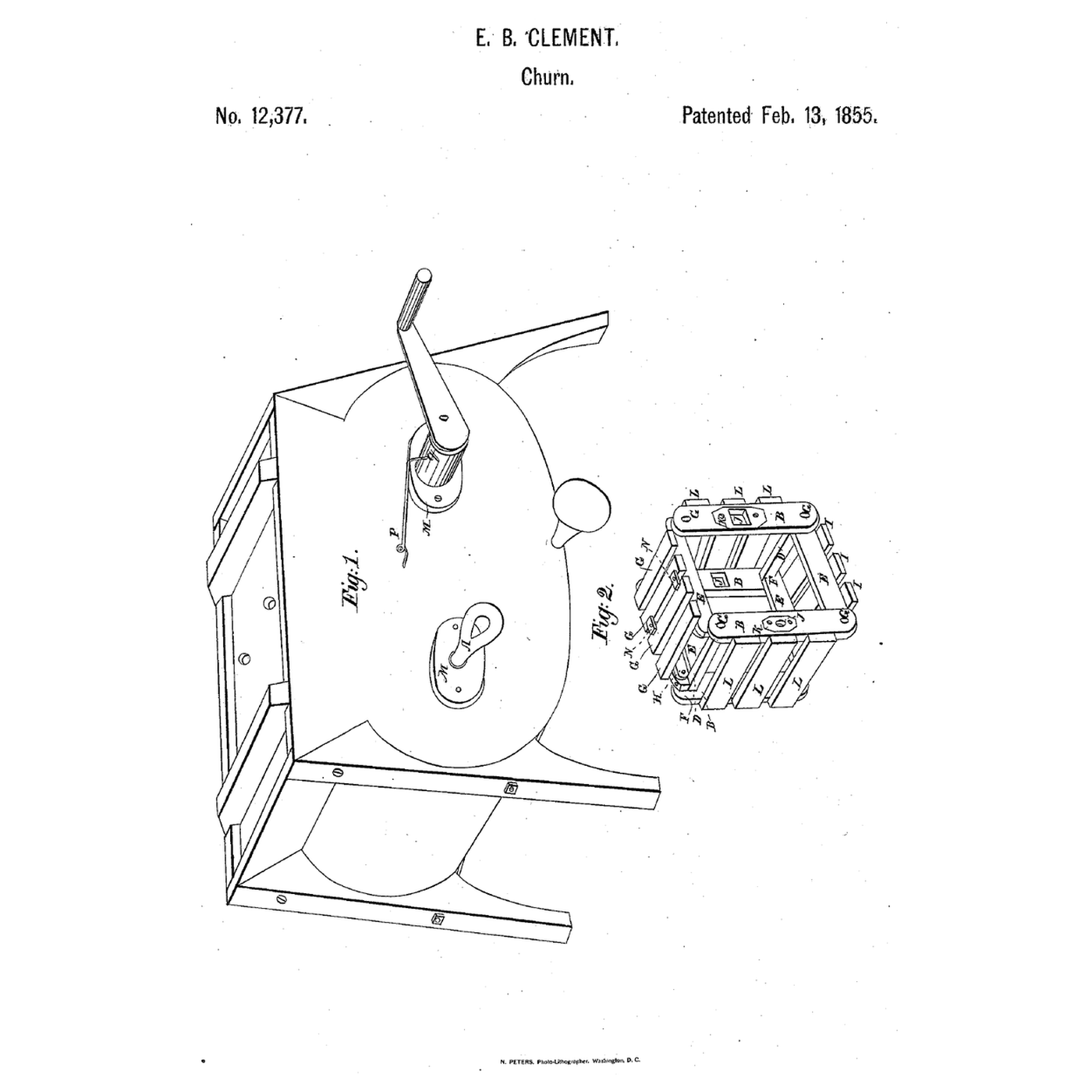

Folding Slat-Box Dasher Churn: A Slatted Parallelogram That Folds to Squeeze the Cream
Clement came back three years after his V-bottom churn with a dasher that folds itself flat.
Edwin B. Clement of Barnet, Caledonia County, Vermont, received US 12,377, dated 13 February 1855, for a dasher that "will surround the cream and force it through spaces between the slats of the dasher by closing or folding together." Four arms carry four shafts at their ends; two arms have square holes for the crank shaft and two round holes for a rod; connecting bars fixed to the shafts join them; slats close the bottom and sides, and two slatted doors held by buttons close the top. Worked forward and back by the crank, "it will open and fold the dasher, and describe the inside of the vessel," whose shape follows the dasher's sweep.
This rung works out how much the box squeezes, then prints the arms, bars and bearings, builds the slatted dasher, and makes and washes butter.
Advanced
About 6 hours, plus printing
Instructions
1
1
How much it squeezes
How much it squeezes
Loading Jupyter Notebook...
2
2
His own earlier churn
His own earlier churn
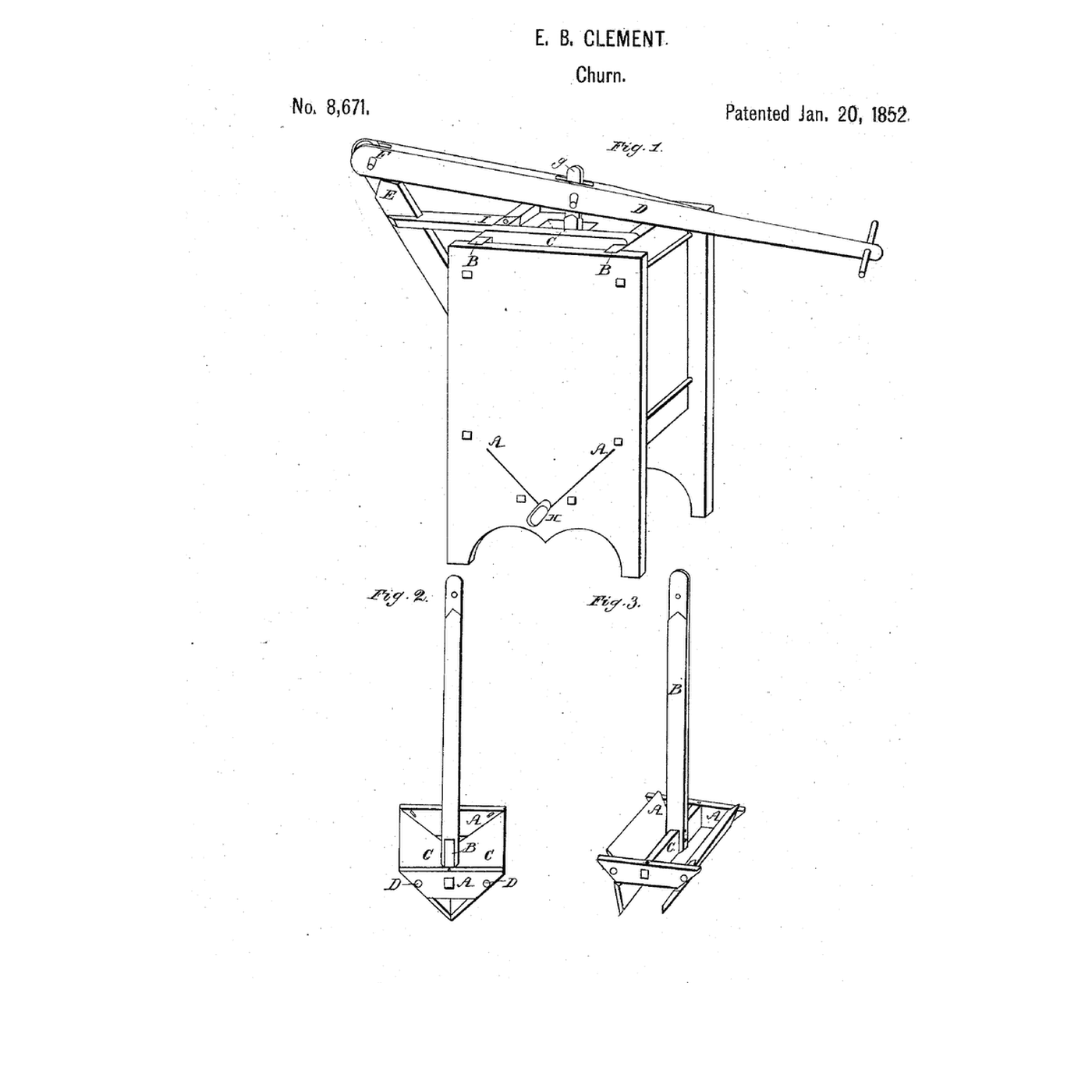
The embedded blueprint is Clement's 1852 dasher, whose floats close into a V to drive the cream up. In 1855 he folds a whole slatted box.
3
3
Read US 12,377
Read US 12,377
"Put in the cream and steadily move the crank forward and back. After the butter becomes separated from the milk, put all the butter into the dasher, draw off the butter milk, and put in a sufficient quantity of pure cold water, and operate as in churning and the butter will be completely washed and ready for the salt."
4
4
Print the parts
Print the parts
Print two arms with square centre holes (/uploads/blueprints/folding-slat-box-dasher-churn-arm-square.stl), two with round ones (/uploads/blueprints/folding-slat-box-dasher-churn-arm-round.stl), four connecting bars (/uploads/blueprints/folding-slat-box-dasher-churn-bar.stl), two bearing boxes (/uploads/blueprints/folding-slat-box-dasher-churn-bearing-box.stl) and two journal sleeves for the crank shaft (/uploads/blueprints/folding-slat-box-dasher-churn-journal-sleeve.stl). Print the arms and bars flat. Print in PETG at 0.2 mm layers, 30 % infill, 4 walls; wash before first use.
Materials for this step:
 PETG Filament1 piece
Tools needed:
 FDM 3D Printer
5
5
The folding box
The folding box
Cut four 10 mm hardwood dowels 174 mm long as the shafts D. Put a square arm and a round arm at each end, the dowels' ends turning loosely in the arms' end holes, and glue a bar across each end of the top pair of dowels and of the bottom pair. Screw thin hardwood slats along the arms' outer edges and under the bottom bars, leaving gaps of about 5 mm, and make two slatted doors for the top, pinned to the top bars and held by turn buttons.
Materials for this step:
 Hardwood Dowels1 piece
 Wood Glue1 piece
 #8 x 1" Wood Screw1 piece
Tools needed:
 Hand Saw
 Cordless Drill
 Drill Bit Set
 Screwdriver Set
 Sandpaper
6
6
Vessel, crank and rod
Vessel, crank and rod
Use a rectangular food-grade container about 260 by 180 mm and 230 mm deep, so the dasher's corners clear it when folded. Screw a bearing box outside each end wall, 100 mm apart, at the arms' pivots. Glue the journal sleeves on the ends of a 10 mm square hardwood crank shaft through the square holes, with a strip of spring steel in each box's slot as his spring P; push a 6 mm stainless rod through the other box and the round holes, and fit a crank arm and handle.
Materials for this step:
 Food-Grade Storage Container1 piece
 Mild Steel Rod1 piece
 Spring Steel Strip1 piece
 Pine Board1 piece#8 x 1" Wood Screw1 piece
 Silicone Sealant1 piece
Tools needed:
Cordless Drill Hole Saw Kit
 HacksawScrewdriver Set
7
7
The build in 3D
The build in 3D
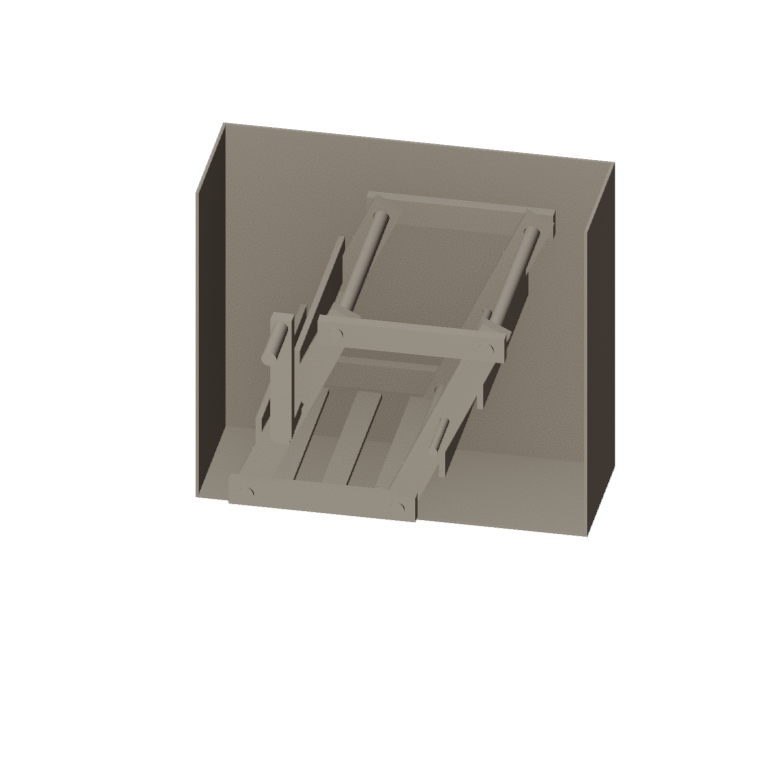
FreeCAD model of this build, not of the patent: the vessel cut open, the dasher's two pairs of arms on the crank shaft and the rod, leaning part-way, with the four shafts, connecting bars and slats of the folding box.
8
8
Fold, then wash in the box
Fold, then wash in the box
Let the heavy cream stand until it reaches about 15 °C, checked with the thermometer. Pour in 2 litres and work the crank steadily forward and back; time until the butter comes. Open the doors, put the butter into the dasher, close them, draw off the buttermilk, pour in cold water and work it as before until the water runs clear; work in a pinch of salt and weigh the butter.
Materials for this step:
 Heavy Cream2000 ml
 Coarse Sea Salt1 piece
 Water1 piece
Tools needed:
 Leave-In Probe Thermometer
 Stopwatch
 Digital Kitchen Scale
 Stainless Steel Mixing Bowl (Large)
9
9
A box that jams
A box that jams
Folding slat-box dasher troubleshooting.
Flow
Loading...
10
10
History and honest limits
History and honest limits
**Edwin B. Clement** of Barnet, Caledonia County, Vermont, received US 12,377, dated 13 February 1855; his earlier folding-float churn is US 8,671 of 1852. He bored the arms' holes "sufficiently large to receive the journals of the shafts ... and not swell and become tight when wet," and cut a thread on the rod to hold it. His vessel's ends are curved to the dasher's sweep. He claimed "the folding dasher operating as described."
**Honest limits.** A rectangular container stands in for his shaped vessel, and our sizes are ours. FDM prints hold food in their layer lines, so wash well and replace when worn. Your times and weights are the result.
Materials
12- 1 piecePlaceholder
- 1 piecePlaceholder
- 1 piecePlaceholder
- 2 piecesPlaceholder
- 1 piecePlaceholder
- 1 piecePlaceholder
- 1 piecePlaceholder
- 1 piecePlaceholder
- 1 piecePlaceholder
- 2000 mlPlaceholder
- 1 piecePlaceholder
- 1 piecePlaceholder
Tools Required
12- Placeholder
- Placeholder
- 1 vendor sell this, none ship to you yetPlaceholder
- Placeholder
- Placeholder
- Placeholder
- Placeholder
- Placeholder
- Placeholder
- Placeholder
- Placeholder
- Placeholder
Design Files
1Related Blueprints
These blueprints share knowledge with this one — techniques, materials, or principles that connect them in the learning graph.
Folding-Float V-Bottom Churn: Floats That Close Into a V on the Down-Stroke
by Woody
Woodworking
5
0
0
0
0
0
Self-Folding Blade Dasher Churn: Six Blades to Churn, Reverse and They Fold to Two That Gather
by Woody
Woodworking
5
0
0
0
0
0
Churning Butter from Cream — The 5,000-Year-Old Fat Separation
by TheChef
CRAFT
47
0
0
0
0
0
CC0 Public Domain
This blueprint is released under CC0. You are free to copy, modify, distribute, and use this work for any purpose, without asking permission.
Support the Maker by purchasing products through their Blueprint where they earn a Maker Commission set by Vendors, or create a new iteration of this Blueprint and include it as a connection in your own Blueprint to share revenue.