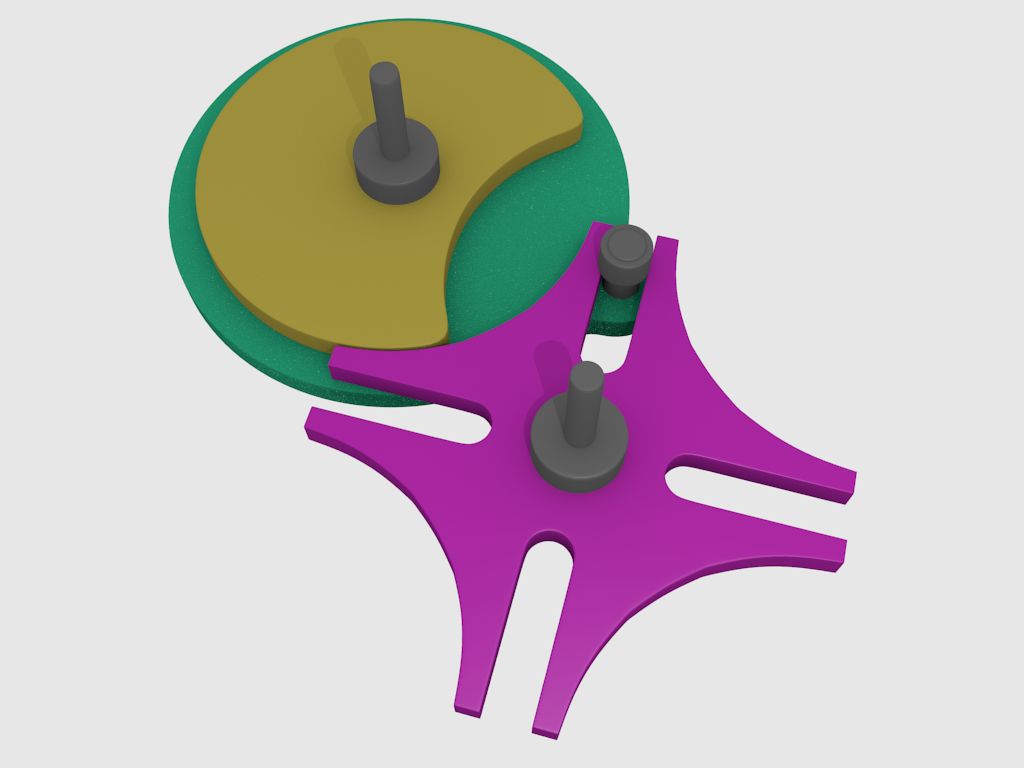


Geneva Drive
Instructions
Cut the slotted wheel
Cut the slotted wheel
The driven wheel does all the geometry.
- Mark a disc with four radial slots at 90 degrees.
- Cut the slots open at the rim, wide enough for a pin to enter freely.
- Cut concave arcs between the slots on the rim.
Materials for this step:
 Plywood Sheet (1/8 inch, 12x12)1 pack
 Protractor1 piece
Make the driver with its pin and lock
Make the driver with its pin and lock
The driver is a disc with a pin and a matching convex face.
- Fit a pin near the rim of a second disc.
- Cut a convex arc on that disc to match the driven wheel's concave arcs.
- Relieve the convex face where the pin sits so the slot can pass.
Materials for this step:
 Ball Bearing2 pieces
 Brass Rod1 length
Assemble and set the centres
Assemble and set the centres
Centre distance is not adjustable — it is determined by the geometry.
- Mount both wheels so the pin enters a slot cleanly and radially.
- Turn the driver slowly by hand through a full revolution.
- Confirm one step of exactly 90 degrees, then a dead stop.
Measure the duty cycle
Measure the duty cycle
Quantify the pause, which is what the mechanism is bought for.
- Turn the driver at a steady speed.
- Measure what fraction of a revolution the driven wheel is moving.
- The rest is dwell.
Tools needed:
 Stopwatch
History and context
History and context
The mechanism is called Geneva after Swiss watchmaking, and Maltese cross after the shape of the slotted wheel. Its original clockmaking use was as a Geneva stop: a version with one slot blocked, fitted to a mainspring barrel so the spring could only be wound through a set number of turns and never over-wound into its strongest, least even part of travel.
Cinema is where it became indispensable. Film must be absolutely stationary while a frame is projected and then advance to the next in a small fraction of a second, twenty-four times a second, without tearing. A Geneva movement does precisely that, mechanically and identically every time, and it drove projectors for a century. Intermittent motion is the whole problem of cinema mechanics, and this is the standard solution.
Elsewhere: indexing tables on machine tools, automatic bottle-filling and capping machines, rotary tool changers, and the mechanism that steps some watch date displays over at midnight. Anywhere you want to move something to one of a fixed set of positions and hold it firmly, this beats a motor and a controller because there is nothing to calibrate and nothing to lose count.
Its honest limits: the acceleration at entry and exit is abrupt, so it is noisy and hard on parts at high speed, and the step size cannot be changed without cutting a new wheel. Modern machines mostly use servo motors, which are adjustable and quiet — and which need power, feedback and software to do what a Geneva wheel does with two pieces of shaped metal.
Materials
4- 1 packPlaceholder
- 1 piecePlaceholder
- Placeholder
- 1 lengthPlaceholder
Related Blueprints
These blueprints share knowledge with this one — techniques, materials, or principles that connect them in the learning graph.

CC0 Public Domain
This blueprint is released under CC0. You are free to copy, modify, distribute, and use this work for any purpose, without asking permission.
Support the Maker by purchasing products through their Blueprint where they earn a Maker Commission set by Vendors, or create a new iteration of this Blueprint and include it as a connection in your own Blueprint to share revenue.