ART
BEAUTY & WELLNESS
CRAFT
CULTURE & HISTORY
ENTERTAINMENT
ENVIRONMENT
FOOD & DRINKS
REVERSE ENGINEERING
SCIENCES
SPORTS
TECHNOLOGY
WEARABLES
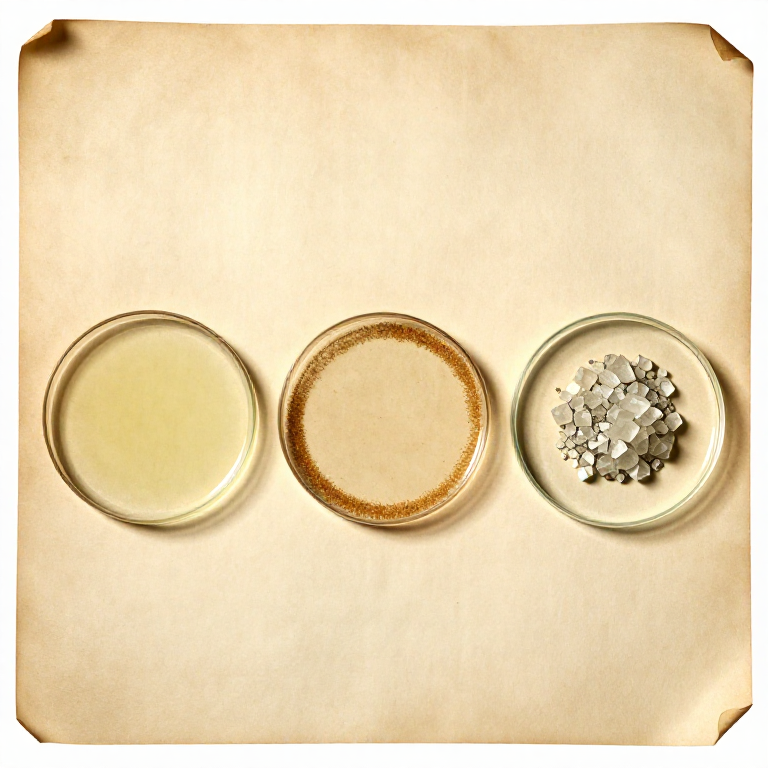


Getting the Solid Back: Evaporate, Crystallise, and Dry to Constant Mass
Boiling a solution dry gives you everything that was dissolved in it, including the impurities. Letting it crystallise slowly gives you the substance you wanted and leaves most of the impurities in the liquid — because a growing crystal is fussy about what it lets in.
So evaporating to dryness and crystallising are not two ways of doing the same job. The first is for recovering everything; the second is for purifying.
Then there is the question of when it is actually DRY, which cannot be answered by looking. The answer is a measurement loop: dry, weigh, dry again, weigh again, and stop when the mass stops changing.
Intermediate
3 hours
Instructions
1
1
Evaporate gently, and never to the last drop over heat
Evaporate gently, and never to the last drop over heat
Use a wide, shallow evaporating dish rather than a beaker: evaporation happens at the surface, so the area is what sets the speed, and a wide dish is faster at a much lower temperature.
Stop while a little liquid remains and let the rest go at room temperature. Once the liquid is nearly gone there is nothing left to absorb the heat, the solid overheats in seconds, and it spits, decomposes or bakes onto the dish.
A steam bath or a hot plate on a low setting is better than a flame for anything that matters. Direct flame heats one spot far above the boiling point of the solution, and many substances that survive 100 degrees do not survive that.
Materials for this step:
 Distilled Water1 liter
 Sodium Chloride - Salt1 piece
Tools needed:
 Evaporating Dish
 Hot Plate
 Watch Glass
2
2
Crystallise slowly, and crystallise on purpose
Crystallise slowly, and crystallise on purpose
Dissolve the solid in the smallest volume of hot solvent that will take it, then let it cool UNDISTURBED. Slow cooling grows few, large, pure crystals; rapid cooling or stirring gives a mass of tiny ones that trap the mother liquor and everything dissolved in it.
If nothing appears, it is usually because there is too much solvent or because there is no nucleus to start on. Boil a little solvent off, scratch the inside of the glass with a rod at the surface, or add one seed crystal.
Then filter the crystals off cold and rinse them with a SMALL amount of ICE-COLD solvent. Rinsing with warm solvent dissolves the product you just spent an hour growing, which is the most disheartening way to lose a yield.
Materials for this step:
Distilled Water1 liter Copper Sulfate Pentahydrate (CuSO4.5H2O)1 piece
Tools needed:
 Glass Beaker
 Glass Stirring Rod
 Buchner Funnel (Porcelain)
 Filter Paper
3
3
Dry to constant mass, which is a measurement not a judgement
Dry to constant mass, which is a measurement not a judgement
Loading Jupyter Notebook...
Materials for this step:
Sodium Chloride - Salt1 pieceTools needed:
 Drying Oven
 Glass Desiccator
 Precision Scale
 Desktop Computer
4
4
Work out the yield, and be honest about it
Work out the yield, and be honest about it
Percentage yield is what you got divided by what the equation says you could have got. Both numbers have to be real: the mass actually recovered and dried, and the theoretical mass calculated from the LIMITING reagent.
Yields above 100% mean the product is not dry, or it has picked up something. That is worth treating as a fault rather than a bonus, because a wet product weighs more and is worth less.
Record where the losses went, in the notebook: left in the mother liquor, stuck to the filter paper, lost in the rinse, spilled. Those lines are what make the next attempt better, and a yield with no explanation attached is a number nobody can improve.
Tools needed:
Precision Scale Calculator
Materials
3- 2 litersPlaceholder
- 1 piecePlaceholder
- Placeholder
Tools Required
12- Placeholder
- Placeholder
- Placeholder
- Placeholder
- Placeholder
- Placeholder
- Placeholder
- Placeholder
- Glass Desiccator10% commissionPlaceholder
- Placeholder
- Placeholder
- Placeholder
Related Blueprints
These blueprints share knowledge with this one — techniques, materials, or principles that connect them in the learning graph.


CC0 Public Domain
This blueprint is released under CC0. You are free to copy, modify, distribute, and use this work for any purpose, without asking permission.
Support the Maker by purchasing products through their Blueprint where they earn a Maker Commission set by Vendors, or create a new iteration of this Blueprint and include it as a connection in your own Blueprint to share revenue.