ART
BEAUTY & WELLNESS
CRAFT
CULTURE & HISTORY
ENTERTAINMENT
ENVIRONMENT
FOOD & DRINKS
REVERSE ENGINEERING
SCIENCES
SPORTS
TECHNOLOGY
WEARABLES


Hollow-Arm Air Churn: A Spinning Dasher That Breathes Air Into the Cream
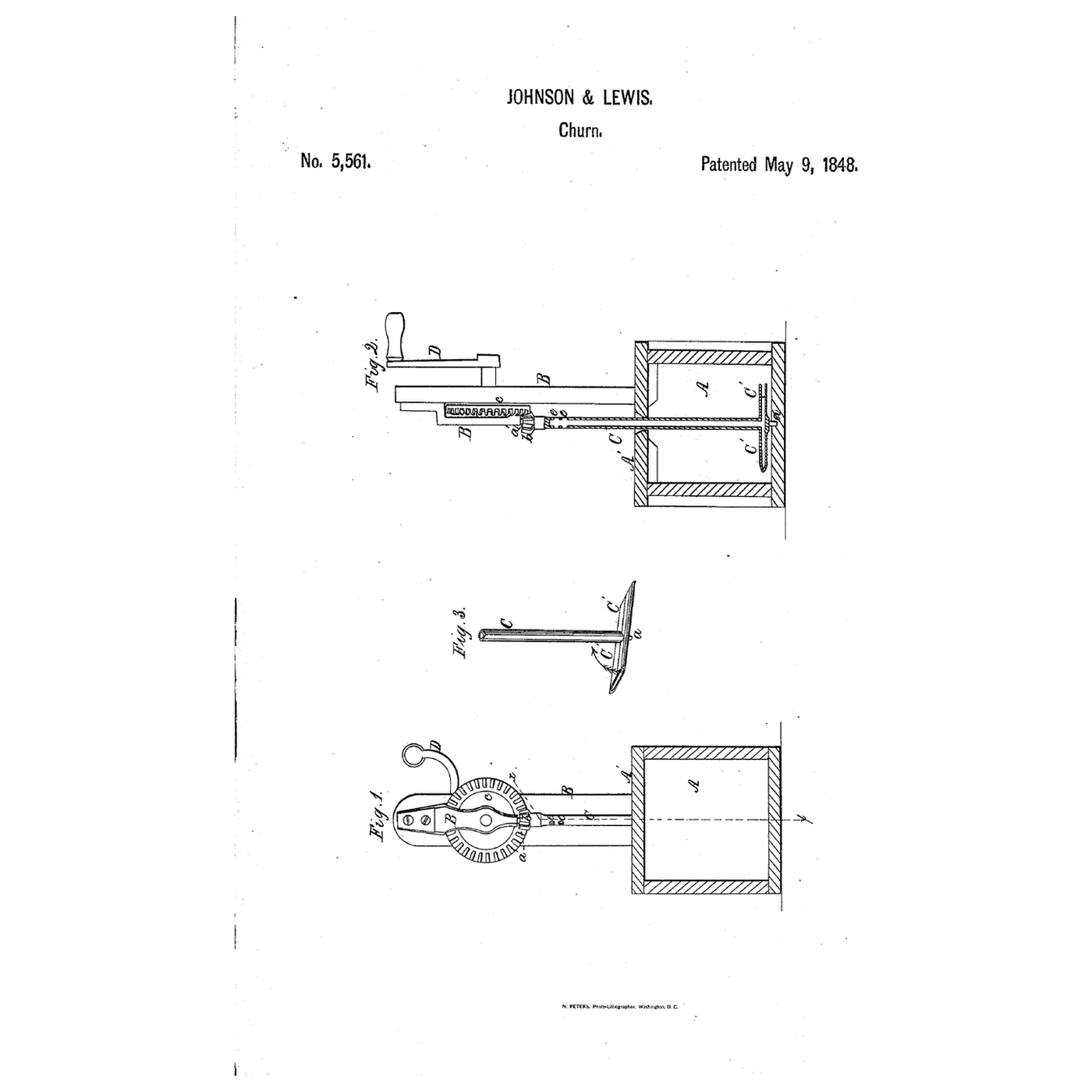
Johnson and Lewis churned "by mixing a stream of atmospheric air with it at the same time that it is subjected to agitation by a revolving dasher."
Willis H. Johnson and Thomas Lewis of Springfield, Illinois, received US 5,561, dated 9 May 1848, for an atmospheric churn whose upright dasher shaft is hollow, with holes near its upper end for the air, which "passes down through the hollow arms" at its foot. The arms' ends are sloped off obliquely so that, turned the right way, the air is drawn out behind them and "ascends to the surface of the cream in numerous small bubbles." A wheel and pinion turn it fast.
This rung estimates the speed the arms need, then prints the one-piece hollow dasher, fits it to a jar, and makes butter.
Intermediate
About 2 hours, plus printing
Instructions
1
1
How fast the arms must turn
How fast the arms must turn
Loading Jupyter Notebook...
2
2
Air carried into the cream before it
Air carried into the cream before it
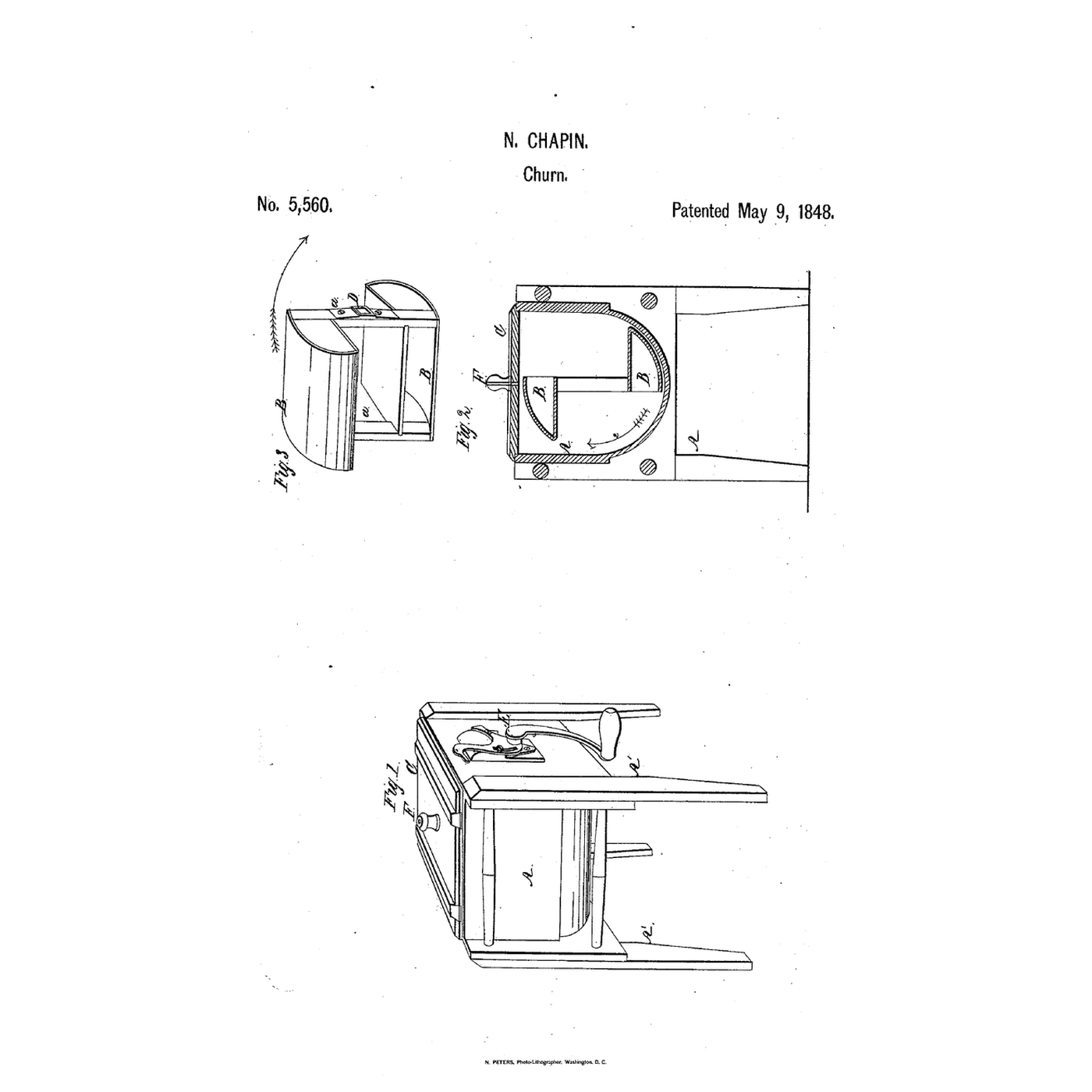
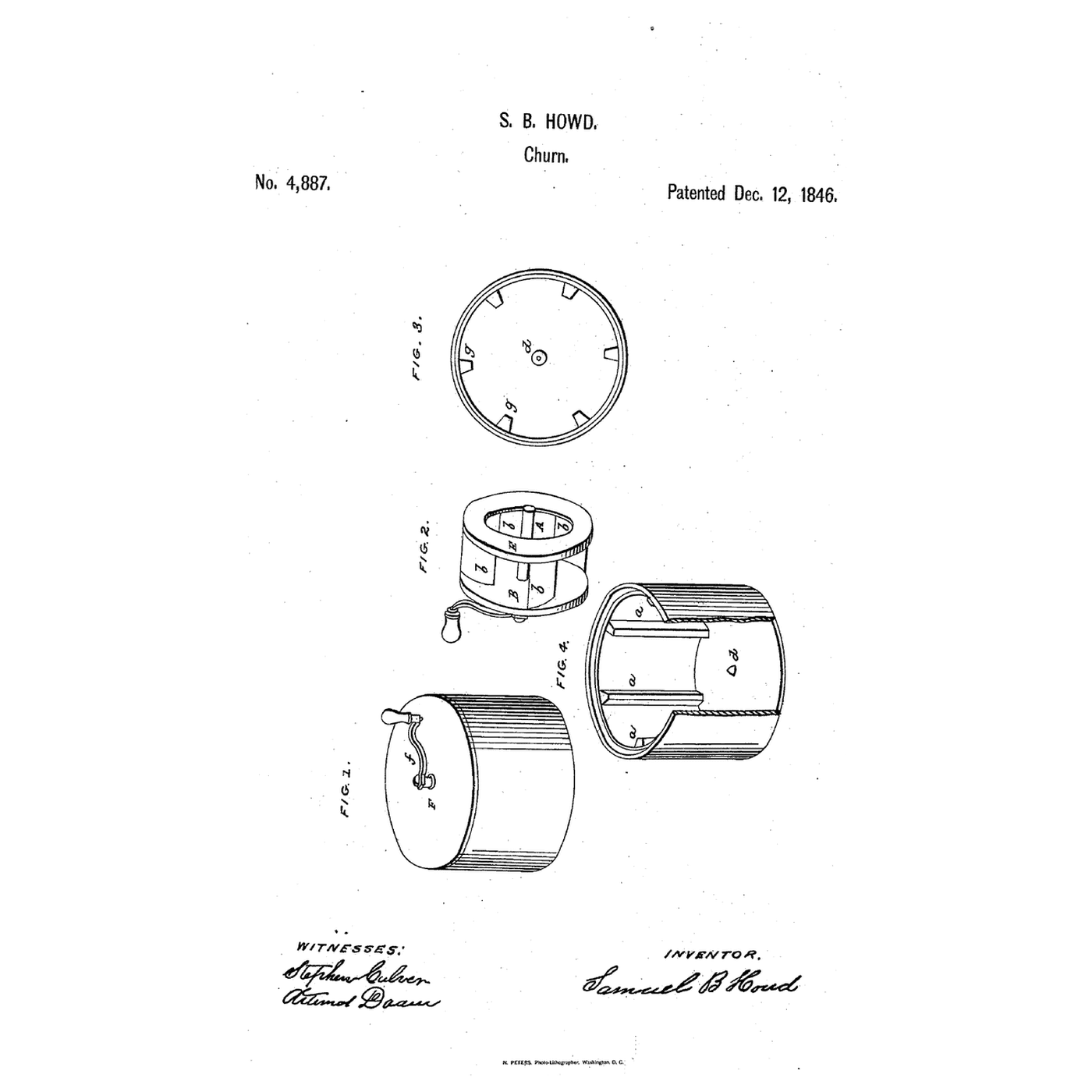
The embedded blueprint carries air down in buckets. Johnson and Lewis draw it down a hollow shaft and out of the arms' ends.
3
3
Read US 5,561
Read US 5,561
"The arms C' C' project from opposite sides of the lower end of the vertical shaft and their ends are sloped off obliquely as represented in order that when turned in the direction indicated by the arrow Fig. 3 a partial vacuum may be formed behind them in the cream into which the air may rush unobstructed from the hollow arms."
4
4
Print the dasher
Print the dasher
Print the hollow dasher upright in one piece (/uploads/blueprints/hollow-arm-air-churn-dasher.stl), with supports under the arms: a 230 mm shaft bored down its length, four air holes near the square head, and two hollow arms with oblique ends. Check the bore is clear by blowing through a top hole. Print the step (/uploads/blueprints/hollow-arm-air-churn-step.stl) and the crank arm (/uploads/blueprints/hollow-arm-air-churn-crank-arm.stl). Print in PLA at 0.2 mm layers, 30 % infill, 4 walls; wash before first use.
Materials for this step:
 PLA Filament1 piece
Tools needed:
 FDM 3D Printer
5
5
Fit the jar
Fit the jar
Bed the step in the centre of a tall wide jar's floor with silicone. Drill the lid at the centre for the shaft. Stand the dasher in the step through the lid, with its air holes above the lid, and press the crank arm on its head.
Materials for this step:
 Glass Jar1 piece
 Silicone Sealant1 piece
Tools needed:
 Cordless Drill
 Drill Bit Set
6
6
Handle
Handle
Glue a hardwood dowel handle into the crank arm.
Materials for this step:
 Hardwood Dowels1 piece
 Wood Glue1 piece
Tools needed:
 Hand Saw
 Sandpaper
7
7
The build in 3D
The build in 3D
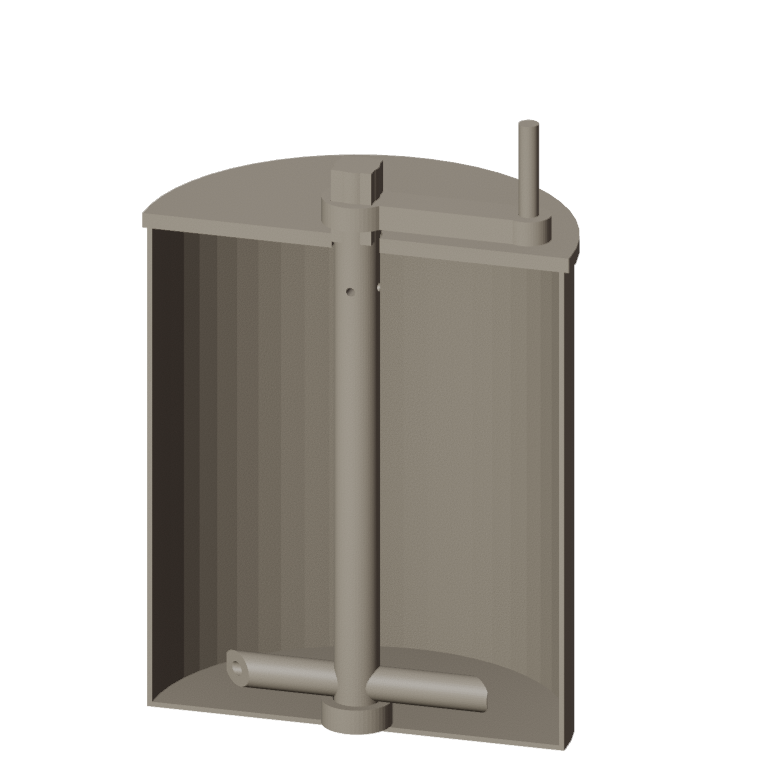
FreeCAD model of this build, not of the patent: the jar cut away to show the hollow dasher standing in its step, the two hollow arms with oblique ends at its foot, the air holes near its top above the lid, and the crank.
8
8
Spin and make butter
Spin and make butter
Let the heavy cream stand until it reaches about 15 °C, checked with the thermometer. Pour in 700 ml. Turn the crank as fast as you can, the way that leaves the arms' open ends trailing, and watch for bubbles; time until the butter comes. By hand you will not reach the speed the notebook gives, so expect few bubbles: that is why they geared the shaft up with a small pinion on a large wheel. Pour off the buttermilk, add cold water, churn a little and pour off again until it runs clear; work in a pinch of salt and weigh the butter.
Materials for this step:
 Heavy Cream700 ml
 Coarse Sea Salt1 piece
 Water1 piece
Tools needed:
 Leave-In Probe Thermometer
 Stopwatch
 Digital Kitchen Scale
 Stainless Steel Mixing Bowl (Large)
9
9
No bubbles, or cream in the shaft
No bubbles, or cream in the shaft
Hollow-arm air churn troubleshooting.
Flow
Loading...
10
10
History and honest limits
History and honest limits
**Willis H. Johnson and Thomas Lewis** of Springfield, Sangamon County, Illinois, received US 5,561, dated 9 May 1848, signed 26 November 1847. The shaft turned in a bearing in the frame above the cover, driven by a pinion geared into a wheel on the winch, "the pinion being much smaller than the wheel." They held that the butter "is sooner formed than by any other known churning machine"; that is their claim. They claimed "the process of making butter by the combined action of the hollow rotary shaft and radial arms."
**Honest limits.** A jar and a printed dasher stand in for their churn, and our crank turns the shaft directly, without their wheel and pinion, so it runs well below the speed at which the notebook expects air to leave the arms; the build shows the hollow shaft and oblique ends, not their full effect. The notebook's speed is an estimate. FDM prints hold food in their layer lines, so wash well and replace when worn. Your times and weights are the result.
Materials
8- 1 piecePlaceholder
- 1 piecePlaceholder
- 1 piecePlaceholder
- 1 piecePlaceholder
- 1 piecePlaceholder
- 700 mlPlaceholder
- 1 piecePlaceholder
- 1 piecePlaceholder
Tools Required
9- Placeholder
- 1 vendor sell this, none ship to you yetPlaceholder
- Placeholder
- Placeholder
- Placeholder
- Placeholder
- Placeholder
- Placeholder
- Placeholder
Design Files
1Related Blueprints
These blueprints share knowledge with this one — techniques, materials, or principles that connect them in the learning graph.

CC0 Public Domain
This blueprint is released under CC0. You are free to copy, modify, distribute, and use this work for any purpose, without asking permission.
Support the Maker by purchasing products through their Blueprint where they earn a Maker Commission set by Vendors, or create a new iteration of this Blueprint and include it as a connection in your own Blueprint to share revenue.