ART
BEAUTY & WELLNESS
CRAFT
CULTURE & HISTORY
ENTERTAINMENT
ENVIRONMENT
FOOD & DRINKS
REVERSE ENGINEERING
SCIENCES
SPORTS
TECHNOLOGY
WEARABLES
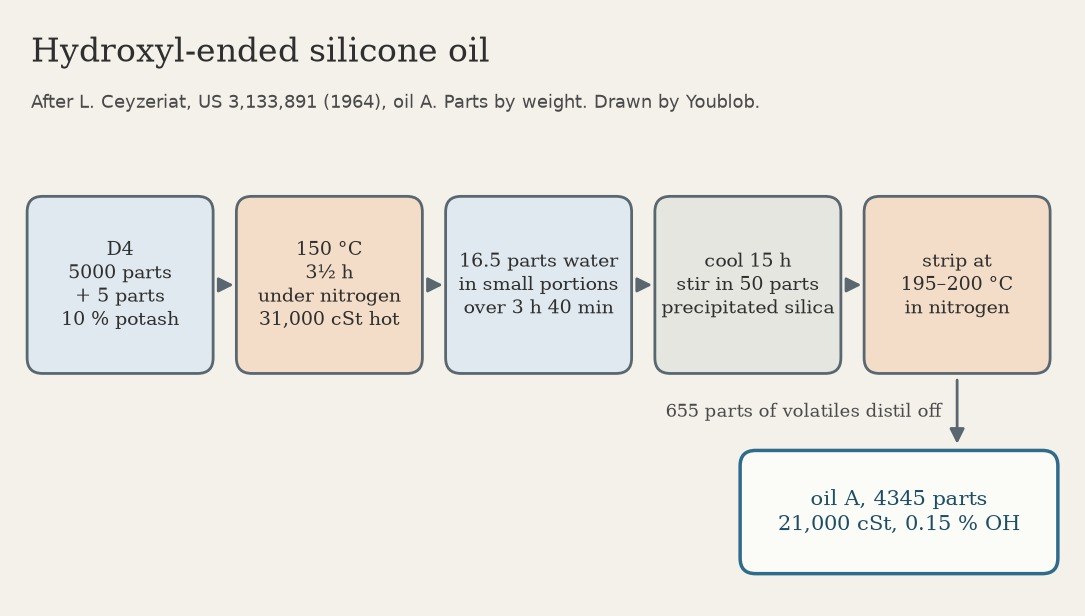
Youblob · CC0


Hydroxyl-Ended Silicone Oil: D4 Opened with Potash, Then Water (Ceyzeriat 1964)
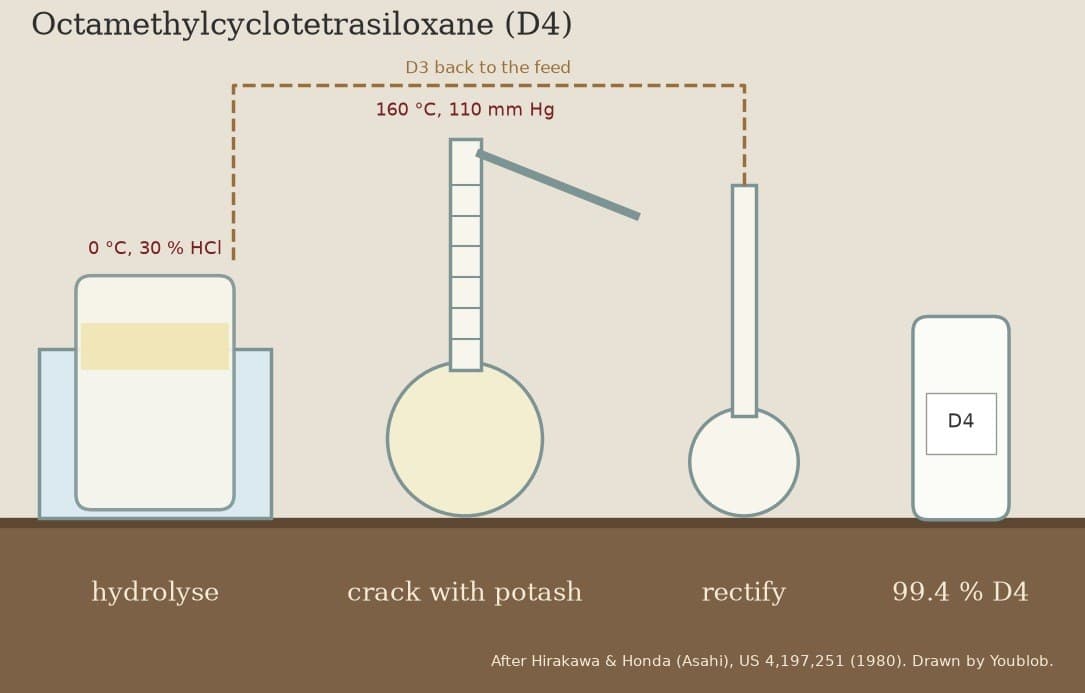
A trace of hot potash opens the ring of D4 and strings it into a long, thick chain. Water added a little at a time then cuts the chains back and leaves hydroxyl groups on their ends, which is what later lets the oil cure into rubber. This is Louis Ceyzeriat's oil A, the base of every sealant in his patent: 21,000 centistokes, 0.15 % hydroxyl.
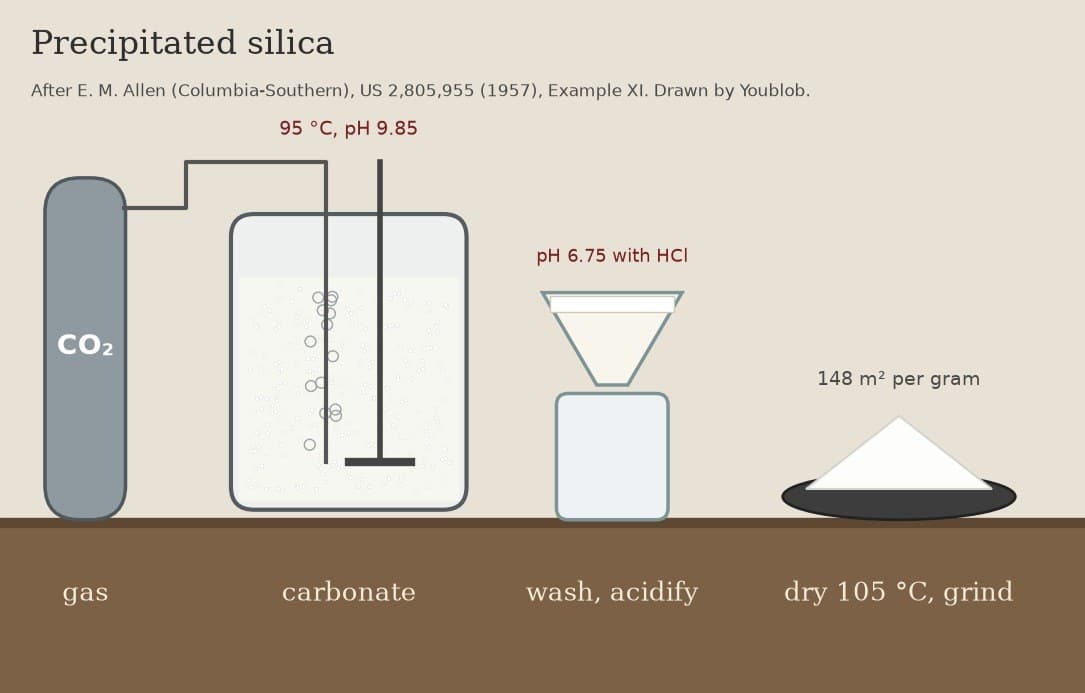
Source: L. Ceyzeriat (Rhône-Poulenc), US 3,133,891 (1964), column 4. His neutraliser was the precipitated silica Hi-Sil X303; we use our precipitated silica in its place. The potash mix and the equipment are ours. Picture drawn by Youblob.
Advanced
2 days
Instructions
1
1
Make the 10 % potash
Make the 10 % potash
Dissolve 0.5 part of potassium hydroxide in 4.5 parts of water (our arithmetic for 5 parts of a 10 % solution). All parts are by weight.
Materials for this step:
 Potassium Hydroxide0.5 parts
 Water4.5 parts
Tools needed:
 Glass Vessel
 Balance Scale
2
2
Heat D4 with the potash under nitrogen
Heat D4 with the potash under nitrogen
Heat 5000 parts of octamethylcyclotetrasiloxane (it melts at 17.5 °C) with the 5 parts of 10 % potash at 150 °C for 3½ hours under nitrogen. The oil thickens to 31,000 centistokes while hot.
Materials for this step:
 Octamethylcyclotetrasiloxane (D4)5000 parts
Tools needed:
 Glass Distillation Flask
 Hot Plate
 Thermometer
 Stirrer
 Nitrogen Gas Cylinder
3
3
Add water a little at a time
Add water a little at a time
Still hot, add 16.5 parts of water in small portions over 3 hours 40 minutes. The hot oil thins to 1730 centistokes.
Materials for this step:
Water16.5 partsTools needed:
Glass Distillation FlaskHot PlateThermometerStirrer4
4
Cool, then neutralise with silica
Cool, then neutralise with silica
Let it cool for 15 hours. Then stir in 50 parts of precipitated silica to neutralise the potash. The liquid now measures 13,400 centistokes at 25 °C.
Materials for this step:
 Precipitated Silica50 parts
Tools needed:
Glass Distillation FlaskStirrer5
5
Strip the volatiles at 195–200 °C
Strip the volatiles at 195–200 °C
Heat it to about 195–200 °C in a current of nitrogen, with a water condenser on the outlet. 655 parts of liquid distil over; 4345 parts of oil A stay in the boiler, 21,000 centistokes at 25 °C with 0.15 % hydroxyl groups.
Tools needed:
Glass Distillation Flask Condenser CoilHot PlateThermometerNitrogen Gas Cylinder
 Glass Jars with Lids
Materials
4- 0.5 partsPlaceholder
- 21 partsPlaceholder
- 5000 partsPlaceholder
- 50 partsPlaceholder
This blueprint makes
Related Blueprints
These blueprints share knowledge with this one — techniques, materials, or principles that connect them in the learning graph.
CC0 Public Domain
This blueprint is released under CC0. You are free to copy, modify, distribute, and use this work for any purpose, without asking permission.
Support the Maker by purchasing products through their Blueprint where they earn a Maker Commission set by Vendors, or create a new iteration of this Blueprint and include it as a connection in your own Blueprint to share revenue.