ART
BEAUTY & WELLNESS
CRAFT
CULTURE & HISTORY
ENTERTAINMENT
ENVIRONMENT
FOOD & DRINKS
REVERSE ENGINEERING
SCIENCES
SPORTS
TECHNOLOGY
WEARABLES
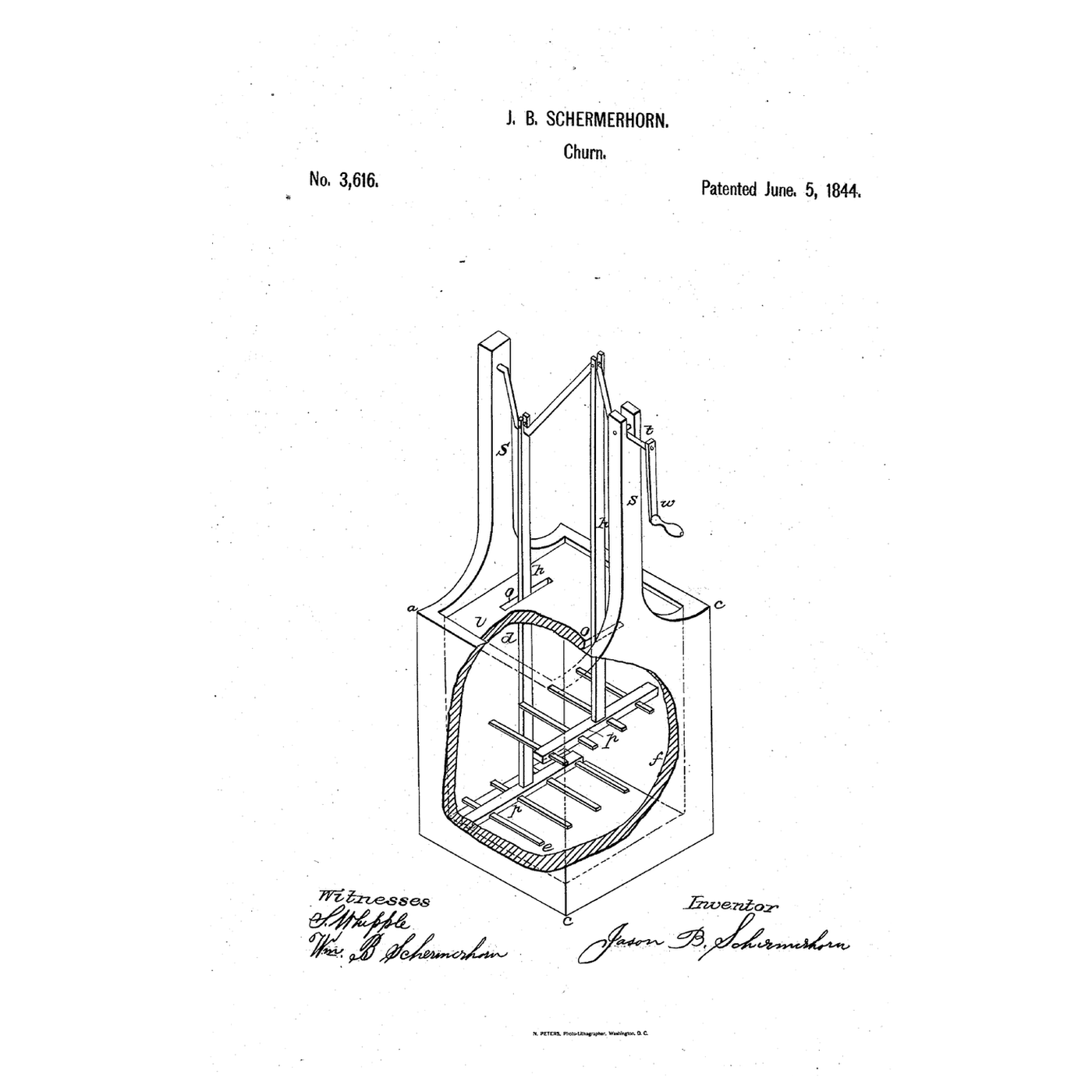


Interraking Plunger Churn: Two Rakes Worked Oppositely by a Double Crank
Schermerhorn did not claim churning with plungers, "either by hand, or by crank motion"; he claimed two of them shaped like rakes.
Jason B. Schermerhorn of Deerfield, New York, received US 3,616, dated 5 June 1844, for a dairy churn with "two rake-formed plungers with teeth interraking, and with oppositely reciprocating motions communicated to them by a cranked shaft." Standards on two sides of a square box carry the crank shaft; the teeth of one plunger pass between those of the other, "the one ascending while the other is descending," which "will produce a violent commotion in the cream."
This rung checks his proportions, then prints the rake heads, crank discs and yokes, builds the standards on a box, and makes butter.
Intermediate
About 5 hours, plus printing
Instructions
1
1
His proportions
His proportions
Loading Jupyter Notebook...
2
2
A double crank before it
A double crank before it
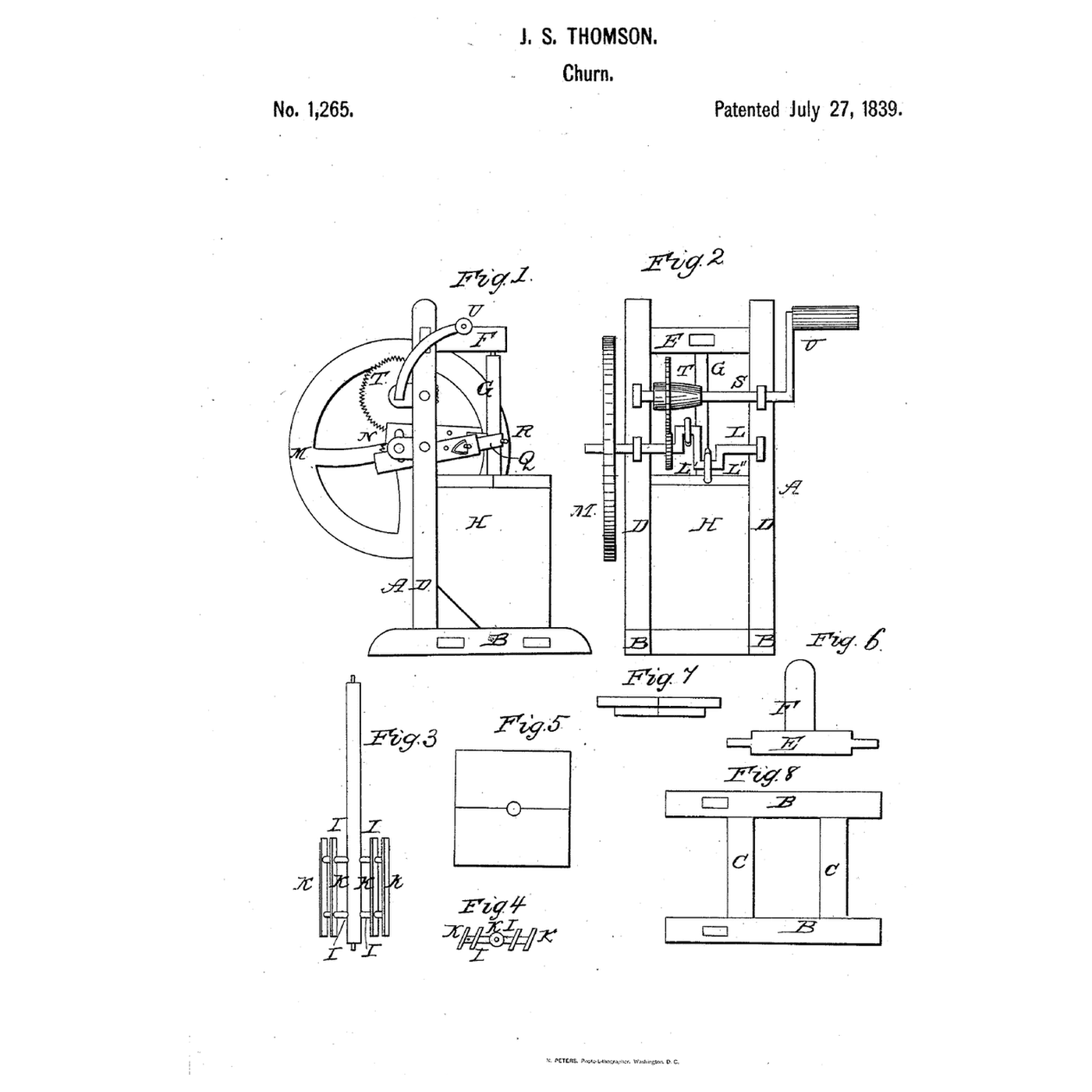
The embedded blueprint uses a double crank to pull two pitmen. Schermerhorn's double crank works two plungers up and down oppositely.
3
3
Read US 3,616
Read US 3,616
"The teeth of the plunger pass through the head piece horizontally, and at right angles therewith, projecting on both sides of the head-piece, but unequally; the projection on the side next the center of the churn being twice or thrice as great as on the other side. The length of the pieces forming the teeth should be equal to about two thirds of the width of the box."
4
4
Print the parts
Print the parts
Print two identical rake heads (/uploads/blueprints/interraking-plunger-churn-rake-head.stl): their teeth are set off-centre, so one turned round passes between the other's. Print two crank discs (/uploads/blueprints/interraking-plunger-churn-crank-disc.stl) and two yokes (/uploads/blueprints/interraking-plunger-churn-yoke.stl). Print in PLA at 0.2 mm layers, 30 % infill, 4 walls; wash before first use.
Materials for this step:
 PLA Filament1 piece
Tools needed:
 FDM 3D Printer
5
5
Box and standards
Box and standards
Take a food-safe box about 150 mm square and 200 mm deep. Screw a pine standard to each of two opposite sides, rising about 200 mm above the top, and drill both for a 10 mm square hardwood crank shaft. Cut two oblong openings in the lid for the plunger rods.
Materials for this step:
 Food-Grade Storage Container1 piece
 Pine Board1 piece
 #8 x 1" Wood Screw1 piece
Tools needed:
 Hand Saw
 Cordless Drill
 Drill Bit Set
 Coping Saw
 Screwdriver Set
6
6
Crank and plungers
Crank and plungers
Slide the crank discs onto the shaft with their pins on opposite sides, half a turn apart, and glue them 60 mm apart. Glue a rake head on each of two 12 mm dowel rods, long sides of the teeth toward the centre, and a yoke on each rod's top. Pass the rods through the lid, hang the yokes on the crank pins, and glue the crank arm and a dowel handle on the shaft's end.
Materials for this step:
 Hardwood Dowels1 piece
 Wood Glue1 piece
Tools needed:
Hand Saw Sandpaper
7
7
The build in 3D
The build in 3D
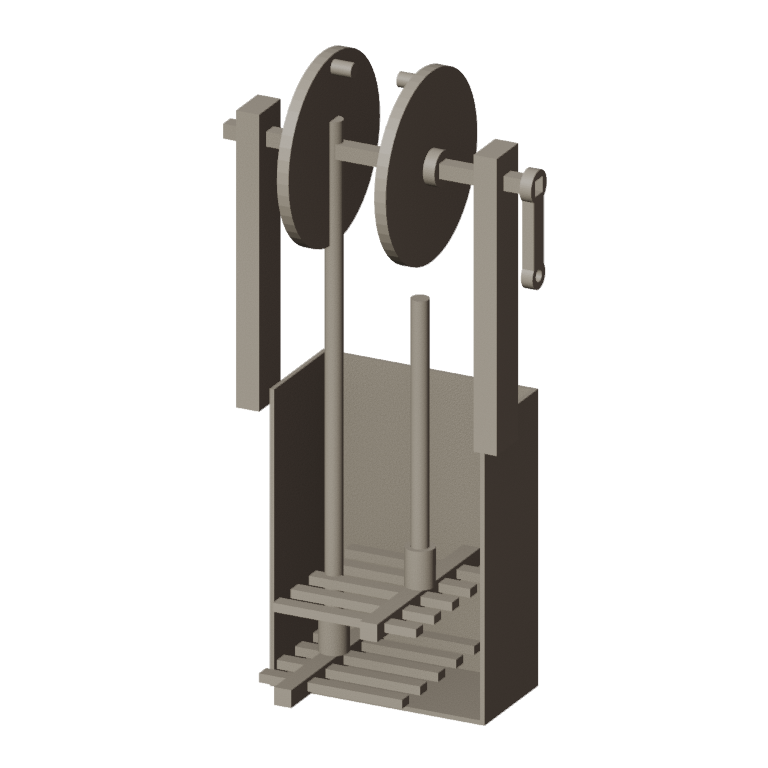
FreeCAD model of this build, not of the patent: the box cut away to show the two rake heads with their teeth interleaving, one at the bottom and one rising, their rods up to the two crank discs on the shaft between the standards, and the crank.
8
8
Crank and make butter
Crank and make butter
Let the heavy cream stand until it reaches about 15 °C, checked with the thermometer. Pour in 1 litre, fit the lid, and crank steadily; time until the butter comes. Pour off the buttermilk, add cold water, churn a little and pour off again until it runs clear; work in a pinch of salt and weigh the butter.
Materials for this step:
 Heavy Cream1000 ml
 Coarse Sea Salt1 piece
 Water1 piece
Tools needed:
 Leave-In Probe Thermometer
 Stopwatch
 Digital Kitchen Scale
 Stainless Steel Mixing Bowl (Large)
9
9
Teeth that clash, rods that bind
Teeth that clash, rods that bind
Interraking plunger churn troubleshooting.
Flow
Loading...
10
10
History and honest limits
History and honest limits
**Jason B. Schermerhorn** of Deerfield, Oneida County, New York, received US 3,616, dated 5 June 1844. His crank was a round iron rod "from one half to five-eighths of an inch in diameter" bent into a double crank "somewhat like a fulling mill crank"; the handles were forked over the cranks and pinned, so the plungers could be withdrawn; the tooth pieces might be one inch wide by half an inch.
**Honest limits.** Printed crank discs on a wooden shaft stand in for his bent iron crank, and a food-safe box for his wooden one. FDM prints hold food in their layer lines, so wash well and replace when worn. Your times and weights are the result.
Materials
9- 1 piecePlaceholder
- 1 piecePlaceholder
- 1 piecePlaceholder
- 1 piecePlaceholder
- 1 piecePlaceholder
- 1 piecePlaceholder
- 1000 mlPlaceholder
- 1 piecePlaceholder
- 1 piecePlaceholder
Tools Required
11- Placeholder
- Placeholder
- 1 vendor sell this, none ship to you yetPlaceholder
- Placeholder
- Placeholder
- Placeholder
- Placeholder
- Placeholder
- Placeholder
- Placeholder
- Placeholder
Design Files
1Related Blueprints
These blueprints share knowledge with this one — techniques, materials, or principles that connect them in the learning graph.

CC0 Public Domain
This blueprint is released under CC0. You are free to copy, modify, distribute, and use this work for any purpose, without asking permission.
Support the Maker by purchasing products through their Blueprint where they earn a Maker Commission set by Vendors, or create a new iteration of this Blueprint and include it as a connection in your own Blueprint to share revenue.