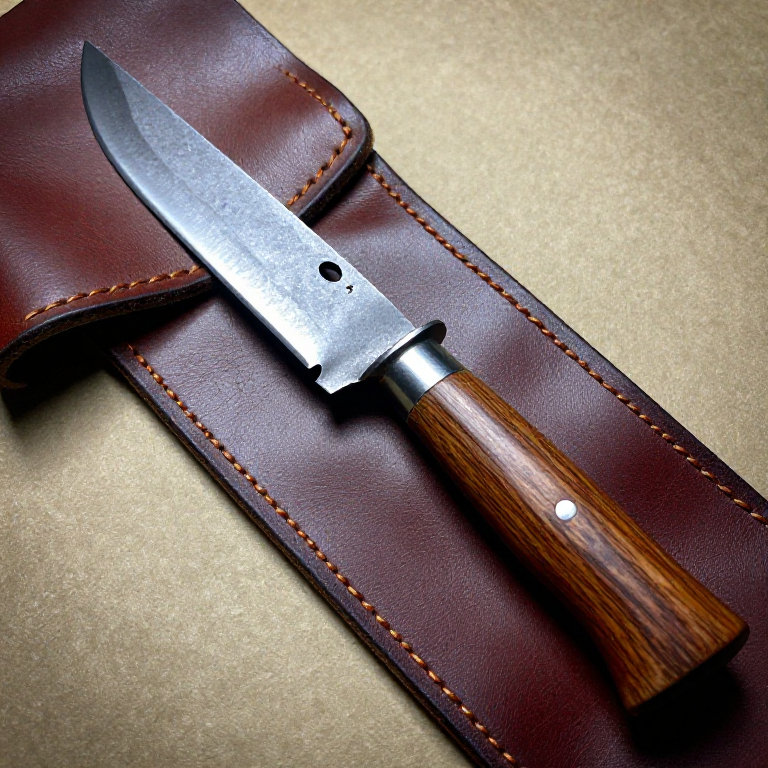


Forging an Iron Knife from a Wrought Iron Bar — The Smith's First Project
The iron knife is traditionally the first object a blacksmith apprentice learns to forge. It teaches every fundamental operation: drawing out (lengthening the metal), tapering (creating a point), bevelling (forming the cutting edge), and finishing (grinding and hafting). An experienced smith can forge a knife in under an hour; a beginner should expect a full day of practice.
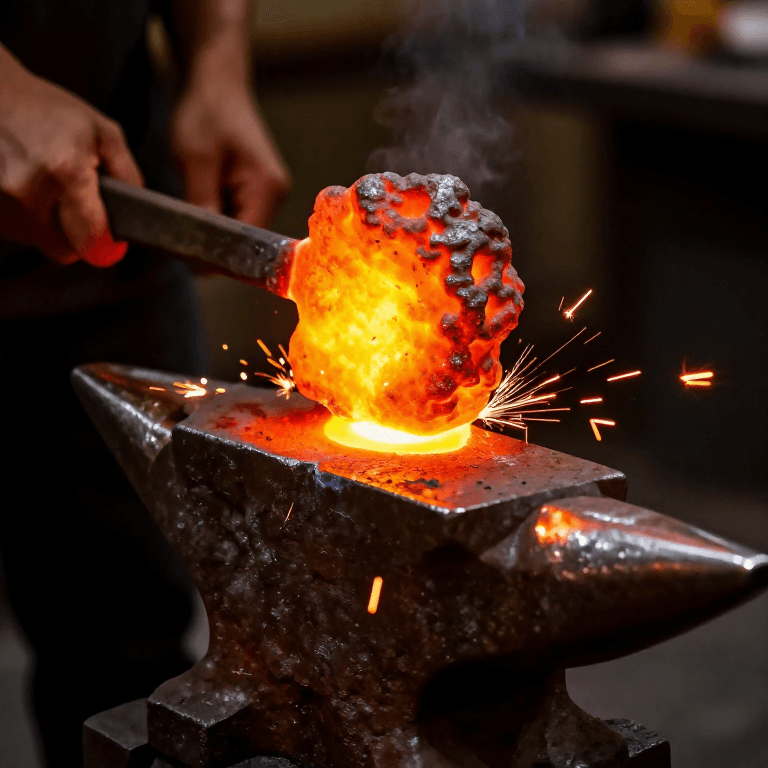
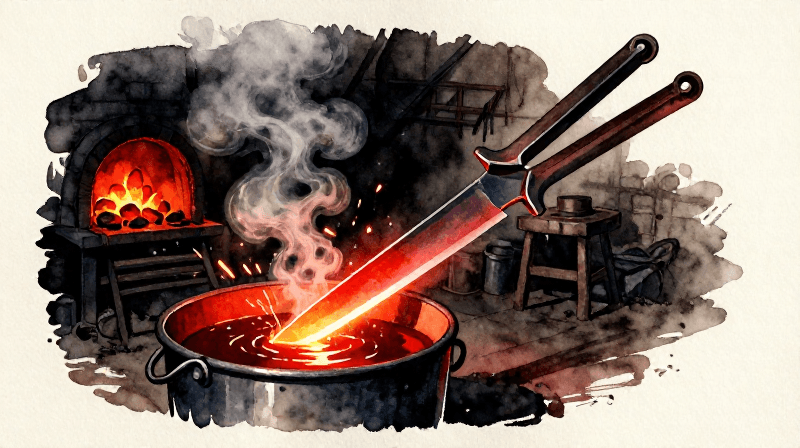
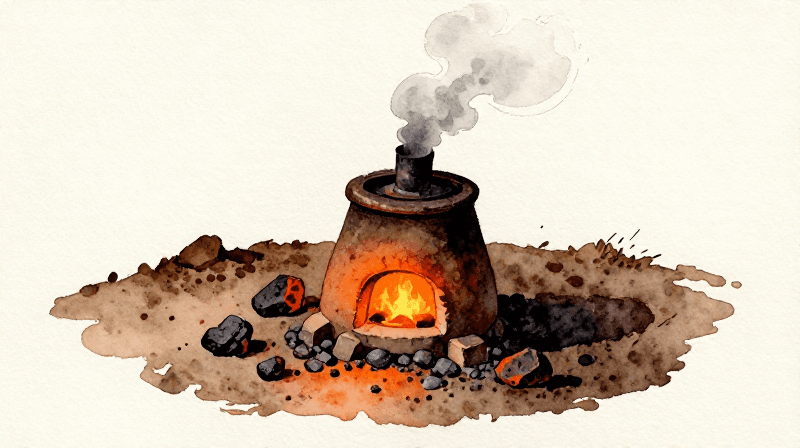
Unlike bronze tools which are cast into shape, iron tools are forged — beaten into shape from a solid bar using only heat, hammer, and anvil. The wrought iron bar is heated to bright orange in a charcoal forge, then hammered on an anvil to draw it into a blade shape. The tang (the part that goes into the handle) is formed by drawing the opposite end to a narrow taper.
The blade is then ground, and the edge can be hardened by case-carburising (packing in charcoal and heating) to add a thin layer of steel to the surface. This gives a wrought iron blade the best of both worlds: a tough, shock-absorbing body with a hard, sharp edge.
Instructions
Select and cut the bar stock
Select and cut the bar stock
Heat the tang end to forging temperature
Heat the tang end to forging temperature
Materials for this step:
 Charcoal3 kg
Draw out the tang
Draw out the tang
Tools needed:
 Forge Hammer
 Forge Tongs
 Hearth (Forge Fire)
Define the shoulder
Define the shoulder
Taper the blade to a point
Taper the blade to a point
Set the bevel
Set the bevel
Straighten and true the blade
Straighten and true the blade
Normalise the blade
Normalise the blade
Grind the edge
Grind the edge
Materials for this step:
 Sandstone (Abrasive)1 piece
 Whetstone1 piece
Haft with a wooden handle
Haft with a wooden handle
Materials
6- 3 kgPlaceholder
- 1 piecePlaceholder
- 1 piecePlaceholder
- 1 piecePlaceholder
- 1 piecePlaceholder
- 1 piecePlaceholder
Tools Required
4- Placeholder
- Placeholder
- Placeholder
- Placeholder
Connected Blueprint Materials
Related Blueprints
These blueprints share knowledge with this one — techniques, materials, or principles that connect them in the learning graph.

CC0 Public Domain
This blueprint is released under CC0. You are free to copy, modify, distribute, and use this work for any purpose, without asking permission.
Support the Maker by purchasing products through their Blueprint where they earn a Maker Commission set by Vendors, or create a new iteration of this Blueprint and include it as a connection in your own Blueprint to share revenue.