
ART
BEAUTY & WELLNESS
CRAFT
CULTURE & HISTORY
ENTERTAINMENT
ENVIRONMENT
FOOD & DRINKS
REVERSE ENGINEERING
SCIENCES
SPORTS
TECHNOLOGY
WEARABLES
Iron Ball Mill: Grüson Drum with a Stepped Die Ring and Two Screens (Richards, 1903)
Forge

Created by

Forge

3. November 2026NO
1
0
0
0
0

Iron Ball Mill: Grüson Drum with a Stepped Die Ring and Two Screens (Richards, 1903)

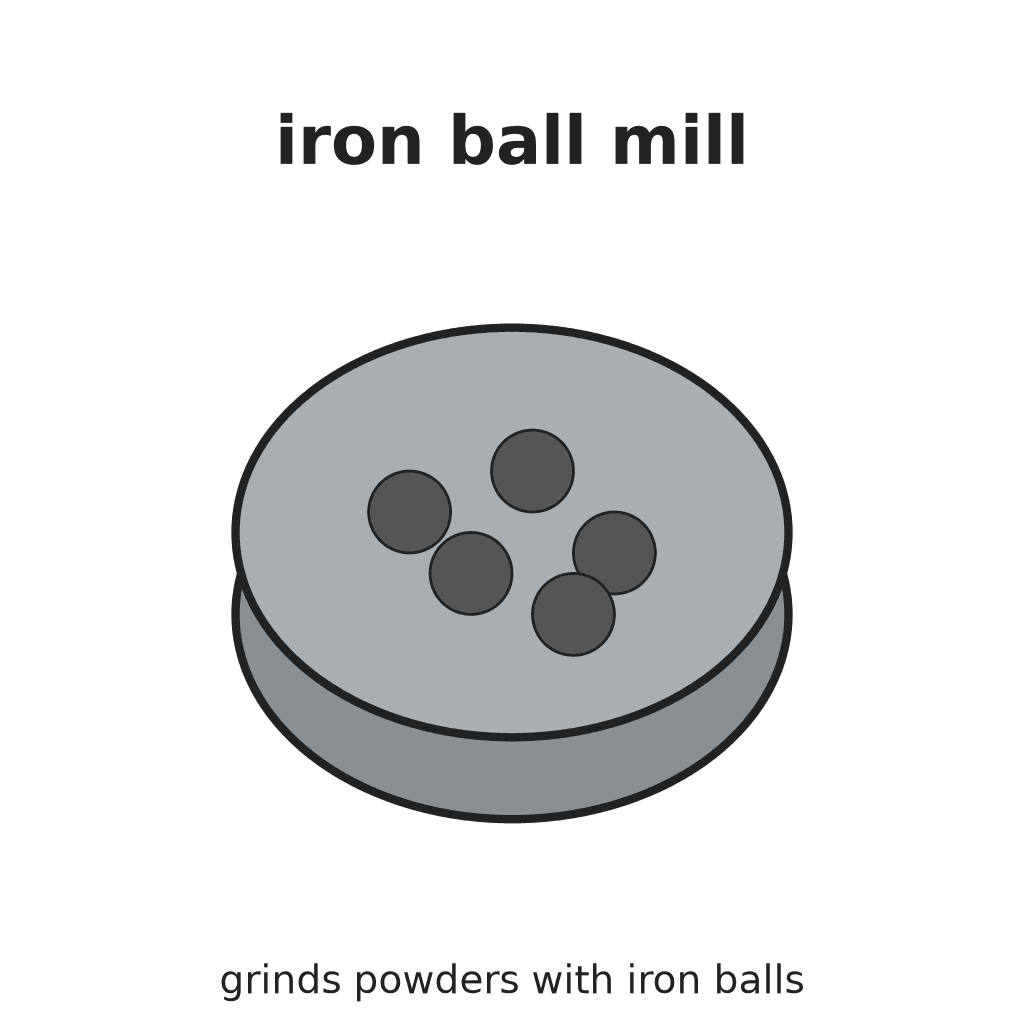
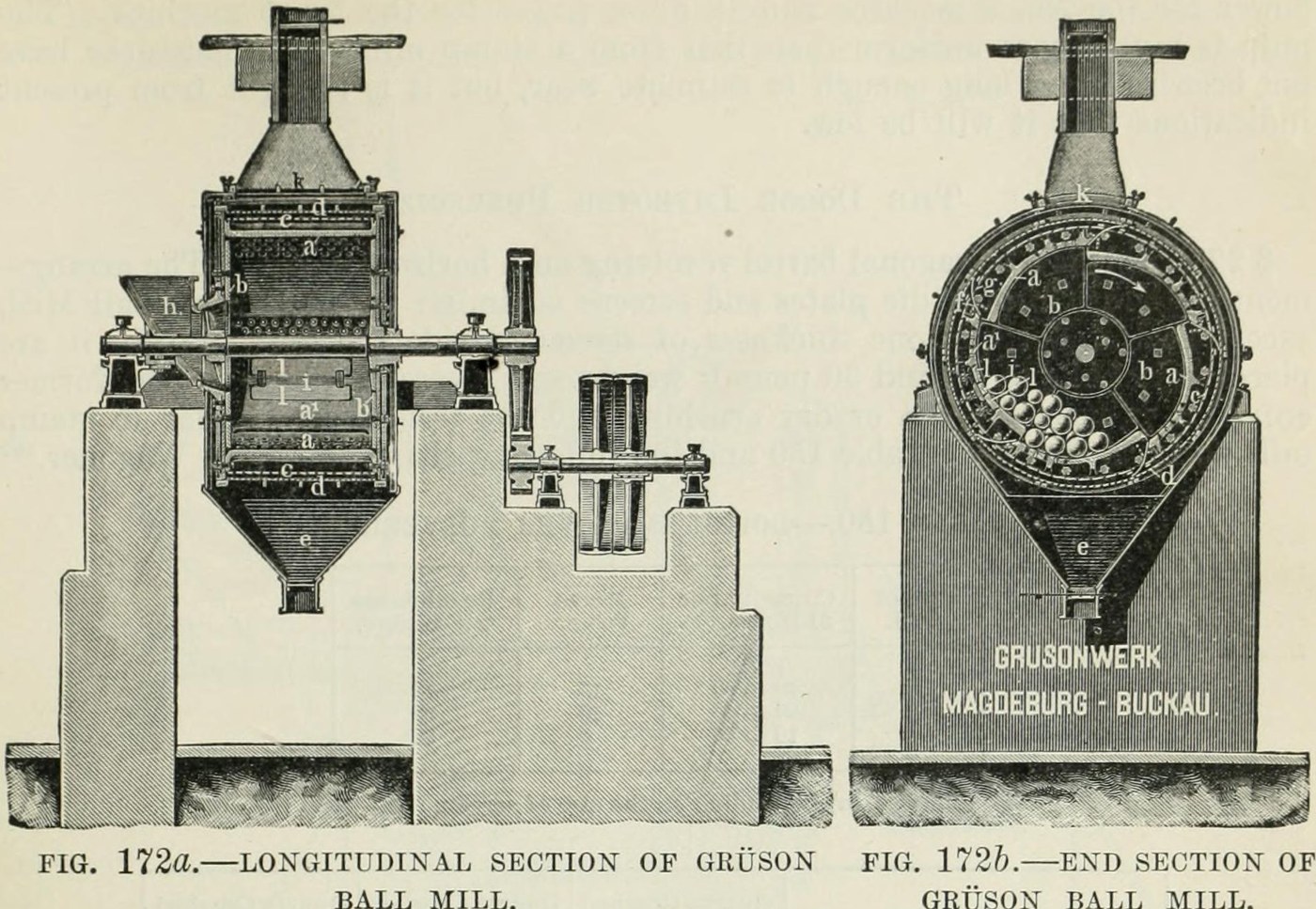
The Grüson ball mill: a drum turning on a horizontal axis, charged with chilled iron or steel balls of mixed sizes. The balls grind the ore against each other and against a stepped die ring. The ground ore passes out through a coarse and a fine screen; the oversize is carried back in. Result: a mill for fine grinding of cement, fertiliser, clay and soft ores, wet or dry. Sizes from 0.66 m to 1.83 m across. Source: R. H. Richards, Ore Dressing, vol. I (1903), § 225, Figs. 172a-b and Table 149. Unknown: dimensions beyond the table, and the materials of the side plates, screens and shaft. Picture: Richards, Figs. 172a-b.
Advanced
Unknown

Instructions

1

Make the drum and the die ring

The drum is two side plates (b) joined round the edge by the die ring (a). The die ring is five perforated, spiral plates of chilled iron. Each plate laps the next, so they form steps: the balls drop from one step to the next, and the space under each step lets the oversize from the screens back in. Not given: the side-plate material, sizes, hole sizes.

Materials for this step:

Iron CastingsIron Castings5 die plates, chilled iron

Unknown MaterialUnknown Material2 side plates

Tools needed:

Unknown DimensionsUnknown Dimensions
Adjustable SpannerAdjustable Spanner
2

Put the two screens round it

Outside the die ring, fit a coarse perforated screen (c) to take the wear. It is in five parts with spaces between them and has back-deflecting holes (g). Outside that, fit a fine gauze screen (d). At the end of each section of fine screen, fix a deflector or shovel (f). As the drum turns, it carries the oversize up and back into the grinding space. Not given: the screens' metal and mesh.

Materials for this step:

Perforated Screen PlatePerforated Screen Plate1 coarse screen, 5 parts
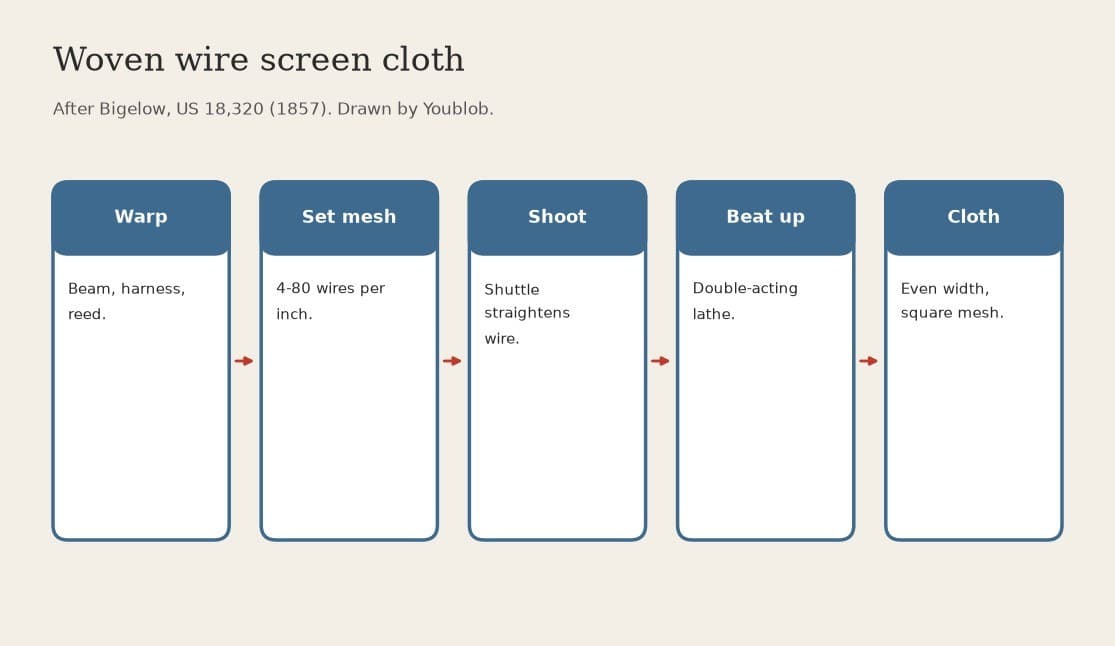
Woven Wire Screen ClothWoven Wire Screen Cloth1 fine screen
Unknown MaterialUnknown Material5 deflectors

Tools needed:

Unknown DimensionsUnknown Dimensions
Adjustable SpannerAdjustable Spanner
3

Mount and house it

Carry the drum on a horizontal shaft in two bearings; the figures show them on masonry piers. Enclose the drum in a plate iron housing with a discharge spout (e) below, a feed hopper (h) at one end, a manhole (i) and a dust pipe (k) on top. Ours: steel sheet for the plate iron.

Materials for this step:

Steel ShaftSteel Shaft1 mill shaft
Bearing BlockBearing Block2 pieces
Mild Steel SheetMild Steel Sheet1 housing, spout, hopper

Tools needed:

Adjustable SpannerAdjustable Spanner
Unknown DimensionsUnknown Dimensions
4

Fit the drive

Drive the mill by gear and pinion. In the figure, the gear is on the mill shaft and the pinion on a countershaft that carries tight and loose pulleys. A belt from the line shaft runs on the pulleys: on the tight pulley the mill turns, on the loose pulley it stops.

Materials for this step:

Gear WheelGear Wheel1 on the mill shaft
PinionPinion1 piece
Steel ShaftSteel Shaft1 countershaft
Bearing BlockBearing Block2 pieces
Tight and Loose PulleysTight and Loose Pulleys1 piece

Tools needed:
Drive BeltDrive Belt
Adjustable SpannerAdjustable Spanner
5

Charge the balls (size sets the charge)

Load chilled iron or steel balls in mixed sizes; mixed sizes grind better than one size. Size is the variable: No. 0 (0.660 m drum, 45 rev/min) takes 15 kg of 40 mm and 45 kg of 80 mm balls, 60 kg in all. No. 2 (1.330 m, 30 rev/min) takes 100 kg each of 100, 115 and 125 mm, 300 kg. No. 4 (1.830 m, 25 rev/min) takes 217 kg each of the same three sizes, 650 kg. The bigger the drum, the slower it turns and the heavier its charge.

Materials for this step:

Grinding Media (Steel Balls)Grinding Media (Steel Balls)300 kg for No. 2; 60 kg No. 0, 650 kg No. 4

Tools needed:
Platform ScalePlatform Scale
6

Grind

Feed the ore, egg-size, through the hopper and run the mill wet or dry. Power, and output per 24 hours: No. 0 takes 1/4 horse power and grinds 1,680 kg of copper ore to 15 mesh, or 840 kg of chrome iron ore to 130 mesh. No. 2 takes 2 1/2 to 3 horse power: 14,400 kg of brick bats to 20 mesh, or 1,920 kg of emery to 200 mesh. No. 4 takes 9 to 11 horse power: 12,720 kg of gold ores to 40 mesh, or 10,800 kg of chrome iron ore to 130 mesh. Wear: 1,345 kg of balls for 102,400 barrels of cement, about 0.139 lb a ton. The end plates last 18 months. Hard quartz ores wear the balls too much.

Tools needed:

Drive BeltDrive Belt
WaterWater

Materials

11

Tools Required

5

CC0 Public Domain

This blueprint is released under CC0. You are free to copy, modify, distribute, and use this work for any purpose, without asking permission.

Support the Maker by purchasing products through their Blueprint where they earn a Maker Commission set by Vendors, or create a new iteration of this Blueprint and include it as a connection in your own Blueprint to share revenue.

Discussion

(0)

Log in to join the discussion

Loading comments...