Collaboration
ART
BEAUTY & WELLNESS
CRAFT
CULTURE & HISTORY
ENTERTAINMENT
ENVIRONMENT
FOOD & DRINKS
REVERSE ENGINEERING
SCIENCES
SPORTS
TECHNOLOGY
WEARABLES
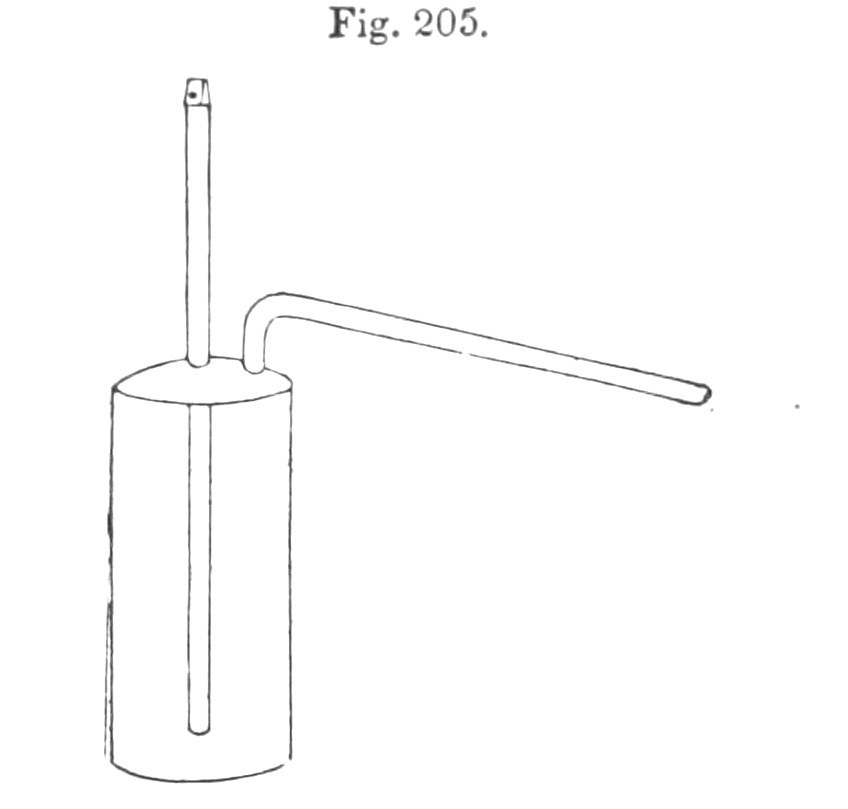


Iron Retort: a Mercury Flask with an Iron Tube Screwed In (Morfit, 1849)
A small iron retort for distilling dry substances that need a high heat. Campbell Morfit (1849) says all iron retorts should be of cast metal, but gives a simpler and cheaper one: an empty mercury flask with an iron gas tube or gun barrel screwed into the top, reaching nearly to the bottom, and another tube bent downwards (his Fig. 205).
The retort is heated in a furnace. Flask size, tube sizes and how the side tube is joined are not given.
Source: C. Morfit, Chemical and Pharmaceutic Manipulations (1849), pp. 241-242. Picture: Fig. 205.
Beginner
Unknown
Instructions
1
1
Read Morfit
Read Morfit
"A simpler and more economical apparatus is a mercury flask, Fig. 205, with an iron gas tube or gun barrel screwed into the top, and reaching nearly to the bottom, and another tube bent downwards. This arrangement, well fitted for distilling dry substances which require a high heat, may be modified by removing the centre pipe and inserting a screw plug, and thus be made well adapted to the distillation of mercury."
2
2
Screw in the centre tube
Screw in the centre tube
Take an empty mercury flask. Screw an iron tube into the top so that it reaches nearly to the bottom of the flask (Fig. 205). Ours: thick-walled steel pipe with threaded ends stands for the iron gas tube. Its bore and length are not given.
Materials for this step:
 Mercury Flask1 piece
 Steel Pipe (thick-walled, threaded ends)1 centre tube
Tools needed:
 Pipe Wrench
3
3
Fit the bent side tube
Fit the bent side tube
Fit a second tube at the top of the flask, bent so it leads away to the receiver (Fig. 205). Morfit does not say how this tube is joined to the flask or how it is bent (unknown).
Materials for this step:
Steel Pipe (thick-walled, threaded ends)1 side tube Unknown Connector1 piece
Tools needed:
 Bench VisePipe Wrench
4
4
History and honest limits
History and honest limits
Faraday (Chemical Manipulation, 1830) describes small iron retorts as bottles with an iron tube fitted by a ground joint, used mostly for distilling oxygen, and heated best by a coal or coke fire. Morfit heats all iron retorts in furnaces, greases them when not in use against rust, and keeps them stoppered. For mercury he takes out the centre pipe and puts in a screw plug.
Not given: flask size, tube bore and length, how the side tube is joined and bent.
Materials
3- 1 piecePlaceholder
- 1 side tubePlaceholder
- 1 piecePlaceholder
Tools Required
2- Placeholder
- Placeholder
This blueprint makes

CC0 Public Domain
This blueprint is released under CC0. You are free to copy, modify, distribute, and use this work for any purpose, without asking permission.
Support the Maker by purchasing products through their Blueprint where they earn a Maker Commission set by Vendors, or create a new iteration of this Blueprint and include it as a connection in your own Blueprint to share revenue.