
The Jacquard Mechanism — Punch Card Programmable Pattern Weaving
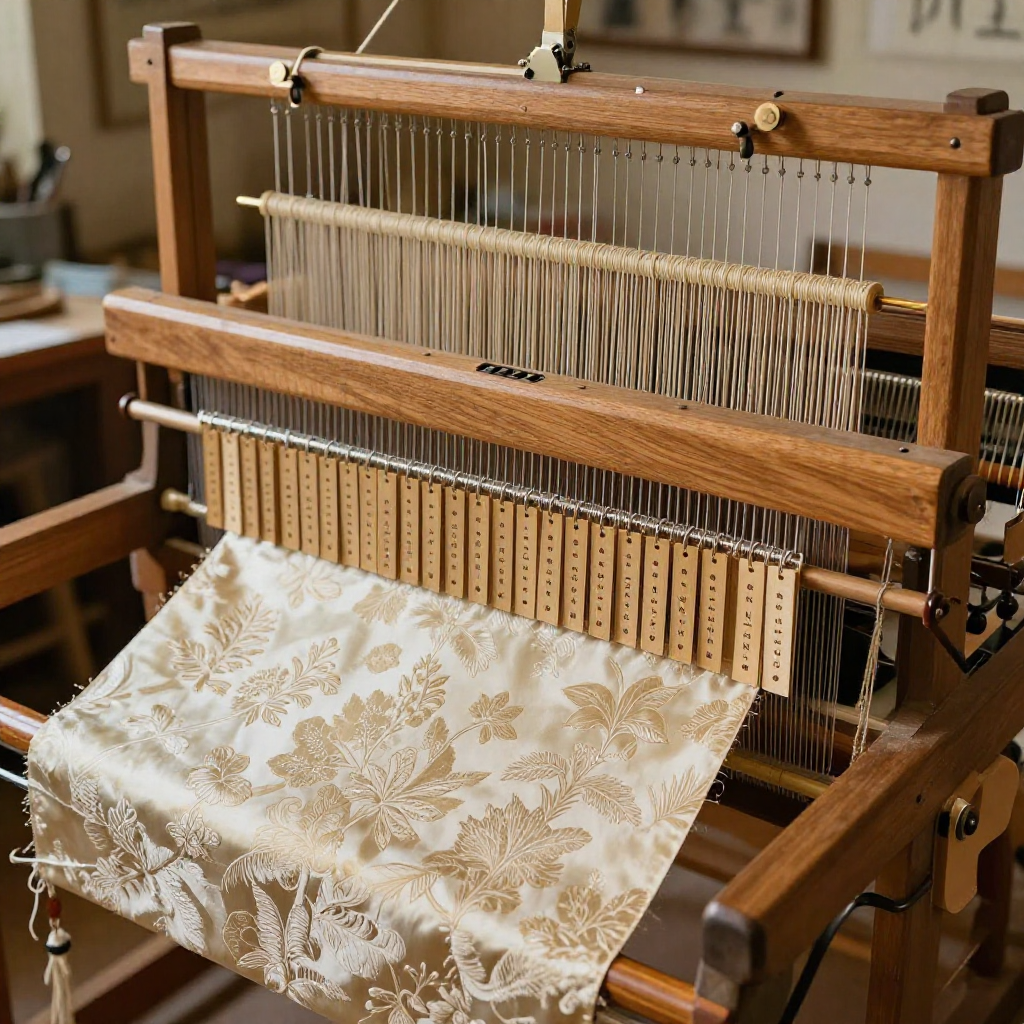
In 1804, Joseph Marie Jacquard of Lyon demonstrated a mechanism that could weave complex figured patterns automatically — brocade, damask, figured silk — without a human drawboy selecting warp threads by hand. The Jacquard mechanism sits on top of a loom and reads a chain of punched cards, each card controlling which warp threads rise for one pass of the shuttle. A hole in the card means 'lift this thread'; no hole means 'leave it down.' The pattern is encoded in cardboard.
Jacquard built on decades of French innovation. Basile Bouchon used a perforated paper tape to control looms in 1725. Jean-Baptiste Falcon replaced the tape with linked cards in 1728. Jacques de Vaucanson automated the selection mechanism with a metal cylinder in the 1740s. Jacquard combined all three ideas into a practical, reliable machine that any weaver could operate. By 1812, there were 11,000 Jacquard looms operating in France alone.
The Jacquard mechanism is often called the first programmable machine. Each punched card is an instruction; the chain of cards is a program; the woven pattern is the output. Charles Babbage studied the Jacquard mechanism closely when designing his Analytical Engine, and Ada Lovelace wrote that the Engine 'weaves algebraical patterns just as the Jacquard loom weaves flowers and leaves.' The punched card survived as a data storage medium into the 1970s. Every computer program descends, conceptually, from a chain of Jacquard cards hanging above a silk loom in Lyon.
Instructions
Design the pattern on point paper
Design the pattern on point paper
Draw the desired woven pattern on point paper — graph paper where each cell represents one intersection of warp and weft. A filled cell means the warp thread passes over the weft (a 'warp float'); an empty cell means the weft passes over the warp (a 'weft float'). Each row of the grid corresponds to one pick (one pass of the shuttle). A simple repeating pattern might need 20–50 rows; a complex pictorial design can require thousands.
Transfer the design to punch cards
Transfer the design to punch cards
Each row of the point paper becomes one punched card. The card has a grid of positions matching the number of hooks on the Jacquard mechanism — typically 200 to 600 positions per card, though large mechanisms reached 1,200. A hole is punched wherever the corresponding warp thread must be lifted for that pick. No hole means the thread stays down. The card is the instruction; the pattern of holes is the program.
Materials for this step:
 Jacquard Punch Cards1 set
Punch the cards with precision
Punch the cards with precision
Place each card on a punching frame and use a hand punch or foot-operated press to cut clean rectangular holes at the marked positions. Every hole must be precisely located — a misplaced hole lifts the wrong thread and creates a visible flaw in the pattern. A skilled card puncher could produce 30–50 cards per hour. Complex figured silks required 10,000 to 24,000 cards for a single repeat.
Lace the cards together into a chain
Lace the cards together into a chain
Bind the punched cards together in sequence by lacing cord through holes at the top and bottom edges of each card. The cards form a continuous loop — after the last card passes through the mechanism, the first card returns. This allows the pattern to repeat indefinitely. Each card must be in the correct order; a single card out of sequence disrupts the entire pattern.
Mount the Jacquard mechanism on the loom
Mount the Jacquard mechanism on the loom
The Jacquard mechanism sits on top of a loom frame, directly above the heddles. It contains a grid of vertical hooks, each connected by a cord (called a 'simple') to one or more warp threads below. A spring-loaded needle corresponds to each hook. The card chain feeds over a perforated cylinder at the front of the mechanism. The entire assembly adds roughly one meter of height to the loom.
Tools needed:
 Jacquard Loom
Prepare the warp beam with fine yarn
Prepare the warp beam with fine yarn
Wind hundreds or thousands of parallel warp threads onto the warp beam. Jacquard weaving typically uses fine, strong yarn — silk was the original fiber in Lyon, though cotton and worsted wool also work. The number of warp ends must match the number of hooks on the Jacquard mechanism. A 400-hook Jacquard with one thread per hook requires 400 warp ends; harness ties can multiply this so each hook controls 2–4 threads for wider fabrics.
Materials for this step:
 Warp Yarn1 kg
Connect warp threads to the Jacquard hooks
Connect warp threads to the Jacquard hooks
Tie each warp thread to its corresponding hook via a cord (the 'simple') that passes through a small eye in a heddle. When the hook rises, it lifts the cord, which lifts the heddle, which lifts the warp thread. This one-to-one connection between hook and thread is what gives the Jacquard its power — every thread is individually addressable, unlike a conventional loom where threads are grouped into shafts.
Pass the warp through the reed
Pass the warp through the reed
Thread each warp end through a dent in the reed, spacing the threads evenly across the weaving width. For fine figured silk, reed densities of 30–60 dents per centimeter are typical. The reed also serves as the beater, pushing each weft pick into place against the fell of the cloth.
Tie the warp to the cloth beam and tension
Tie the warp to the cloth beam and tension
Gather the warp threads into small bundles, tie them to the cloth beam apron, and tension the warp evenly by adjusting the warp beam brake. Consistent tension across all threads is critical — Jacquard weaving produces intricate patterns where tension variations become immediately visible as distortions in the design.
Load the shuttle with weft yarn
Load the shuttle with weft yarn
Insert a bobbin of weft yarn into the shuttle. Figured Jacquard fabrics often use multiple weft colors — brocades may require 3–6 different colored shuttles, changed according to the pattern. For a single-color damask, one shuttle suffices. The weft yarn should be finer and softer than the warp to produce a smooth cloth surface.
Materials for this step:
 Weft Yarn500 g
Engage the mechanism and begin weaving
Engage the mechanism and begin weaving
Start the loom. On each cycle, the perforated cylinder presses the current card against the grid of spring-loaded needles. Where a card has a hole, the needle passes through and its corresponding hook is caught by a rising griffe (lifting bar). Where there is no hole, the needle is pushed back and the hook misses the griffe. The selected hooks rise, lifting their warp threads to form the shed.
Observe the card reading mechanism
Observe the card reading mechanism
Watch the cylinder rotate one position after each pick. The next card presses against the needles, selecting a different set of hooks for the next shed. This is the heart of the Jacquard: binary selection — hole or no hole, lift or don't lift — repeated across hundreds of positions, card after card. Each card is one line of a program; the loom is the processor; the cloth is the output.
Throw the shuttle through the shed
Throw the shuttle through the shed
With the selected warp threads raised, pass the shuttle carrying the weft through the open shed — by hand on early looms, or mechanically with a flying shuttle or power picking mechanism on later Jacquard power looms. The weft lays across the full width, interlacing only with the lowered warp threads. Beat the weft into place with the reed.
Monitor the emerging pattern
Monitor the emerging pattern
After several centimeters of weaving, the pattern becomes visible in the cloth. Check that the design matches the original point paper drawing. Errors indicate either a mispunched card (wrong hole position) or a broken connection between hook and warp thread. A single mispunched card creates a visible horizontal line of errors across the full width — the card must be repunched and replaced in the chain.
Change weft colors for multi-color designs
Change weft colors for multi-color designs
For brocade or tapestry-style Jacquard weaving, switch shuttles to introduce different weft colors at specific points in the pattern. The card chain controls which warp threads rise, but the weaver (or later, an automatic shuttle-changing mechanism) controls which color of weft fills each shed. The combination of programmable warp selection and multiple weft colors produces the richly figured fabrics that made Lyon the silk capital of Europe.
Advance the cloth and replace bobbins as needed
Advance the cloth and replace bobbins as needed
A take-up mechanism winds the finished cloth onto the cloth beam at a controlled rate, maintaining consistent pick density. Replace empty weft bobbins as needed. Jacquard weaving is slower than plain power loom weaving — typically 30–60 picks per minute compared to 100+ for plain cloth — because the card reading and selective shedding take more time per cycle.
Remove the finished figured cloth
Remove the finished figured cloth
When the warp is exhausted or the desired length is reached, stop the loom, cut the warp behind the heddles, and unwind the finished fabric. Jacquard-woven cloth ranges from simple geometric damasks to photorealistic portraits — the famous woven portrait of Jacquard himself, produced in 1839 by Michel-Marie Carquillat, required 24,000 punched cards and is often cited as the most complex mechanical program created before the electronic computer.
Tools needed:
 Sharp Scissors
Understand the Jacquard's dual legacy
Understand the Jacquard's dual legacy
The Jacquard mechanism has two legacies. In textiles, it made complex patterned fabric affordable — designs that once required a master weaver and a drawboy working in concert for weeks could now be produced by a single operator tending a mechanical loom. In computing, it introduced the concept of stored programs on a physical medium. Herman Hollerith adapted punched cards for the 1890 US Census. IBM built its empire on punched card data processing. The line from Jacquard's silk loom to the modern computer is direct and unbroken.
Materials
3- 1 setPlaceholder
- Placeholder
- 500 gPlaceholder
Connected Blueprint Materials
Cartwright's Power Loom — Mechanized Weaving by Steam and Water
by Tex
Textile & Leather
Weaving with a Flying Shuttle — Kay's Invention That Launched the Textile Revolution
by Tex
Textile & Leather
Crompton's Spinning Mule — The Machine That Made Fine Cotton Possible
by Tex
Textile & Leather
Related Blueprints
These blueprints share knowledge with this one — techniques, materials, or principles that connect them in the learning graph.

CC0 Public Domain
This blueprint is released under CC0. You are free to copy, modify, distribute, and use this work for any purpose, without asking permission.
Support the Maker by purchasing products through their Blueprint where they earn a Maker Commission set by Vendors, or create a new iteration of this Blueprint and include it as a connection in your own Blueprint to share revenue.