ART
BEAUTY & WELLNESS
CRAFT
CULTURE & HISTORY
ENTERTAINMENT
ENVIRONMENT
FOOD & DRINKS
REVERSE ENGINEERING
SCIENCES
SPORTS
TECHNOLOGY
WEARABLES
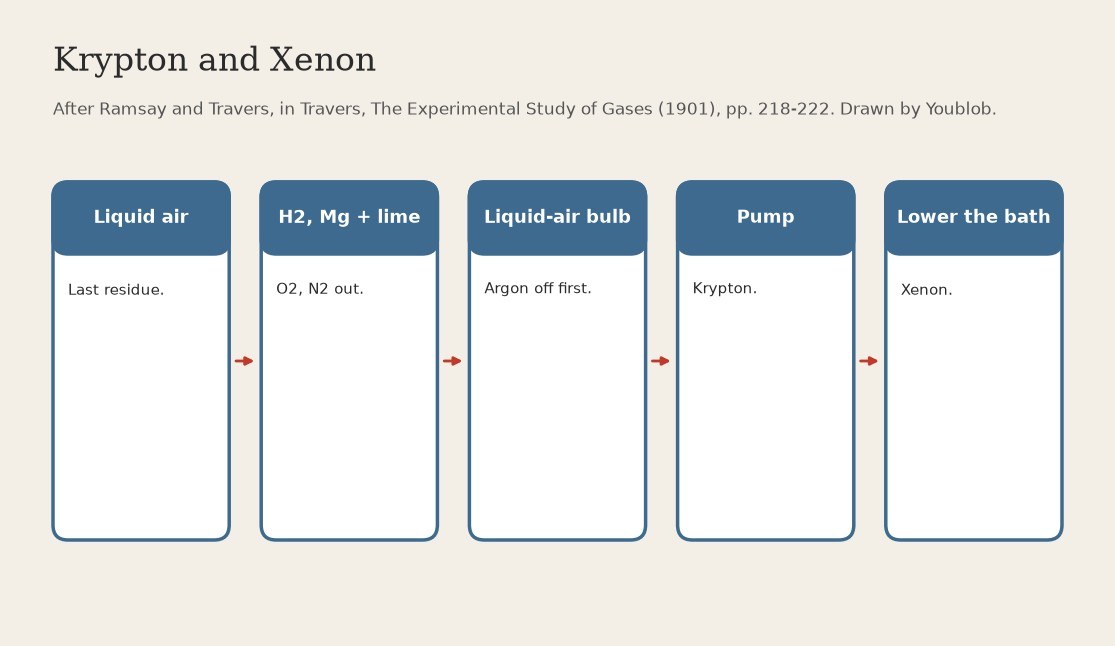


Krypton and Xenon: Liquid-Air Residues Cleaned and Fractionated at the Temperature of Liquid Air (Ramsay and Travers, 1901)
When liquid air boils away, the heavy noble gases stay in the last of it. Ramsay and Travers took that residue, stripped out the oxygen and nitrogen, and separated what was left by condensing it in liquid air and letting it boil off in fractions: argon first, then krypton, and xenon last of all.
Result: krypton and xenon gases (a litre of liquid air gives at most 0.1-0.2 cc of xenon).
Source: M. W. Travers, The Experimental Study of Gases (1901), pp. 218-222. Hydrogen is flammable; liquid air is very cold. Picture drawn by Youblob.
Advanced
2 weeks
Instructions
1
1
Collect the last of the liquid air
Collect the last of the liquid air
Let liquid air evaporate quietly in a vacuum vessel. The last of it is nearly all oxygen with some nitrogen, argon, krypton and xenon; evaporate it into a gasholder. Work from much liquid air: one litre gives at best 0.1-0.2 cc of xenon.
Materials for this step:
 Liquid Air1 many litres
Tools needed:
 Vacuum Vessel (Dewar)
 Gasholder
2
2
Strip out oxygen and nitrogen
Strip out oxygen and nitrogen
Pass the gas with hydrogen through a heated iron tube to remove the oxygen. Absorb the nitrogen with a mixture of magnesium and lime. Pass it over heated copper oxide to take out traces of carbon monoxide and hydrogen, then treat it with soda solution. Ours: a tube furnace for the heating.
Tools needed:
 Hydrogen
 Iron Tube
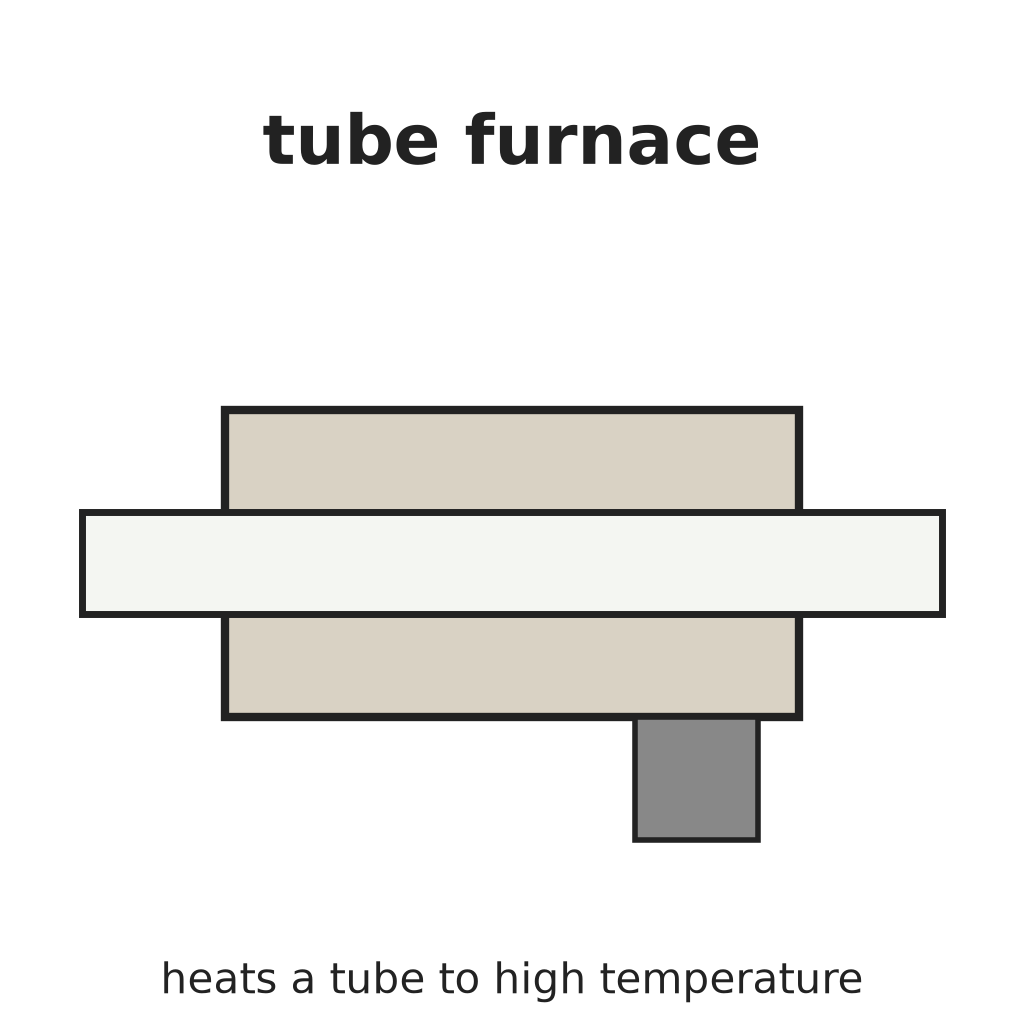 Tube Furnace
 Magnesium
 Quicklime
 Copper Oxide
 Sodium Hydroxide SolutionGasholder
3
3
First fractionation
First fractionation
Condense the gas in a bulb cooled by liquid air. Let the first part, mostly argon, boil off into a gasholder; collect the rest. Take the last traces off with the pump while the liquid-air vessel is lowered, so the xenon comes too. Travers got about 300 cc of heavy gas.
Tools needed:
 Glass TubeLiquid AirVacuum Vessel (Dewar)
 Vacuum PumpGasholder
4
4
Refractionate
Refractionate
Condense and boil off again in six equal portions, throwing away the argon-rich first ones, and repeat, guided by the spectroscope. Let the liquid-air surface just touch the bottom of the bulb while the gas goes in, then immerse it; take every fraction off through the pump. Krypton has a vapour pressure of no more than 150 mm at this temperature; xenon hardly any.
Tools needed:
Glass TubeLiquid AirVacuum Vessel (Dewar)Vacuum Pump Handheld Spectroscope
5
5
Part krypton from xenon
Part krypton from xenon
Condense the mixed gas and pump off everything that will come: that is krypton. Then lower the liquid air and collect the xenon. Repeat on each part several times, since krypton hides in the solid xenon.
Tools needed:
Glass TubeLiquid AirVacuum Vessel (Dewar)Vacuum PumpGasholderMaterials
1- 1 many litresPlaceholder
Tools Required
13- Placeholder
- Placeholder
- Placeholder
- Placeholder
- Placeholder
- Placeholder
- Placeholder
- Placeholder
- Placeholder
- Placeholder
- Placeholder
- 1 vendor sell this, none ship to you yetPlaceholder
- Placeholder
This blueprint makes


Related Blueprints
These blueprints share knowledge with this one — techniques, materials, or principles that connect them in the learning graph.

CC0 Public Domain
This blueprint is released under CC0. You are free to copy, modify, distribute, and use this work for any purpose, without asking permission.
Support the Maker by purchasing products through their Blueprint where they earn a Maker Commission set by Vendors, or create a new iteration of this Blueprint and include it as a connection in your own Blueprint to share revenue.