ART
BEAUTY & WELLNESS
CRAFT
CULTURE & HISTORY
ENTERTAINMENT
ENVIRONMENT
FOOD & DRINKS
REVERSE ENGINEERING
SCIENCES
SPORTS
TECHNOLOGY
WEARABLES
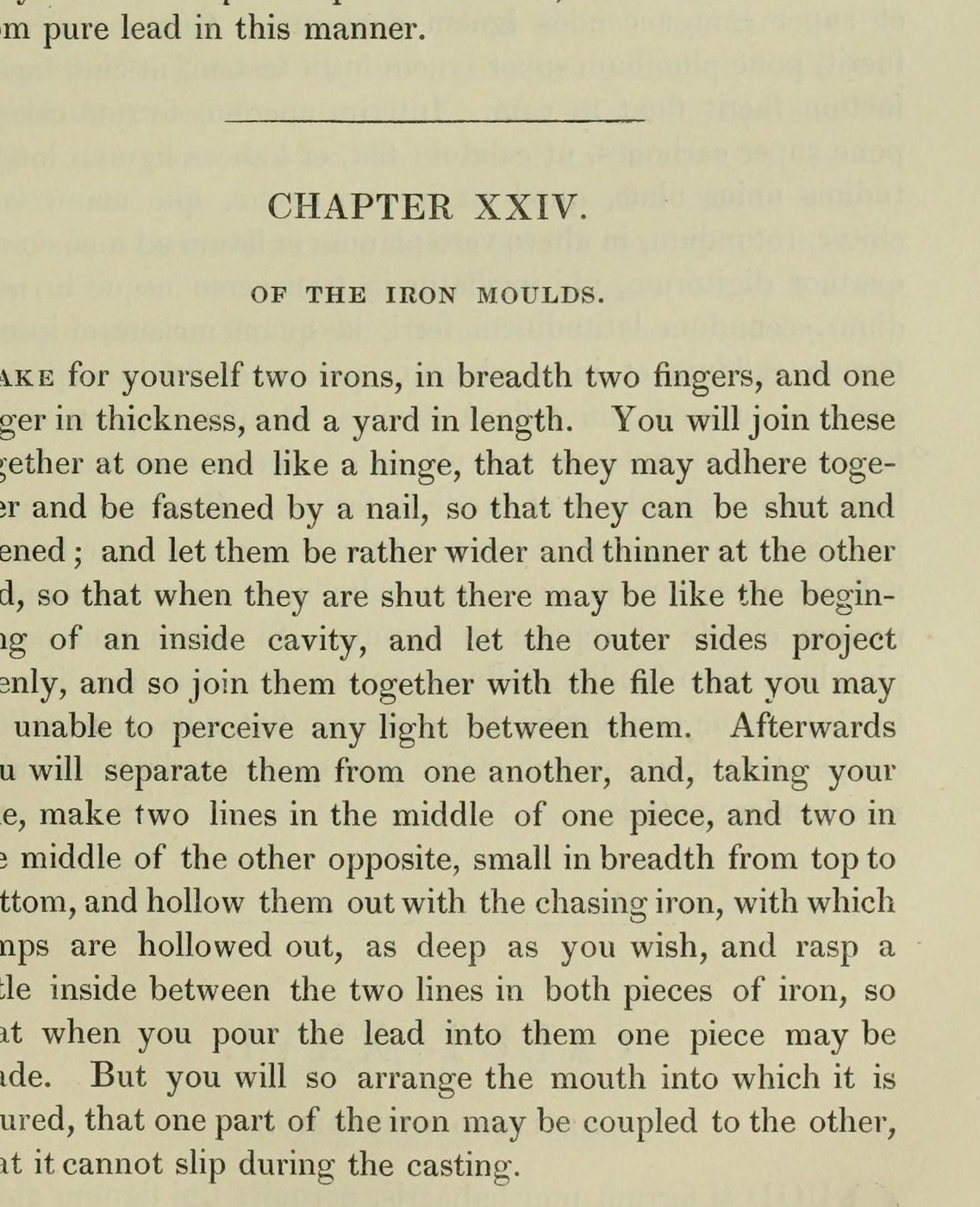


Lead Came Mould: Two Hinged Grooved Irons (Theophilus, tr. Hendrie 1847)
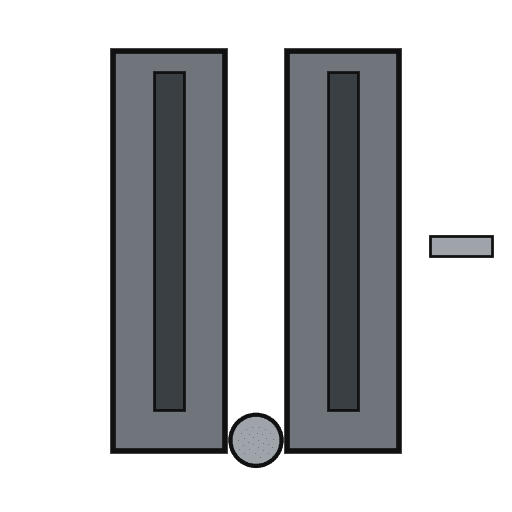
The iron mould in which Theophilus cast the lead rods of glass windows: two irons a yard long, hinged at one end with a nail, filed to close without a chink of light, with a matching groove hollowed down the middle of each so the lead poured in makes one rod.
The free ends are made a little wider and thinner to form a pouring mouth, and the two halves are keyed so they cannot slip while casting.
Source: Theophilus, De Diversis Artibus, Book II, ch. XXIV, tr. R. Hendrie (1847), p. 147. Picture: the chapter.
Intermediate
Unknown
Instructions
1
1
Hinge the irons
Hinge the irons
Take two irons two fingers broad, one finger thick and a yard long. Join them at one end like a hinge, fastened by a nail, so they open and shut. Make the other ends a little wider and thinner, so that when shut they form the start of a cavity (the pouring mouth). Not given: how the hinge is formed.
Materials for this step:
 Wrought Iron Bars2 2 fingers x 1 finger x 1 yard
 Nails1 hinge pin
Tools needed:
 Hammer
2
2
Fit the faces
Fit the faces
Let the outer sides lie even, and file the two faces together until no light shows between them when closed.
Tools needed:
 Metal File
3
3
Cut the grooves
Cut the grooves
Open the irons. With a rule, draw two narrow lines down the middle of each piece, facing each other, from top to bottom. Hollow out between them with the chasing iron used for hollowing lamps, as deep as you wish, and rasp a little inside so the lead poured in makes one piece. Key the mouth so one half cannot slip on the other while casting.
Tools needed:
 Ruler
 Rasp
Materials
2- 2 2 fingers x 1 finger x 1 yardPlaceholder
- 1 hinge pinPlaceholder
This blueprint makes
CC0 Public Domain
This blueprint is released under CC0. You are free to copy, modify, distribute, and use this work for any purpose, without asking permission.
Support the Maker by purchasing products through their Blueprint where they earn a Maker Commission set by Vendors, or create a new iteration of this Blueprint and include it as a connection in your own Blueprint to share revenue.