ART
BEAUTY & WELLNESS
CRAFT
CULTURE & HISTORY
ENTERTAINMENT
ENVIRONMENT
FOOD & DRINKS
REVERSE ENGINEERING
SCIENCES
SPORTS
TECHNOLOGY
WEARABLES
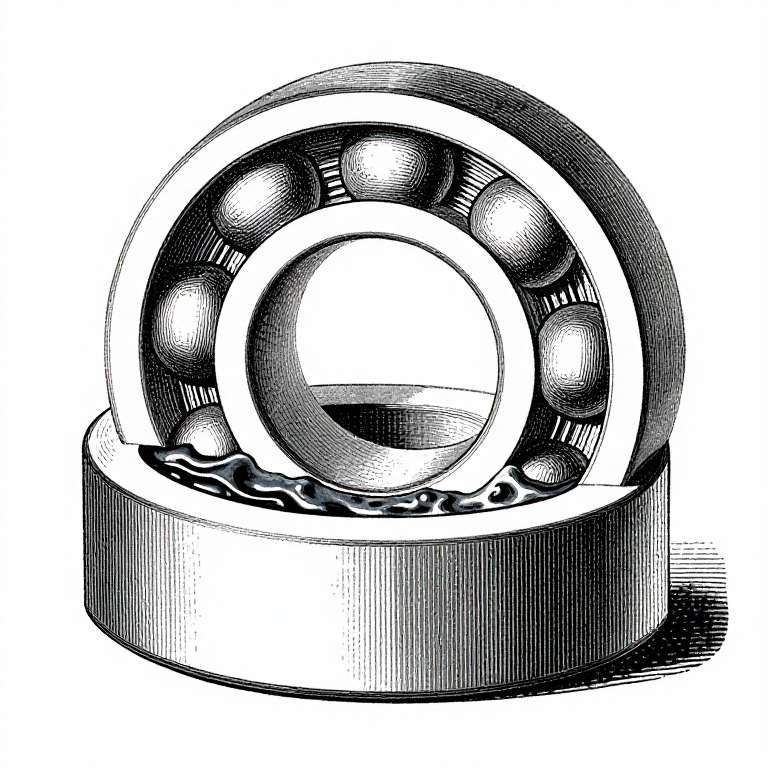


Lubrication: The Film Does the Work, and More Grease Is Not More Lubrication
Lubricant does not make surfaces slippery. It keeps them APART — a film thick enough that the peaks on one surface never touch the peaks on the other, so there is no metal-to-metal contact to wear.
In a plain bearing that film is built by the rotation itself: the shaft drags oil into a narrowing wedge and the pressure that generates lifts the shaft off the bearing. A plain bearing running properly has no contact at all, and that is why it can last decades.
Which explains the two commonest failures. A film too thin lets the peaks touch, and a bearing PACKED full of grease has nowhere to shed the heat its own churning generates — so it overheats. Both are cured by the right amount, not by more.
Intermediate
2 hours
Instructions
1
1
Pick the viscosity for the speed and the load
Pick the viscosity for the speed and the load
Thicker oil makes a thicker film, which is what a heavy load needs. Thicker oil also churns harder, which generates heat — and heat thins the oil again.
So the rule of thumb runs the way people find surprising: HIGH speed and light load want THINNER oil, low speed and heavy load want thicker. A thick oil in a fast bearing is not extra protection, it is extra heat.
Temperature is the other half. Oil viscosity falls steeply with temperature, so a grade chosen at room temperature may be far too thin at operating temperature. Viscosity grades are quoted at a stated temperature for that reason, and comparing two oils at different temperatures compares nothing.
Tools needed:
 Calculator
2
2
Grease is oil held in a sponge
Grease is oil held in a sponge
Grease is base oil plus a thickener — usually a metallic soap — that holds it in place. The thickener does not lubricate; it is a reservoir that releases oil slowly, which is why grease works where oil would simply run out.
So the important property of a grease is its BASE OIL viscosity, not how stiff it feels. Two greases of the same apparent thickness can have base oils differing tenfold, and it is the base oil that makes the film.
Do not mix greases. Different thickeners can be chemically incompatible, and the mixture often turns to a liquid that runs straight out of the bearing — which looks exactly like a seal failure and is not.
Tools needed:
 Nitrile Rubber Gloves
3
3
How much: a third full, not full
How much: a third full, not full
Fill the bearing's free space about one third, and no more than half. The rest is room for the grease to be flung clear of the rolling elements and to let air carry heat away.
A bearing packed solid has to churn grease continuously. That churning is work, work becomes heat, and the heat has nowhere to go — so an over-greased bearing runs far hotter than a correctly greased one and fails sooner.
Slow bearings can take more, fast ones want less. A bearing at a few hundred revolutions per minute tolerates being fuller; one at several thousand wants a quarter fill at most, and above that region oil mist or oil bath replaces grease entirely.
Tools needed:
Nitrile Rubber Gloves Precision Scale
4
4
Relubricate on a schedule, and purge the old
Relubricate on a schedule, and purge the old
Grease ages. The oil bleeds out, oxidises, and picks up wear particles and moisture, so even a sealed bearing has a grease life — and it is usually shorter than the bearing's own.
Where there is a grease nipple, add a small amount regularly rather than a large amount rarely, and let the old grease PURGE out of the relief. A housing with no relief simply fills up, and then the pressure pushes the seals out.
Write the dates down. Lubrication is the maintenance task most often skipped and most often blamed afterwards, and a line in a log turns "I think we did it in the spring" into a fact — the notebook rung applied to a machine.
Materials for this step:
 Degreaser (Citrus-Based)1 piece
Tools needed:
Nitrile Rubber GlovesMaterials
1- 1 piecePlaceholder
Tools Required
3- Placeholder
- Placeholder
- Placeholder
Related Blueprints
These blueprints share knowledge with this one — techniques, materials, or principles that connect them in the learning graph.
CC0 Public Domain
This blueprint is released under CC0. You are free to copy, modify, distribute, and use this work for any purpose, without asking permission.
Support the Maker by purchasing products through their Blueprint where they earn a Maker Commission set by Vendors, or create a new iteration of this Blueprint and include it as a connection in your own Blueprint to share revenue.