ART
BEAUTY & WELLNESS
CRAFT
CULTURE & HISTORY
ENTERTAINMENT
ENVIRONMENT
FOOD & DRINKS
REVERSE ENGINEERING
SCIENCES
SPORTS
TECHNOLOGY
WEARABLES
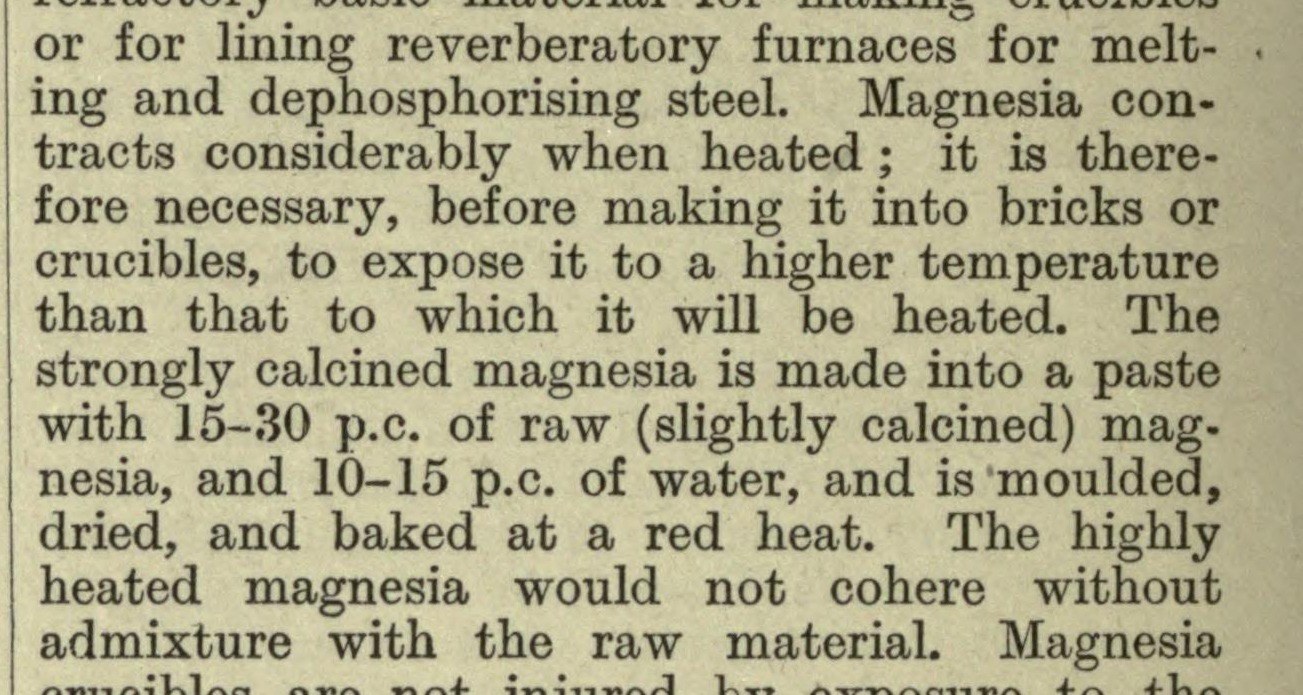


Magnesia Crucible: Strongly Calcined Magnesia Bound with Raw Magnesia and Baked at a Red Heat (Thorpe 1912)
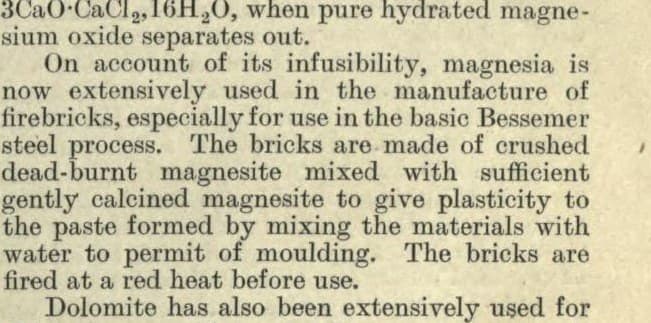
A magnesia crucible is a pot of magnesia, a basic refractory. Thorpe's Dictionary of Applied Chemistry (1912) gives the recipe introduced by Caron: magnesia shrinks a great deal when heated, so it is first calcined hotter than it will ever be used, then bound with 15-30 per cent of raw, slightly calcined magnesia and 10-15 per cent of water, moulded, dried and baked at a red heat.
He gives no calcining temperature, mould or size; those are unknown here.
Source: Thorpe, Dictionary of Applied Chemistry vol. II (1912), CRUCIBLES, p. 170. Picture: that passage.
Intermediate
Two to three days
Instructions
1
1
Read Thorpe
Read Thorpe
"The highly heated magnesia would not cohere without admixture with the raw material."
2
2
Calcine most of the magnesia hard
Calcine most of the magnesia hard
Magnesia contracts considerably when heated, so before making it into a crucible expose it to a higher temperature than the crucible will meet in use. The temperature itself is not given. Keep back a part of the magnesia only slightly calcined.
Materials for this step:
 Magnesium Oxide1 as required
Tools needed:
 Kiln
 Heat-Resistant Gloves
3
3
Make the paste
Make the paste
Grind the strongly calcined magnesia and mix it with 15-30 per cent of the raw (slightly calcined) magnesia and 10-15 per cent of water into a paste. The raw part is what makes it hold together.
Materials for this step:
 Water1 10-15 per cent
Tools needed:
 Mortar & Pestle
 Precision Digital Scale
 Dust Mask
4
4
Mould the crucible
Mould the crucible
Mould the paste into crucibles. Thorpe does not describe the mould or give sizes (unknown).
Tools needed:
 Unknown Material
 Unknown Dimensions
5
5
Dry and bake
Dry and bake
Dry the crucibles, then bake them at a red heat. Thorpe notes that magnesia crucibles are not harmed by standing in the air.
Tools needed:
KilnHeat-Resistant Gloves6
6
History and honest limits
History and honest limits
Thorpe credits Caron with introducing magnesia for crucibles and for lining reverberatory furnaces in which steel was melted and dephosphorised. He also lists magnesia-bauxite crucibles (Gaudin) and calcined magnesite with a boron compound (Rawson and Littlefield, 1900).
The calcining temperature, the mould, the size and the drying are not given; the tools are ours.
Tools Required
7- Placeholder
- Placeholder
- Placeholder
- Placeholder
- Placeholder
- Placeholder
- Placeholder
This blueprint makes
Related Blueprints
These blueprints share knowledge with this one — techniques, materials, or principles that connect them in the learning graph.
CC0 Public Domain
This blueprint is released under CC0. You are free to copy, modify, distribute, and use this work for any purpose, without asking permission.
Support the Maker by purchasing products through their Blueprint where they earn a Maker Commission set by Vendors, or create a new iteration of this Blueprint and include it as a connection in your own Blueprint to share revenue.