
Beauchamp-Feuillet Notation
How do you write a dance down on a sheet of paper? Music had its staff for centuries. Dance passed from body to body, and vanished with the master who knew it.
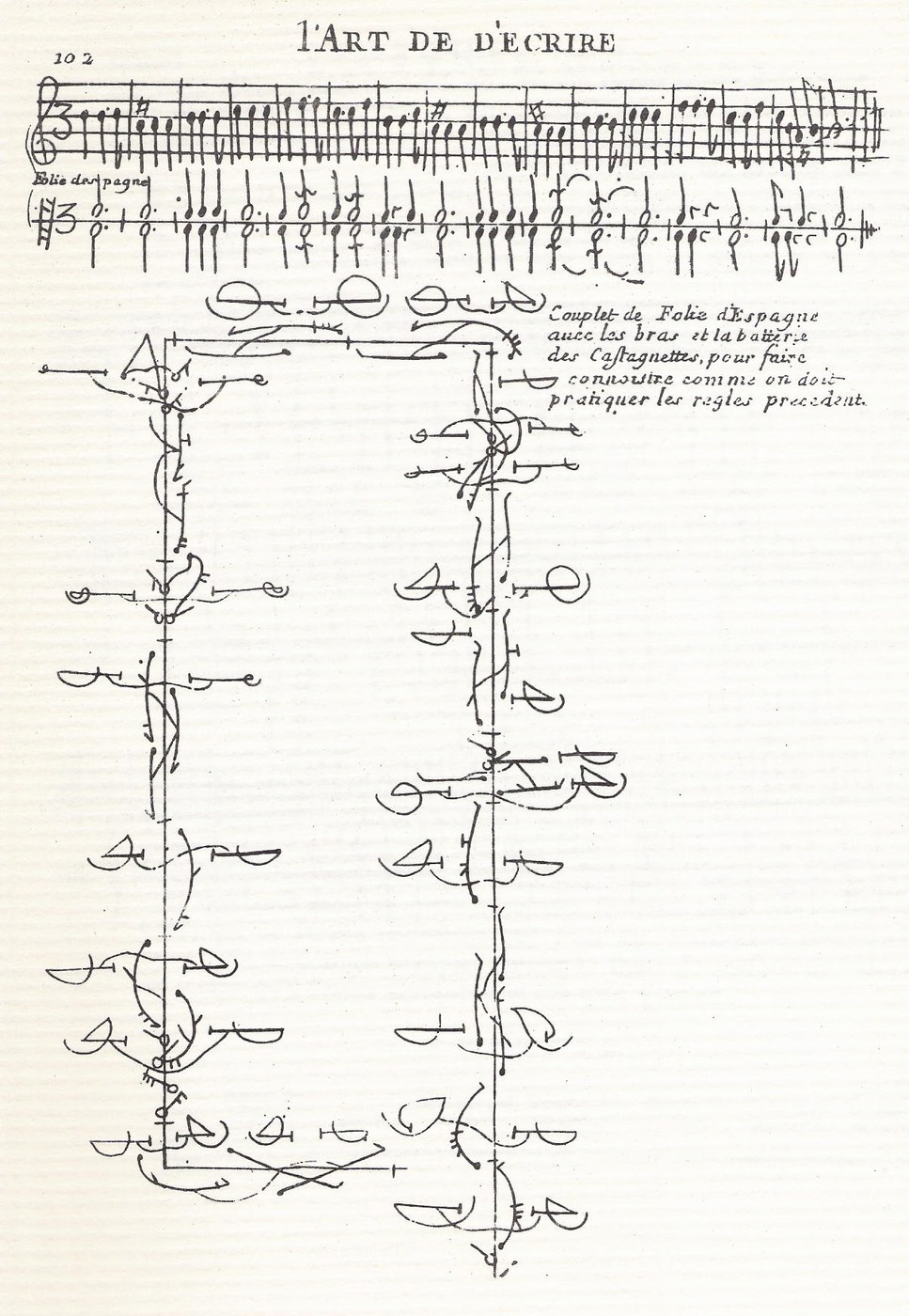
The answer found at the court of Louis XIV is unusually elegant: you do not draw the dancer, you draw the path they travel across the floor. This is the tract, a line seen from above, like a plan. The steps hang along that line, the music is printed across the top of the page, and the bar lines cut across the tract — so you see at a glance which step falls on which beat.
This is not an archival exercise. More than three hundred dances have reached us solely through this system. Without it we would not know how people danced in 1700 — we would have paintings and words, and nothing else.
Instructions
Set the page up as a plan seen from above
Set the page up as a plan seen from above
Take a sheet in portrait orientation. The whole page represents the floor of the room, seen from overhead. Nothing is drawn in profile.
Materials for this step:
 Watercolour Paper1 sheet
Tools needed:
 Journaling Pen Set (Acid-Free, 8 Colors)
Mark the presence at the top of the page
Mark the presence at the top of the page
The top of the page is the king's side — the presence. Write it out. Every direction in the dance is read against that point, never against the dancer.
Reserve the top for the musical staff
Reserve the top for the musical staff
Reserve a band across the top of the page and copy the melody there on an ordinary staff. This is one of the system's real inventions: the musician reads their usual page, directly above the dance.
Tools needed:
 Metal Ruler (30cm)
Draw the dancer's path
Draw the dancer's path
Draw the tract: a continuous line starting at the opening position and following the travel across the floor. Straight for a straight passage, curved for a contour.
Place both dancers and their facing
Place both dancers and their facing
Mark each dancer's starting position and the direction they face. The figure must say immediately who is where, and facing what.
Cut the tract with the bar lines
Cut the tract with the bar lines
Draw a short stroke across the tract at every bar line in the music. This is what synchronises foot and note: you can see exactly where the dancer is at each measure.
Draw the step sign against the line
Draw the step sign against the line
Each step is drawn as a short stroke perpendicular to the tract, with a mark at the end for the foot. Which side of the tract it sits on tells you which leg works: right of the line for the right foot, left for the left.
Notate the five true positions
Notate the five true positions
Learn the foot positions first — the five so-called true positions, which Feuillet sets out before anything else, then the false positions. The whole step vocabulary starts there.
Add the six leg movements
Add the six leg movements
Six movements attach to the step sign: plié, relevé, sauté, cabriole, tombé, glissé. Each has its own mark, added to the stroke of the leg concerned.
Distinguish the four families of step
Distinguish the four families of step
A step is straight, circular, waving or beaten, and the drawing of the sign shows which. It is the same logic as a musical note: the shape of the sign carries the information, not a caption.
Notate a complete pas de bourrée
Notate a complete pas de bourrée
Write out a pas de bourrée: a plié, then three transfers of weight along the tract, spread across one measure. Check that all three signs fit between two bar lines.
Continue for eight measures
Continue for eight measures
Carry the tract on for eight measures, keeping the spacing between bar lines even. A tract with irregular measures reads badly even when it is correct.
Mark the arms and the joined hands
Mark the arms and the joined hands
Add the arm signs where they matter, and show the moments when the dancers take and release hands. Without that, a dance for two becomes unreadable.
Have someone else read the page
Have someone else read the page
The real test: hand the sheet to someone who has not seen the dance and ask them to walk it on the floor. Whatever they cannot recover is what your notation failed to say.
History & Context
History & Context
A royal commission. The system was devised in the 1680s at the court of Louis XIV, commissioned by the king, by Pierre Beauchamp. He never published it. It was Raoul-Auger Feuillet who described and printed it in 1700 in Chorégraphie, ou l'art de décrire la danse.
The 1704 lawsuit. Beauchamp took Feuillet to court, arguing that the invention was his. He lost for want of proof — he had published nothing. The judgment is instructive: in the history of technique it is publication that fixes authorship, not priority. The modern name, Beauchamp-Feuillet notation, does justice to both: Feuillet is generally held not to be the inventor, but the man who documented, published and probably adapted the system.
What it saved. More than three hundred dances survive in this notation. It is by far the principal source on baroque dance: without it there would be only written descriptions and still images, from which no sequence can be deduced. The system stayed in use, in modified forms, into the 1780s.
Its limits, honestly. The notation describes the feet above all. Arms are treated thinly, the upper body barely at all, and style — the quality of movement, what separates a good dancer from an accurate one — escapes the paper entirely. Modern reconstructions therefore also lean on the written treatises of the period, such as Kellom Tomlinson's. A notation says what must be done; it does not say how it should be beautiful.
And the word. Feuillet's title gave French, and then every other language, the word choreography — which meant, literally and at the start, the art of writing dance down. The sense drifted toward composition itself; the writing stayed an unsolved problem, and every century since has proposed a system of its own.
Materials
1- 1 sheetPlaceholder
Tools Required
2- Placeholder
- Placeholder
CC0 Public Domain
This blueprint is released under CC0. You are free to copy, modify, distribute, and use this work for any purpose, without asking permission.
Support the Maker by purchasing products through their Blueprint where they earn a Maker Commission set by Vendors, or create a new iteration of this Blueprint and include it as a connection in your own Blueprint to share revenue.