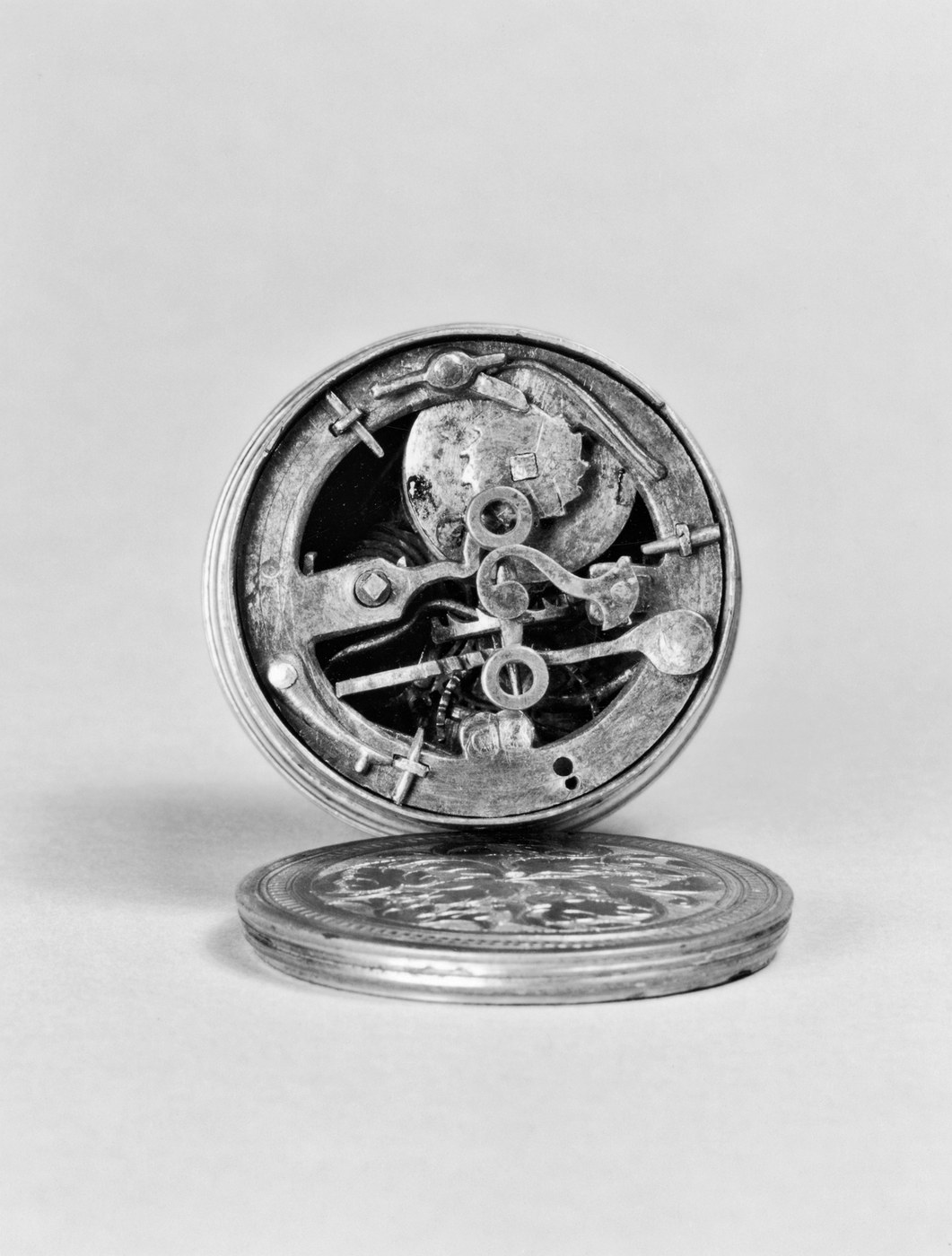

Nuremberg Egg
A watch worn round the neck has no weight to drive it. It needs a spring — and that is where the real problem starts: a wound spring pushes hard at the beginning and weakly at the end. The watch runs fast in the morning and slow by evening.
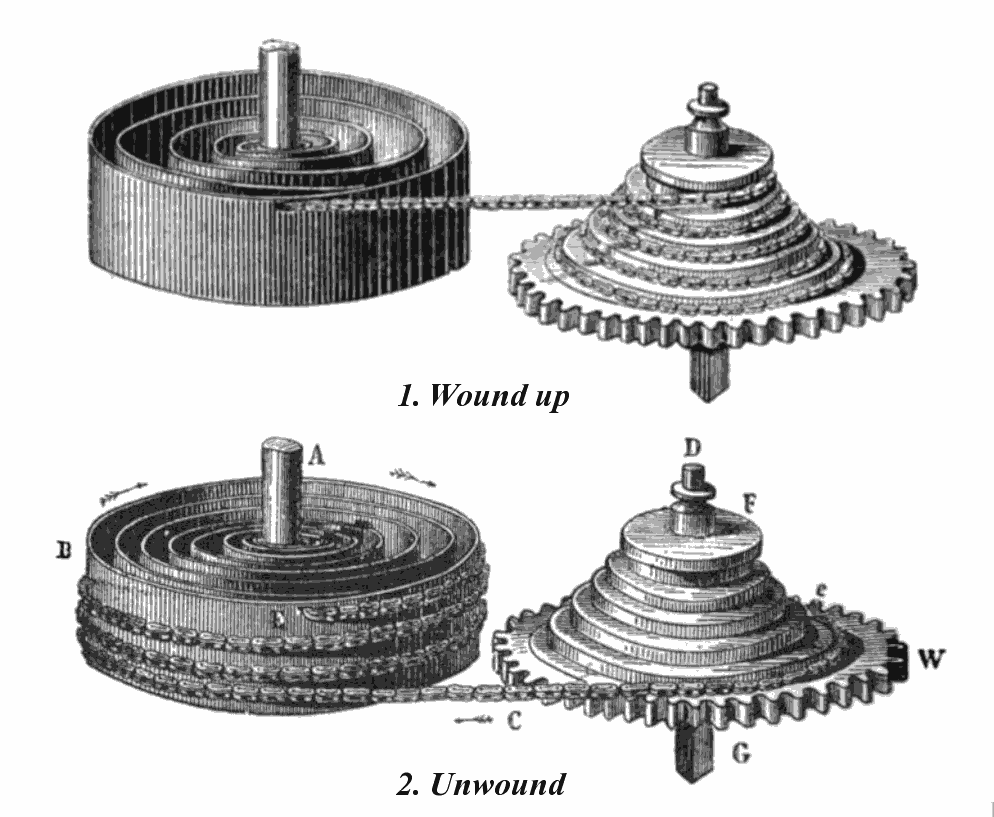
Nuremberg solved it with the stackfreed — a snail-shaped cam with a spring-loaded roller working against the mainspring: heavy opposition at the start, almost none at the finish. Nowhere else built it this way. Elsewhere the fusee with its chain won out, and in the end it won here too.
This is watchmaking, not a craft afternoon. Taken seriously it means a working movement with a verge escapement, a spring barrel and a stackfreed — and one hand, as the sixteenth century had it.
Instructions
Saw two brass plates
Saw two brass plates
Saw two round plates from 1.5 mm brass, 45 mm across. Pin them together and ream them as a pair so every hole lines up through both.
Materials for this step:
 Brass Sheet1 piece
Tools needed:
 Piercing Saw
 Needle File Set
Turn and fit the pillars
Turn and fit the pillars
Turn four brass pillars 8 mm tall and join the plates with them. The spacing sets the overall height of the movement.
Materials for this step:
 Brass Rod1 piece
Turn the spring barrel
Turn the spring barrel
Turn a barrel 22 mm across with a lid and an arbor. The arbor takes the inner end of the mainspring, the wall the outer.
Fit the mainspring
Fit the mainspring
Lay in a hardened steel spring and secure both ends. Goggles on — a spring that escapes while you are fitting it travels unchecked.
Tools needed:
 Safety Goggles
Cut the stackfreed cam
Cut the stackfreed cam
Cut an eccentric cam in a snail shape with a groove in its edge for the roller. It makes exactly one revolution over the whole running period.
Mount the gear on the cam
Mount the gear on the cam
Fit a gear to the cam, driven by a gear on the barrel arbor. The ratio is what makes one turn of the cam equal one full run of the watch.
Make the spring arm and roller
Make the spring arm and roller
Bend a stiff spring arm with a small roller at its end. The roller rides the groove: the wide part of the cam at the start, the narrow part at the end.
Set the opposing force
Set the opposing force
Adjust the arm so it opposes the mainspring strongly at the beginning and barely at all by the end. That is the entire point of the stackfreed — to keep the force reaching the train constant.
Calculate and cut the train
Calculate and cut the train
Work out the wheels and pinions so the hand turns once in twelve hours, then cut the teeth. An arithmetic error only shows itself in the finished movement.
Fit the verge and crown wheel
Fit the verge and crown wheel
Set the crown wheel vertically and mount the verge across it on its two pallets. The pallets enter the teeth alternately — this is the verge escapement, the same mechanism that had run tower clocks since the thirteenth century.
Fit the balance or foliot
Fit the balance or foliot
Put a foliot or a plain balance on the verge. With no hairspring it has no natural period of its own — the rate depends entirely on the force fed to it, which is exactly why the stackfreed is needed at all.
Make a dial with one hand
Make a dial with one hand
Make a dial divided into hours and fit one hand. At this accuracy a minute hand would be a lie.
Raise the case as a drum
Raise the case as a drum
Raise a cylindrical brass case with a lid and true up the rim. The early Nuremberg watches are drum watches — flat ones for wearing on a cord, taller ones for the table or a purse.
Pierce the lid
Pierce the lid
Pierce the lid so the hour can be read without opening it. The pattern is ornament and function at once.
Measure the rate over a day
Measure the rate over a day
Wind it and check it against a modern clock over 24 hours. Write down how far it gains at the start and loses at the end, with the stackfreed set and with it slackened off. That difference is the whole experiment.
History & Context
History & Context
Peter Henlein — and what is wrongly credited to him. Henlein worked in Nuremberg and was making portable clock-watches around 1505–10; his part in the rise of the Nuremberg neck-watch trade is not in doubt. The famous "Henlein watch" in the Germanisches Nationalmuseum is another matter: the signature carrying the date 1510 is a later forgery, running across older scratches, and examination under raking light and computed tomography shows that many of the parts did not originally belong together. Henlein died in 1542.
The "eggs" came after him. The oval, egg-shaped drum watch only becomes common from about 1580, and the earliest examples date to around 1550 — after Henlein's death. He cannot have originated the Nuremberg egg, and the popular story that he invented it is simply wrong on that point.
Where the name comes from. Probably not from eggs at all. "Eierlein" appears to be a corruption of Uhr by way of Middle Low German forms such as Aeurlein or Ueurlein, with Johann Fischart's 1571 translation of Rabelais somewhere in the chain. So it is possible that the name came first and the oval shape followed it, rather than the other way round.
Three forms. Early sixteenth-century Nuremberg produced tall cylindrical drum watches for a table or a purse, flat drum watches worn on a cord round the neck, and spherical watches built into pomanders. The pocket watch in the modern sense is later — clothing barely had pockets yet.
Stackfreed against fusee. The name probably comes from starke Feder, strong spring. Surviving stackfreed timepieces date from roughly 1530 to 1640 and are almost exclusively German. It generates a great deal of friction and cuts the running time substantially, and it was abandoned after about a century. The fusee won: a conical pulley with a chain to the barrel, changing the leverage as the spring unwinds and equalising the force far more cleanly. The stackfreed is the solution that lost — which is precisely why it is worth building and measuring one yourself.
Tools Required
3- Placeholder
- Placeholder
- Placeholder
Connected Blueprint Materials

This blueprint makes
CC0 Public Domain
This blueprint is released under CC0. You are free to copy, modify, distribute, and use this work for any purpose, without asking permission.
Support the Maker by purchasing products through their Blueprint where they earn a Maker Commission set by Vendors, or create a new iteration of this Blueprint and include it as a connection in your own Blueprint to share revenue.