ART
BEAUTY & WELLNESS
CRAFT
CULTURE & HISTORY
ENTERTAINMENT
ENVIRONMENT
FOOD & DRINKS
REVERSE ENGINEERING
SCIENCES
SPORTS
TECHNOLOGY
WEARABLES
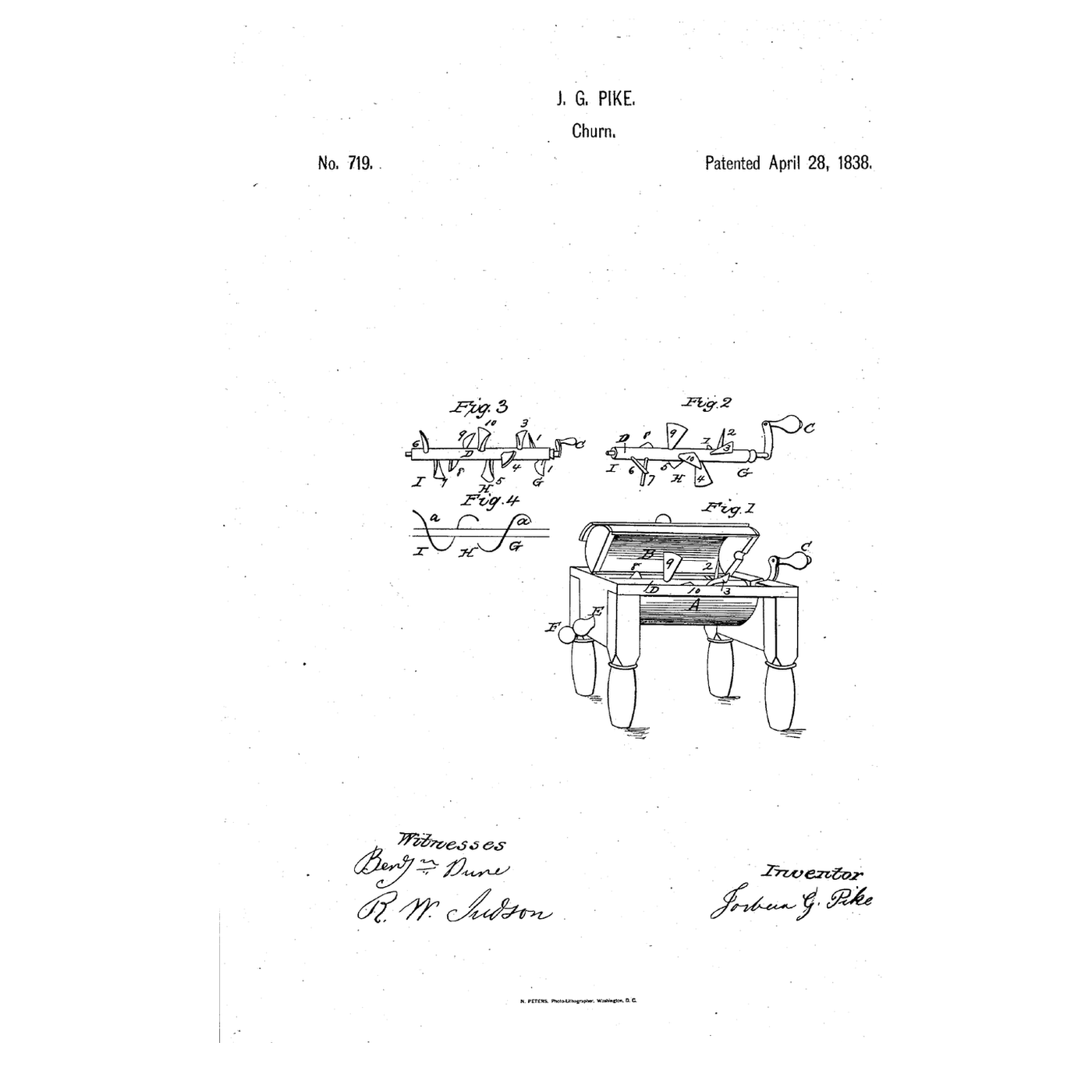


Oblique-Paddle Churn: Turn One Way to Gather the Butter, Back to Spread It
Once the butter comes, it has to be gathered from the whey, then worked and salted by hand.
Joshua G. Pike of Lisbon, New York, received US 719, dated 28 April 1838, for a machine for churning and working butter: a horizontal cylinder with paddles set obliquely round its shaft, "so arranged that by turning the shaft in one direction the butter will be collected into one place in the center of the churn and thus separated from the whey while by reversing the motion it will be again spread over the internal surface of the cylinder and prepared for salting."
This rung works out the butter a batch gives, then prints the paddle hubs, builds a tabletop cylinder churn, and makes butter.
Intermediate
About 4 hours, plus printing
Instructions
1
1
Butter yield and paddle push
Butter yield and paddle push
Loading Jupyter Notebook...
2
2
The churning it does
The churning it does
The embedded blueprint makes butter by agitating cream. Pike sets the paddles so the same churn also gathers and works the butter.
3
3
Read US 719
Read US 719
"When formed the butter is successively struck by the paddles 1, 2, 3, 4 and 5, (see Figs. 2 and 3) in their revolution and by their oblique position moved toward the center of the churn from G to H. At the same time and by the same operation the paddles 6, 7, 8, 9 and 10 sloping in the opposite direction from those first mentioned move the butter in the opposite direction viz. from I to H."
4
4
Print the paddle hubs
Print the paddle hubs
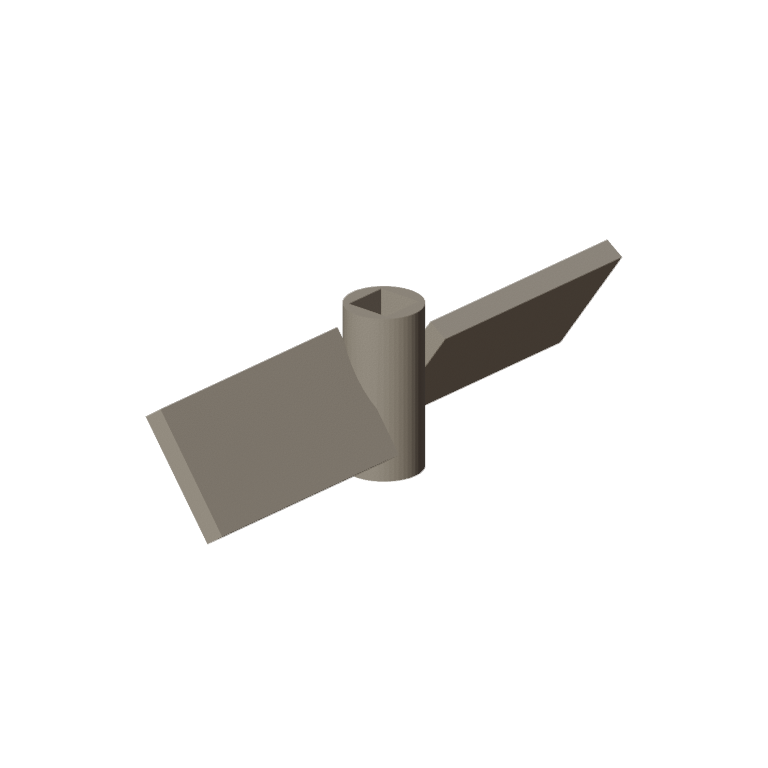
Print two right-hand hubs (/uploads/blueprints/oblique-paddle-churn-hub-right.stl) and two left-hand hubs (/uploads/blueprints/oblique-paddle-churn-hub-left.stl), plus one more of either for the middle. Print in PLA at 0.2 mm layers, 30 % infill, 4 walls; wash before first use.
Materials for this step:
 PLA Filament1 piece
Tools needed:
 FDM 3D Printer
5
5
Make the cylinder
Make the cylinder
Cut 180 mm of 120 mm PVC pipe. Close both ends with plywood disks bedded in silicone, each drilled for the shaft. Saw the top quarter off as a lid, and drill a drain hole in the bottom with a plug.
Materials for this step:
 PVC Pipe1 piece
 Plywood Sheet1 piece
 Silicone Sealant1 piece
Tools needed:
 Hacksaw
 Coping Saw
 Hole Saw Kit
 Cordless Drill
 Drill Bit Set
6
6
Shaft and crank
Shaft and crank
Cut a square hardwood shaft 8 × 8 mm. Slide the hubs on: two right-hand toward one end, two left-hand toward the other, so both sets push toward the middle when turned forward. Fit a crank at one end and set the cylinder on legs.
Materials for this step:
 Hardwood Dowels1 piece
 Hardwood Block1 piece
 #8 x 1" Wood Screw1 piece
 Two-Part Epoxy1 piece
Tools needed:
HacksawCordless DrillDrill Bit Set Screwdriver Set
7
7
The build in 3D
The build in 3D
FreeCAD model of this build, not of the patent: a 120 mm cylinder with its lid raised 45°, the square shaft with five printed oblique-paddle hubs, the crank, the drain and the legs.
8
8
Churn, gather and spread
Churn, gather and spread
Let 500 ml of heavy cream stand until it reaches about 15 °C, checked with the thermometer. Pour it in, close the lid, and turn the crank steadily; time until the butter comes. Turn on to gather it in the middle, drain the buttermilk, then turn back to spread it. Pour off the buttermilk, add cold water, churn a few turns and pour off again until it runs clear; work in a pinch of salt and weigh the butter.
Materials for this step:
 Heavy Cream500 ml
 Coarse Sea Salt1 piece
 Water1 piece
Tools needed:
 Leave-In Probe Thermometer
 Stopwatch
 Digital Kitchen Scale
 Stainless Steel Mixing Bowl (Large)
9
9
Butter that will not come, will not gather
Butter that will not come, will not gather
Oblique-paddle churn troubleshooting.
Flow
Loading...
10
10
History and honest limits
History and honest limits
**Joshua G. Pike** of Lisbon, St. Lawrence County, New York, received US 719, dated 28 April 1838. The cylinder's upper half is the cover; the whey is drawn off by a spout. After salting, turning the shaft back and forth gives the butter a horizontal and rotary motion that separates the whey and mixes in the salt, "and thus saves the labor of working and salting by any of the modes now in use." He claimed paddles directing cream and butter from each end toward the centre, or from the centre toward each end.
**Honest limits.** A PVC cylinder and printed hubs stand in for his wooden churn. FDM prints hold food in their layer lines, so wash well and replace when worn. Your times and weights are the result.
Materials
11- 1 piecePlaceholder
- 1 piecePlaceholder
- 1 piecePlaceholder
- 1 piecePlaceholder
- 1 piecePlaceholder
- 1 piecePlaceholder
- 1 piecePlaceholder
- 1 piecePlaceholder
- 500 mlPlaceholder
- 1 piecePlaceholder
- 1 piecePlaceholder
Tools Required
11- Placeholder
- Placeholder
- Placeholder
- Placeholder
- 1 vendor sell this, none ship to you yetPlaceholder
- Placeholder
- Placeholder
- Placeholder
- Placeholder
- Placeholder
- Placeholder
Design Files
1Related Blueprints
These blueprints share knowledge with this one — techniques, materials, or principles that connect them in the learning graph.

CC0 Public Domain
This blueprint is released under CC0. You are free to copy, modify, distribute, and use this work for any purpose, without asking permission.
Support the Maker by purchasing products through their Blueprint where they earn a Maker Commission set by Vendors, or create a new iteration of this Blueprint and include it as a connection in your own Blueprint to share revenue.