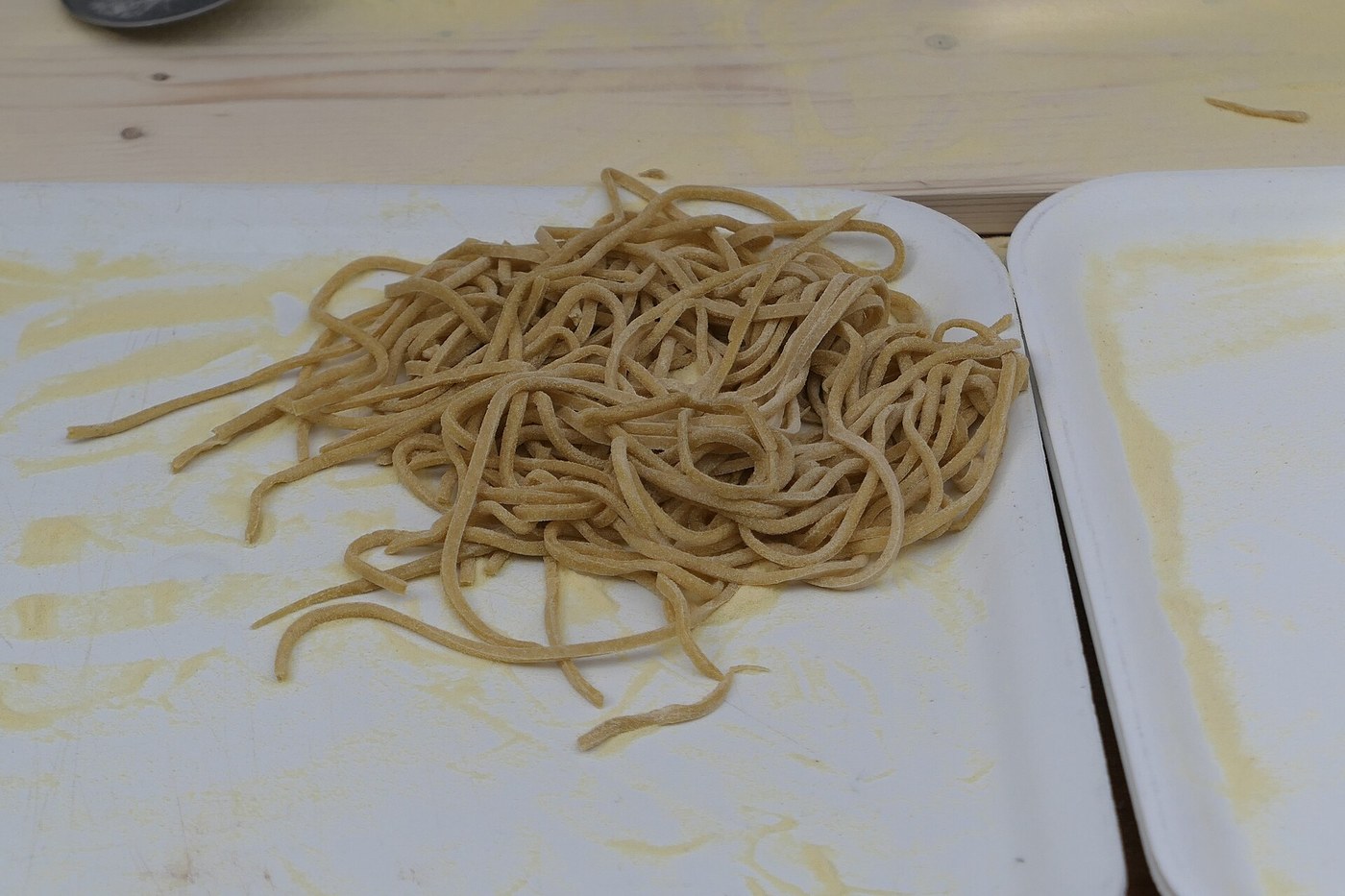

Egg Pasta
Egg pasta is not a complicated recipe: it is flour and eggs, and that's all. No water, no oil, no salt in the dough. The proportion handed down in Emilia is always the same — one egg for every hundred grams of flour — and it has held for centuries because it works.
What really matters is not the ingredients but the hands. The sheet is rolled out with a rolling pin until it becomes so thin that you can see light through it. The sfogline of Bologna do it in a few minutes; for us it will take much longer, and that's perfectly fine.
Here we make the sheet by hand and cut it into tagliatelle. Then it cooks in three minutes, and this is the part where you understand why it was worth the effort.
Instructions
Fresh eggs and clean hands
Fresh eggs and clean hands
Raw eggs are used, so they must be fresh and stored properly. Wash your hands and the work surface before starting. Pregnant people or those with weakened immune systems should use pasteurized eggs.
Weigh 300 g of soft wheat flour type 00
Weigh 300 g of soft wheat flour type 00
Weigh the flour, don't measure it in cups: the difference between a heaped cup and a level one changes the whole dough. The 00 gives a smooth and elastic sheet.
Materials for this step:
 Plain Flour1 kit
Tools needed:
 Digital Scale (0.01g)
Making the fountain on the cutting board
Making the fountain on the cutting board
Pour the flour onto the wooden cutting board and spread it into a ring, with a wide hole in the middle and tall walls. Wood is better than marble: it is porous and the dough clings to it while you roll it out.
Break 3 eggs into the well
Break 3 eggs into the well
Three medium eggs, about 55-60 g each, for 300 g of flour. Break each egg into a small bowl first and then pour it in: one spoiled egg ruins the whole dough.
Materials for this step:
 Egg3 pieces
Beat the eggs with the fork without breaking the walls
Beat the eggs with the fork without breaking the walls
Beat the eggs in the center with a fork, taking a little flour from the inner edge at a time. If the wall breaks, the egg escapes onto the cutting board — it happens to everyone the first time.
Knead by hand for 10 minutes
Knead by hand for 10 minutes
When the dough comes together, work it with the palm of your hand, pushing forward and folding it over, for at least ten minutes. It must become smooth and firm, not sticky: this is where the gluten forms that will hold the sheet of pasta together.
Let it rest covered for 30 minutes
Let it rest covered for 30 minutes
Make a ball, wrap it in plastic wrap and let it sit for half an hour at room temperature. Without resting, the dough shrinks back under the rolling pin and you can't roll it thin.
Start rolling out the dough from the center
Start rolling out the dough from the center
Flatten the ball and roll the rolling pin always from the center outwards, turning the dough slightly each time to keep it round.
Roll the dough sheet onto the rolling pin and stretch it out
Roll the dough sheet onto the rolling pin and stretch it out
Wrap the dough sheet around the rolling pin and roll it back and forth, pushing outward with your palms. This is the movement that really stretches the dough sheet, much more than simple pressure.
Continue until you can see your hand through it
Continue until you can see your hand through it
Stretch until about 1 mm or less. The test is this: place your hand under the sheet and see its shadow through it. Flour very lightly, only if it sticks.
Let the dough dry for 15 minutes
Let the dough dry for 15 minutes
Leave it spread out on the cutting board for a quarter of an hour, until it is no longer damp to the touch but is still flexible. If it is too damp it will stick together when cut, if it is too dry it will break.
Roll up and cut the tagliatelle to 7 mm
Roll up and cut the tagliatelle to 7 mm
Roll the sheet of pasta up on itself without squeezing and slice into strips about 7 mm wide with a wide knife. Once cooked they swell up to the 8 mm measurement recorded in Bologna.
Tools needed:
 Measuring Ruler
Open the nests and dust lightly with flour
Open the nests and dust lightly with flour
Unroll the tagliatelle right away, dust with a very little semolina and shape soft nests on the frame or on a cloth.
Tools needed:
 Pasta Drying Rack (Collapsible)
Cook for 2-3 minutes in plenty of salted water
Cook for 2-3 minutes in plenty of salted water
One litre of water for every 100 g of pasta, 10 g of coarse salt per litre, water at a full boil. Fresh pasta cooks in 2-3 minutes: taste it, don't watch the clock. Do not add oil to the water.
Drain, reserving a ladle of cooking water
Drain, reserving a ladle of cooking water
Drain the tagliatelle and toss them in the pan with the sauce, adding a little cooking water. The starch in the water binds the sauce to the pasta — that's what makes the difference between dressed and drowned.
History and context — why one egg per etto
History and context — why one egg per etto
Two Italies, two different pastas. In the North, pasta is made with soft wheat flour and eggs; in the South, with durum wheat semolina and only water. This isn't parochialism: it's what grew there. Durum wheat wants the heat and drought of the South, while soft wheat prefers the Po Valley climate. In the North, the egg also serves to give structure, because soft wheat alone doesn't have the strength of durum. These are two food technologies born from two agricultures, not two versions of the same thing.
The size of tagliatelle really exists. In 1972 the Italian Academy of Cuisine deposited with the Chamber of Commerce of Bologna the official measurement of the Bolognese tagliatella: 8 mm in width when cooked. That's why it is cut at 7 mm raw — it swells during cooking. It's a rule born half as a joke and half seriously, but the proportion it describes is real.
Why the rest can't be skipped. When kneading, gluten meshes form, and as soon as they form they are under tension: the dough pulls back like an elastic band. Half an hour of rest allows those meshes to relax, and the sheet can be rolled thin without shrinking back. Whoever skips the rest isn't saving time, they're just moving it to the rolling pin.
Two things you hear said that aren't true. Oil in the cooking water does not keep pasta from sticking: it floats on the surface and its only effect is to make the pasta slippery, so the sauce then doesn't cling. And salt is not added to the sheet dough: it stiffens the gluten and makes the sheet harder to roll out. Salt goes in the water.
On the origins. The legend that Marco Polo brought pasta from China is a twentieth-century advertising story. Dried pasta was already documented in Sicily in the 12th century, before Marco Polo was born. On egg pasta, medieval and Renaissance documentation is rich; the idea that tagliatelle were invented for the hair of Lucrezia Borgia, on the other hand, is an invention of 1931, and should be told for what it is.
Tools Required
3- Placeholder
- Placeholder
- Placeholder
This blueprint makes
Related Blueprints
These blueprints share knowledge with this one — techniques, materials, or principles that connect them in the learning graph.

CC0 Public Domain
This blueprint is released under CC0. You are free to copy, modify, distribute, and use this work for any purpose, without asking permission.
Support the Maker by purchasing products through their Blueprint where they earn a Maker Commission set by Vendors, or create a new iteration of this Blueprint and include it as a connection in your own Blueprint to share revenue.