
Harvesting and Processing Abaca Fiber — The Strongest Natural Fiber in the World
Instructions
Get to know the abaca plant
Get to know the abaca plant
Abaca (Musa textilis) is a species of banana native to the Philippines. Unlike ordinary bananas, abaca is grown for its fiber, not its fruit. The plant grows 3 to 8 meters tall. The pseudostem is made up of stacked leaf sheaths that contain the valuable fiber. Each plant produces 12 to 25 leaf sheaths.
Determine the right time for harvesting
Determine the right time for harvesting
Abaca is ready to be harvested after 18 to 24 months from planting. The sign of maturity: the first flower (inflorescence) has already appeared, or some outer leaves have started to dry out and turn yellow. Do not harvest too early — the fiber of a young plant is weak and thin. Also do not wait too long — overly mature fiber becomes coarse and brittle.
Prepare the equipment
Prepare the equipment
A sharp machete or bolo is needed for cutting the stalks and slicing the bark. Also prepare a stripping knife (tuxying knife) — a sharp blade attached to a wooden base that is used to pull the fiber from the bark. You will also need string for binding the fibers and bamboo poles or wire for a drying rack.
Tools needed:
 Sharp Bolo (large knife)
 Tuxying Knife (stripping blade)
 Tying Twine
 Bamboo Drying Poles
Cut the abaca stalk
Cut the abaca stalk
Cut the abaca stalk at the base, about 5 to 10 cm from the ground, using a sharp bolo. The cut should be clean and horizontal. After cutting, lay the whole stalk down in a clean area. The cutting should be done in the morning when the plant is still full of moisture — this makes it easier to strip the fiber.
Materials for this step:
 Mature Abaca Stalk (18-24 months old)1 stalk
Tools needed:
Sharp Bolo (large knife)Cut the stalk into tuxies
Cut the stalk into tuxies
Cut each leaf sheath from the stalk, starting from the outermost one. Each sheath is approximately 5 to 8 cm wide. Cut each sheath into thin strips called tuxies — about 5 to 7 cm wide and as long as the entire stalk (2 to 3 meters). The outer sheaths have coarser fibers, the inner sheaths have the finest fibers.
Tools needed:
Sharp Bolo (large knife)Perform the tuxying (hand-stripping)
Perform the tuxying (hand-stripping)
Ang tuxying is the main process of extracting fiber. Place one end of the tuxy under the tuxying knife blade, which is fixed on a board or wooden base. Hold the blade down with one hand or foot. Using the other hand, pull the tuxy out quickly and forcefully. The blade scrapes off the pulp and leaves clean fiber. Repeat on both sides of the tuxy.
Tools needed:
Tuxying Knife (stripping blade) Stripping Block (wooden)
Wash the fibers
Wash the fibers
Rinse the new strip fibers in clean water to remove the remaining pulp, resin, and other residue. Soak in water for 5 to 10 minutes, then squeeze. Do not use soap or chemicals — natural hemp fibers do not require chemical processing. Clean fibers should be smooth and free of any remaining sticky pulp.
Materials for this step:
 Distilled Water (1 Liter)20 liters
Tools needed:
 Washing Basin
Dry the fibers
Dry the fibers
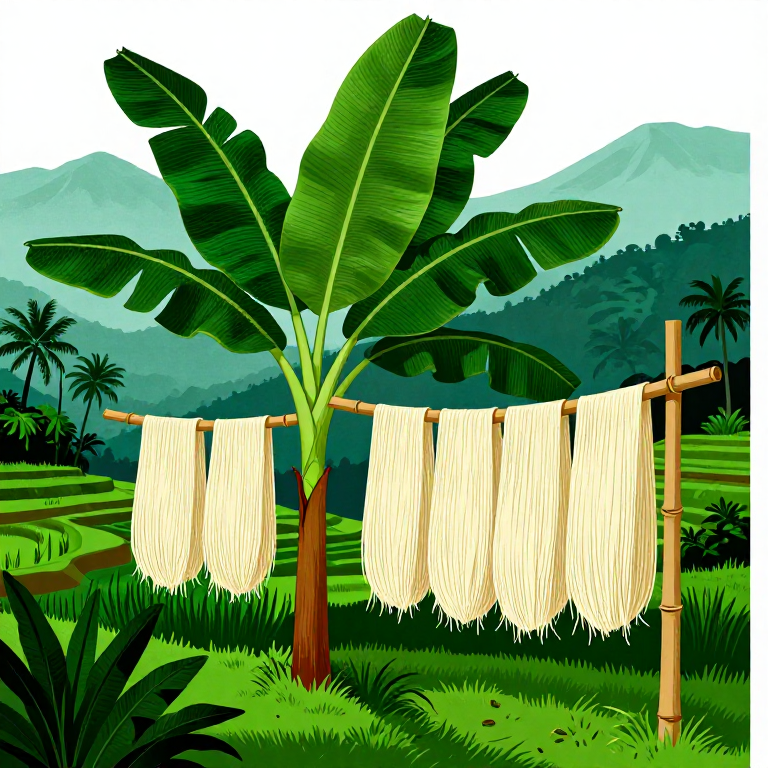
Hang the washed fibers on bamboo or wire in direct sunlight. Keep the fibers spread out and not piled up for even drying. Drying takes 4 to 8 hours in hot weather (30 to 35 degrees Celsius). Properly dried fiber is white to light gold in color, light, and flexible without breaking.
Tools needed:
Bamboo Drying Poles Drying Area (direct sunlight)
Check the quality of drying
Check the quality of drying
Dried abaca fiber should have a moisture content of only 10 to 12%. To check: wrap a fiber around your finger — it should be flexible and not break. If it breaks, it is too dry. If it is still soft or sticky, it needs more drying. The color indicates quality: white or light gold = best, medium brown = average, dark brown = low quality.
Grade the fibers
Grade the fibers
Abaca fiber is graded in the Philippines using the Philippine Fiber Inspection Service (FIS) system. The main grades: S2 and S3 (best — white, clean, strong) for special paper and banknotes. I2 and I3 (medium — light to light tan) for ropes and twine. G and H (low grade — dark brown) for packaging. Separate the fibers by color, strength, and cleanliness.
Tools needed:
 Sorting Table
Bundle the fibers
Bundle the fibers
After grading, bundle the fibers of the same grade into bundles called hanks. Each hank is typically 1 to 2 kilograms. Use the hemp twine itself to tie each hank at two points — in the middle and near the end. Do not tie too tightly, as it will leave marks on the fiber that will affect quality.
Materials for this step:
 Abaca Tying Twine5 meters
Proper Fiber Storage
Proper Fiber Storage
Store abaca hanks in a dry, well-ventilated warehouse with proper ventilation. Place the hanks on elevated wooden racks — do not place them on the floor as they may absorb moisture. The humidity of the storage area should be less than 65%. Protect from rain, direct sunlight, and pests such as rats that may gnaw on the fiber.
Tools needed:
 Wooden Storage Rack
 Dry Ventilated Storage Area
Understanding the uses of abaca
Understanding the uses of abaca
Abaca fiber has a tensile strength of 70 to 80 MPa — three times stronger than cotton and twice as strong as sisal. It does not decay in saltwater, so it is used in ship ropes and fishing nets. It is also used in making banknotes (including Japanese yen and Euro), tea bags, specialty paper, and automotive composites. The highest grade (S2) is used for banknote paper.
Record and document production
Record and document production
Record the number of stalks harvested, the weight of dry fiber obtained, the grade of each hank, and the harvest date. The typical yield is 1 to 3% of the weight of the whole stalk — meaning, from 100 kg of stalks, you can obtain 1 to 3 kg of dry fiber. These records are important for improving the process and estimating income for the next harvest.
Tools needed:
 Field Notebook
 Weighing Scale
Materials
3- Placeholder
- 20 litersPlaceholder
- 5 metersPlaceholder
Tools Required
12- Placeholder
- Placeholder
- Placeholder
- Placeholder
- Placeholder
- Placeholder
- Placeholder
- Placeholder
- Placeholder
- Placeholder
- Placeholder
- Placeholder
This blueprint makes
CC0 Public Domain
This blueprint is released under CC0. You are free to copy, modify, distribute, and use this work for any purpose, without asking permission.
Support the Maker by purchasing products through their Blueprint where they earn a Maker Commission set by Vendors, or create a new iteration of this Blueprint and include it as a connection in your own Blueprint to share revenue.