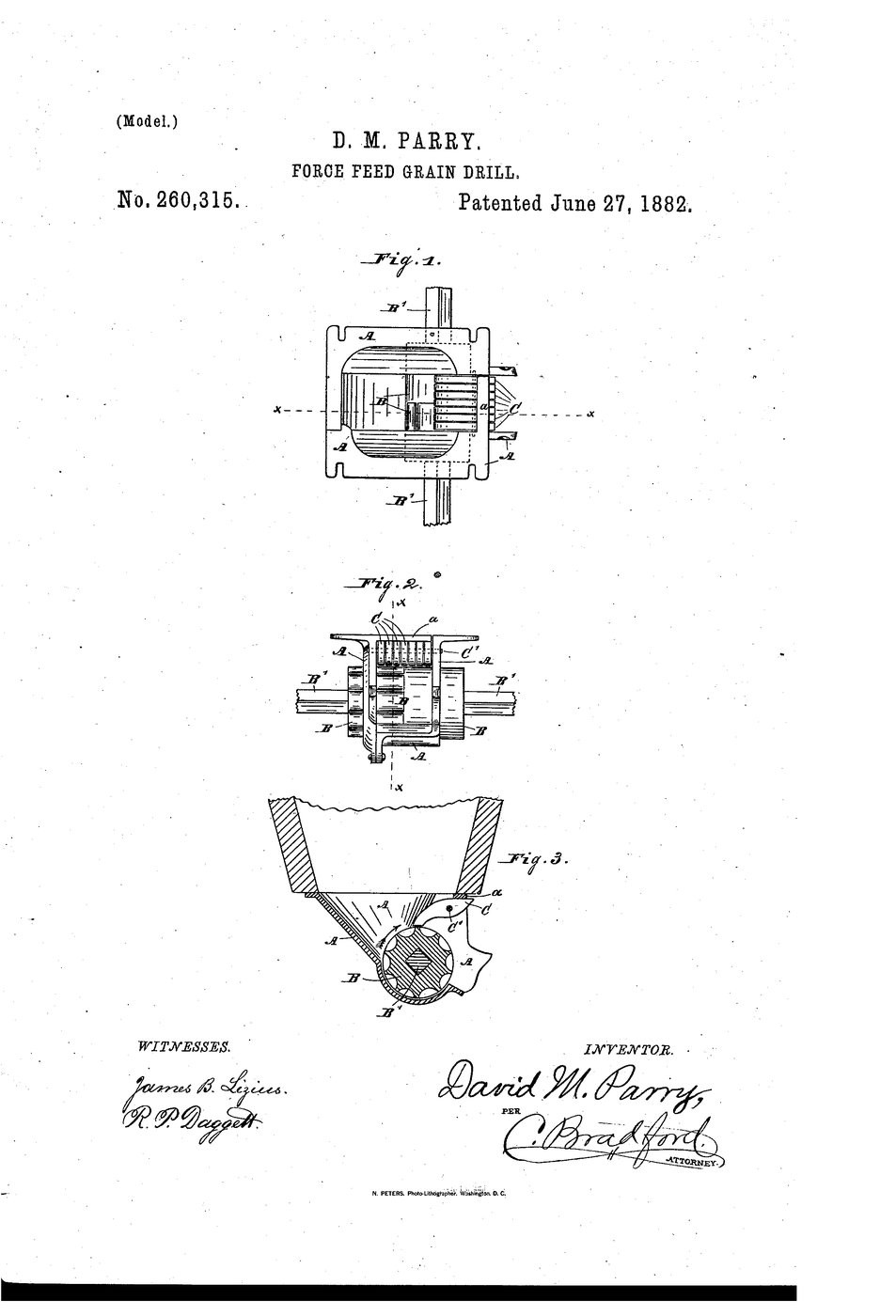


Force-Feed Grain Drill
Sowing grain by hand — broadcasting fistfuls across the field — wastes seed and plants it badly. Some falls thick, some thin, most lies on the surface for birds, and only a fraction reaches the right depth to grow. A seed drill fixes the placement; but for a drill to be trusted, it must also fix the rate — the exact amount of seed sown per acre.
Early drills metered seed by gravity, and gravity is unreliable. Seed dribbling through holes flows faster when the hopper is full than when it is low, and faster running downhill than up, so the sowing rate wanders across the field.
The force-feed drill meters seed positively. A fluted roller turns in the bottom of the hopper and pushes a fixed pocket of seed out on every revolution — geared to the wheels, so the rate depends only on distance travelled, not on how full the hopper is or which way the land slopes.
US Patent 260,315, "Force-feed grain-drill", granted 27 June 1882 (filed 1881) to David M. Parry of Rushville, Indiana.
Instructions
Read the two words: force feed
Read the two words: force feed
Parry claims a "force-feed" grain drill — the seed is pushed out at a set rate, not left to trickle. Note that the rate, not just the placement, is the point.
Broadcast seed by hand and count the spread
Broadcast seed by hand and count the spread
Scatter a handful of seed across a marked square by hand. Count seeds in a few spots. The density is wildly uneven — record the range.
Materials for this step:
 Wheat Berries200 g
Build a gravity hopper with a hole
Build a gravity hopper with a hole
Make a hopper with a hole in the bottom that seed trickles through. This is the old gravity feed.
Materials for this step:
 Corrugated Cardboard Sheet1 sheet
Tools needed:
 Craft Knife
Measure the gravity flow full versus nearly empty
Measure the gravity flow full versus nearly empty
Catch the seed for ten seconds with the hopper full, then again nearly empty. The rate falls as it empties — the head of seed above the hole changes the flow. Record both.
Tools needed:
 Balance Scale
Tilt the gravity hopper and measure again
Tilt the gravity hopper and measure again
Tip the hopper as if going up- and down-hill. The rate changes with the slope. A gravity feed cannot be trusted across real ground.
Build a fluted roller
Build a fluted roller
Cut lengthwise grooves (flutes) into a dowel roller. Each flute is a pocket that carries a fixed amount of seed as it turns.
Materials for this step:
 Dowel Rod1 piece
Tools needed:
 Needle File Set
Set the roller in the hopper floor
Set the roller in the hopper floor
Mount the fluted roller in the bottom of the hopper so seed fills its flutes and is carried out and dropped as it rotates. Turn it by hand.
Measure the force-feed rate full versus empty
Measure the force-feed rate full versus empty
Turn the roller a set number of times with the hopper full, then nearly empty, catching the seed. The amount per turn is the same — compare with step 4. The roller, not the head of seed, sets the rate.
Tilt it and confirm the rate holds
Tilt it and confirm the rate holds
Repeat step 5 with the force-feed. Slope barely changes it. Positive metering does not care which way the land runs.
Gear the roller to a ground wheel
Gear the roller to a ground wheel
Drive the roller from a wheel that rolls along the ground. Now seed drops per distance travelled, not per second — so it sows the same rate whether the machine moves fast or slow.
Materials for this step:
 Pulley1 set
Drill seed into a row at set depth
Drill seed into a row at set depth
Lead the dropped seed down a tube behind a small furrow-opener so it lands in a row, covered at an even depth — not scattered on top for birds.
Count the seed used to sow the same square
Count the seed used to sow the same square
Sow the marked square from step 2 with the drill and weigh the seed used. Far less seed, evenly placed at depth — that is seed saved and better germination.
History & Context — metering the seed, not just placing it
History & Context — metering the seed, not just placing it
The patent. US 260,315, "Force-feed grain-drill", filed 1881 and granted 27 June 1882 to David M. Parry of Rushville, Indiana. A note on names: the fluted force-feed is most famously associated with the Van Brunt brothers of Wisconsin, whose company made it a standard — but this specific patent number is Parry's, so that is who is credited here. Reading the patent, not the brand, keeps the record straight.
The seed drill is old; positive metering is the improvement. Sowing seed in covered rows at a set depth goes back to ancient China and was famously mechanised in England by Jethro Tull around 1701. But for two centuries drills metered the seed by gravity — seed trickling through holes or nudged by agitators — and gravity is fickle: steps 4 and 5 show the rate drifting as the hopper empties and as the land tilts. A drill you cannot trust to sow an even rate is only half a machine. The force feed fixes exactly this: a fluted roller carries a fixed pocket of seed out on every turn (steps 6 to 8), so the rate is set by the roller and the distance travelled, not by the head of seed or the slope. Gear it to a ground wheel (step 10) and the drill sows the same seeds per foot everywhere, at any speed.
Why the rate matters as much as the placement. Seed is expensive, and sowing rate is one of a farmer's key decisions — too thick wastes seed and crowds the crop, too thin leaves yield in the ground. Broadcasting (step 2) does neither placement nor rate well; a force-feed drill does both, cutting seed use sharply while planting every grain at the right depth for good germination (step 12). That is why the fluted force-feed became, and remains, the standard metering mechanism on grain drills — the modern air-seeder simply blows the metered seed down long tubes instead of dropping it, but the fluted-roller measuring principle is unchanged. It is the quiet, quantitative half of the seed drill: not just where the seed goes, but exactly how much.
Materials
4- Placeholder
- 1 sheetPlaceholder
- 1 piecePlaceholder
- 1 setPlaceholder
Tools Required
3- Placeholder
- Placeholder
- Placeholder
Related Blueprints
These blueprints share knowledge with this one — techniques, materials, or principles that connect them in the learning graph.

CC0 Public Domain
This blueprint is released under CC0. You are free to copy, modify, distribute, and use this work for any purpose, without asking permission.
Support the Maker by purchasing products through their Blueprint where they earn a Maker Commission set by Vendors, or create a new iteration of this Blueprint and include it as a connection in your own Blueprint to share revenue.