

Vapour-Compression Refrigeration
You cannot make cold. There is no such substance. All you can do is move heat from somewhere you want cool to somewhere you don't care about — and move it uphill, from a cold place to a warm one, which is the direction heat refuses to go on its own.
The trick is a fluid that boils at a convenient temperature, driven round a closed loop by four components you already know from the hydraulics batch: a compressor, a condenser, an expansion valve and an evaporator.
What does the actual work is latent heat. A boiling liquid absorbs a great deal of energy without getting any hotter — all of it spent breaking the liquid apart into vapour. So in the evaporator the refrigerant boils at low pressure, drinking heat out of the food. The compressor then squeezes that vapour, which raises its boiling point, so the same fluid that was freezing at −20°C will now condense at +40°C against ordinary room air. It dumps its heat there, becomes liquid again, and the expansion valve drops it back to low pressure — where it is cold once more.
Pressure is the lever. By choosing what pressure the fluid sits at, you choose what temperature it boils at, and you can therefore make the same substance both colder than your food and hotter than your kitchen, twice a second, forever.
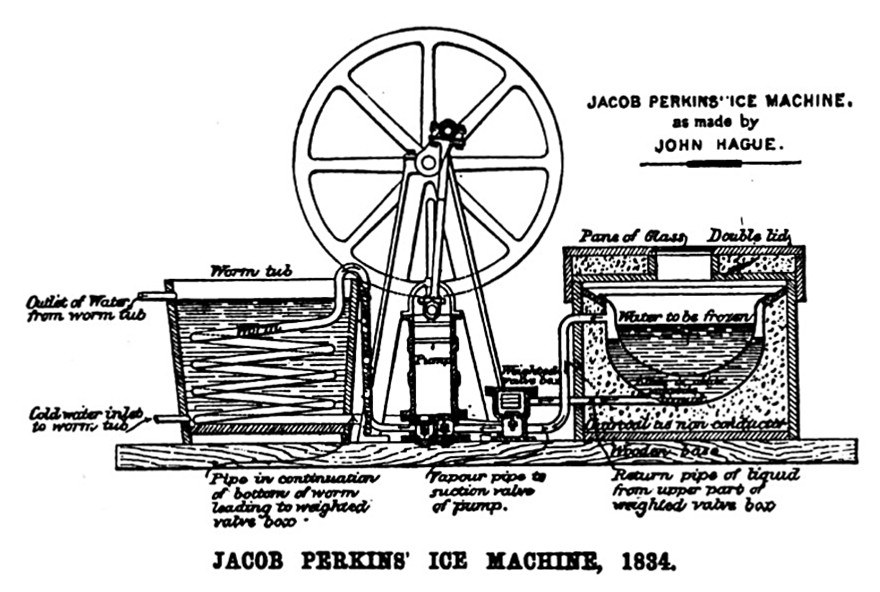
Jacob Perkins, British patent 6662, "Apparatus and means for producing ice, and in cooling fluids", granted 14 August 1834 — the first working closed-cycle refrigerating machine.
Instructions
Feel latent heat before you build anything
Feel latent heat before you build anything
Wet the back of your hand with surgical spirit and blow on it.
It feels cold — colder than the liquid ever was. Nothing was taken away from your hand except heat, and the heat went into turning liquid into vapour.
Now measure it: put a thermometer bulb in a wet cotton wad and fan it. Record the drop.
That is the entire refrigerator. Everything after this step is plumbing to make that evaporation happen where you want it, over and over, with the same fluid.
Tools needed:
 Thermometer (0-100°C)
 Surgical Spirit (Isopropyl Alcohol)
Prove that pressure sets the boiling point
Prove that pressure sets the boiling point
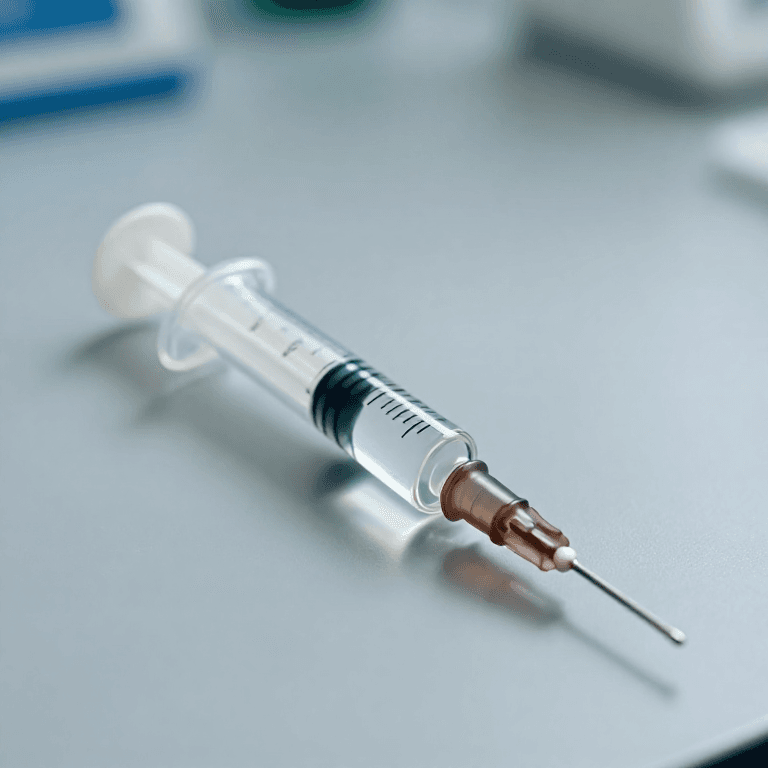
Half-fill a syringe with warm water, seal the nozzle, and pull the plunger hard.
Watch bubbles form. The water is boiling at room temperature, because you lowered the pressure above it.
Now push instead. The bubbles collapse.
Record what you have just established: boiling temperature is not a property of the fluid alone — it is a property of the fluid at a pressure. That single fact is what lets one refrigerant be colder than your freezer and hotter than your room within one revolution of the machine.
Tools needed:
 Syringe Set (5ml and 50ml)
Trace the four components and which way heat goes
Trace the four components and which way heat goes
Find the loop on a working fridge — a domestic one has all four parts visible if you look behind it.
Compressor — the black canister that hums. Raises pressure, and with it the boiling point.
Condenser — the warm black grille. Vapour gives up heat here and turns liquid.
Expansion device — a valve or a long thin capillary. Pressure drops.
Evaporator — the cold plate inside. Liquid boils and drinks heat from your food.
Feel the pipes with the back of your hand and mark on a sketch which are warm and which are cold.
Note the direction: heat leaves the machine at the back, into your kitchen. A fridge with its door open warms a room, because it also dumps the compressor's own work.
Tools needed:
 Infrared Thermometer
Measure the temperature split across the loop
Measure the temperature split across the loop
With the infrared thermometer, read the condenser outlet and the evaporator inlet while the machine runs.
Expect a spread of 50-60°C between them, from one fluid in one sealed circuit.
Then compute what matters: the heat moved divided by the electrical work put in. A domestic fridge shifts roughly two to three times more heat than the energy it consumes.
That is not a violation of anything. You are not creating the heat, only carrying it, and carrying is cheaper than making. The same arithmetic run backwards is why a heat pump warms a house for a third of the electricity a bar fire would use.
Find the limit: why it stops working
Find the limit: why it stops working
Block the condenser grille with a towel for a few minutes and watch the temperatures. Then uncover it.
Expect the inside to get warmer, not colder — the machine cannot dump its heat, so the condensing pressure climbs, and with it the compressor's work.
This is why a fridge pushed tight against a wall runs hot and dies young, and why a freezer in an unheated garage in winter can stop working entirely.
Restore the airflow as soon as you have the reading — do not run a compressor blocked for long.
History & Context
History & Context
The patent. British patent 6662, "Apparatus and means for producing ice, and in cooling fluids", Jacob Perkins, granted 14 August 1834. It describes a closed cycle that could run continuously — which is the whole difference between a laboratory curiosity and a machine. Perkins used ether, and his apparatus did make ice.
The idea was not his alone. Oliver Evans had described a closed vapour-compression cycle in 1805 and never built it. Perkins built and patented it. That distinction matters and is worth stating plainly: the cycle is Evans', the machine is Perkins'.
It went nowhere for forty years. Ether is dangerously flammable, the seals leaked, and natural ice cut from lakes in winter was cheap. A better machine lost to a cheaper supply chain — a thing that happens to good engineering more often than the histories admit. Commercial refrigeration only took hold once ammonia replaced ether and city populations outgrew what the ice trade could deliver.
What actually changed the world was the refrigerant, not the cycle. The four components have not altered since 1834. Ether gave way to ammonia, ammonia to sulphur dioxide and methyl chloride — both toxic, both responsible for domestic deaths in the 1920s — then to the CFCs of the 1930s, which were safe to breathe and turned out to destroy the ozone layer, then to HFCs, which are safe for ozone and are potent greenhouse gases. Each generation solved the previous one's fatal flaw and introduced its own. The current shift back to propane and ammonia — the flammable and toxic options Perkins started with — closes a loop worth thinking about.
Where the cycle went. Every fridge, freezer, air conditioner, dehumidifier, heat pump, water chiller and cold store on Earth. It made the transport of food independent of season and latitude, which reshaped agriculture, cities and diet more thoroughly than most inventions that get more attention.
Tools Required
4- Placeholder
- Placeholder
- Placeholder
- Placeholder
Related Blueprints
These blueprints share knowledge with this one — techniques, materials, or principles that connect them in the learning graph.

CC0 Public Domain
This blueprint is released under CC0. You are free to copy, modify, distribute, and use this work for any purpose, without asking permission.
Support the Maker by purchasing products through their Blueprint where they earn a Maker Commission set by Vendors, or create a new iteration of this Blueprint and include it as a connection in your own Blueprint to share revenue.