ART
BEAUTY & WELLNESS
CRAFT
CULTURE & HISTORY
ENTERTAINMENT
ENVIRONMENT
FOOD & DRINKS
REVERSE ENGINEERING
SCIENCES
SPORTS
TECHNOLOGY
WEARABLES
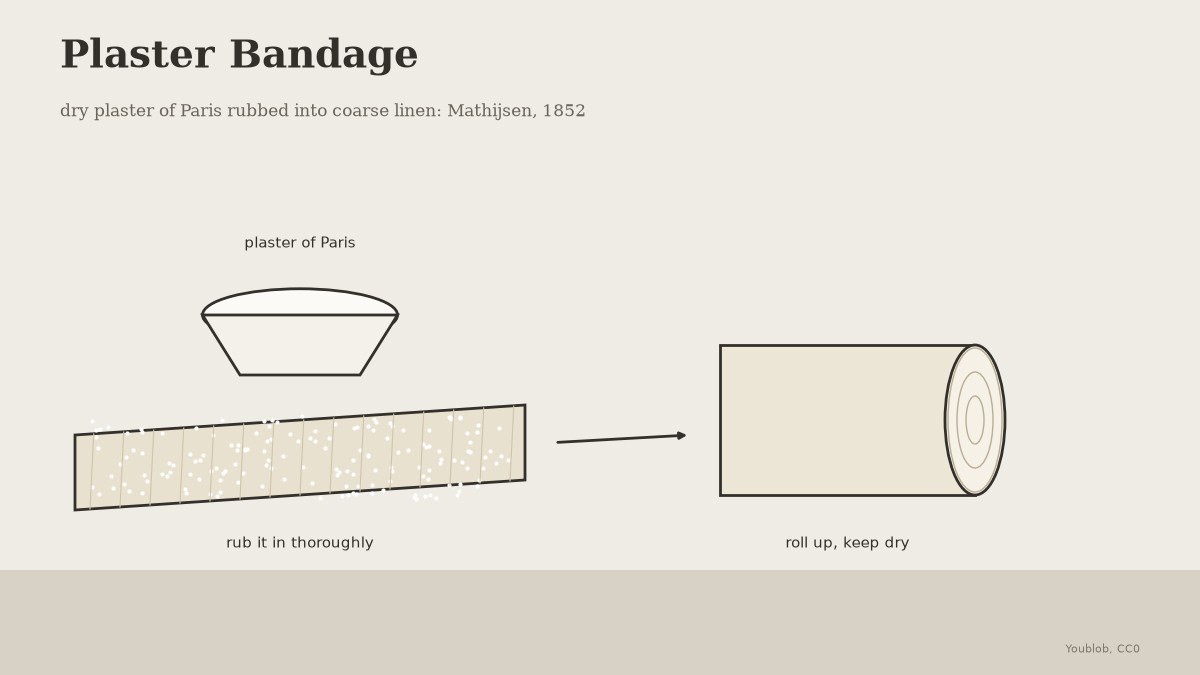


Plaster Bandage: Dry Plaster of Paris Rubbed into Coarse Linen, Mathijsen 1852
The plaster bandage of the Dutch army surgeon Antonius Mathijsen (1852): coarse linen with dry plaster of Paris rubbed well into it. Wetted as it goes on and rubbed by hand, it sets hard within minutes. Until 1931 hospitals made their own this way.
The picture: our own drawing.
Beginner
1 hour
Instructions
1
1
Cut coarse linen strips
Cut coarse linen strips
Cut a coarsely woven linen into long strips, bandage width.
Materials for this step:
 Linen Fabric1 sqm
Tools needed:
 Fabric Scissors
2
2
Rub the plaster in
Rub the plaster in
Lay a strip flat and rub dry plaster of Paris thoroughly into the weave, working along its length. Do it slowly so the dust stays down.
Materials for this step:
 Plaster of Paris500 g
Tools needed:
 Bowl
 N95 Respirator Mask
3
3
Roll and keep dry
Roll and keep dry
Roll each strip loosely and store it closed and dry: any damp sets the plaster. To use, wet it as it goes on and rub it smooth by hand.
Tools needed:
 Glass Jars with Lids
Materials
2- 1 sqmPlaceholder
- 500 gPlaceholder
Tools Required
4- Placeholder
- Placeholder
- Placeholder
- Placeholder
This blueprint makes

CC0 Public Domain
This blueprint is released under CC0. You are free to copy, modify, distribute, and use this work for any purpose, without asking permission.
Support the Maker by purchasing products through their Blueprint where they earn a Maker Commission set by Vendors, or create a new iteration of this Blueprint and include it as a connection in your own Blueprint to share revenue.