ART
BEAUTY & WELLNESS
CRAFT
CULTURE & HISTORY
ENTERTAINMENT
ENVIRONMENT
FOOD & DRINKS
REVERSE ENGINEERING
SCIENCES
SPORTS
TECHNOLOGY
WEARABLES
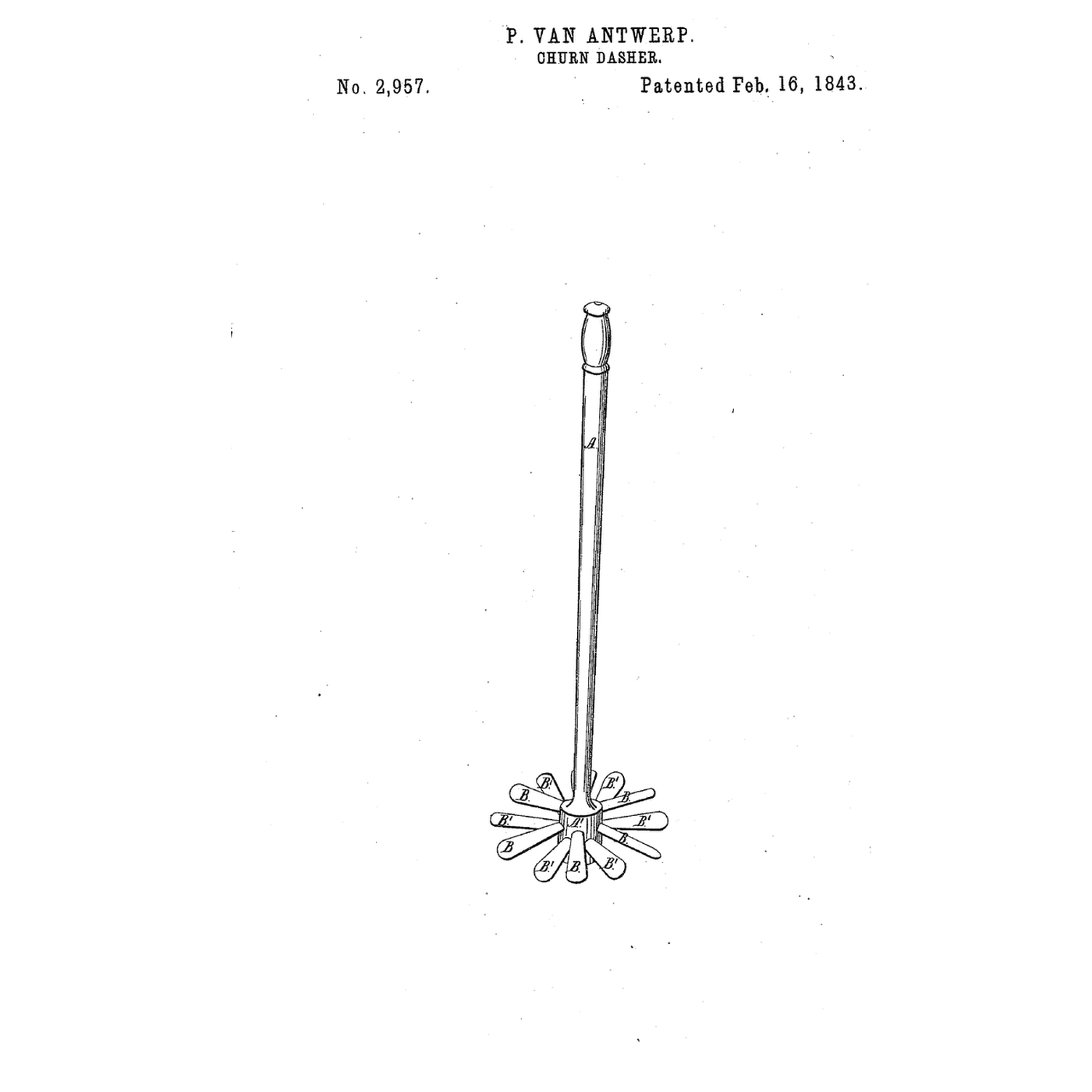


Reacting Churn Dasher: Two Rows of Oars Pitched Opposite Ways
Van Antwerp set out to improve "the common churn or hand dasher," worked up and down in an upright churn.
Peter Van Antwerp of Coeymans, New York, received US 2,957, dated 16 February 1843, for "Van Antwerp's Reacting Churn-Dasher": a knob on the dasher's rod carrying two rows of radial paddles shaped like oars, the upper row pitched one way and the lower row the other, so that "a reaction is also produced in the cream as it is impelled in one direction by the paddles B in the upper series and in the opposite direction by the paddles B' in the lower series." A cork in the end of the knob softens its blow on the churn's bottom.
This rung works out the oars' tilt, then prints the knob and twelve oars, fits them to a rod, and makes butter in a bucket.
Beginner
About 1 hour, plus printing
Instructions
1
1
Tilt and pitch
Tilt and pitch
Loading Jupyter Notebook...
2
2
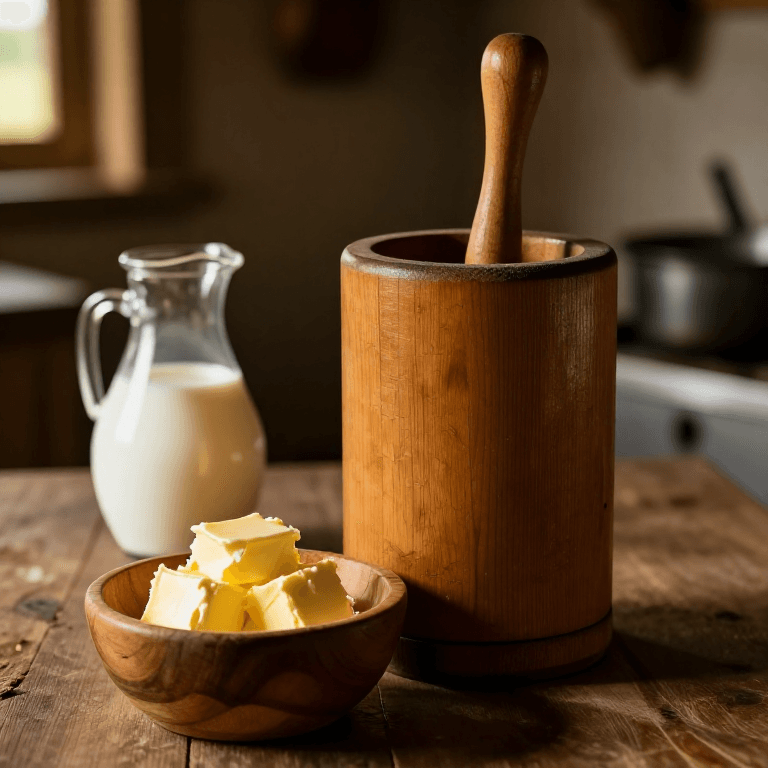
The common dash churn it improves
The common dash churn it improves
The embedded blueprint makes butter by agitating cream. Van Antwerp's dasher works the same up-and-down way, with pitched oars instead of a flat cross.
3
3
Read US 2,957
Read US 2,957
"This mode of constructing the dasher gives it great advantage over the ordinary churn dasher as by the employment of paddles arranged in the manner stated no vacuum is created interfering with the operation of the churn, consequently there is no mingling of air with the cream to obstruct the gathering of the butter."
4
4
Print the knob and oars
Print the knob and oars
Print the knob upright (/uploads/blueprints/reacting-churn-dasher-knob.stl), with supports in its sockets. Its square sockets are turned 45° so each oar's blade takes its pitch, the upper row one way and the lower row, under the gaps, the other. Print twelve oars flat (/uploads/blueprints/reacting-churn-dasher-oar.stl). Print in PLA at 0.2 mm layers, 30 % infill, 4 walls; wash before first use.
Materials for this step:
 PLA Filament1 piece
Tools needed:
 FDM 3D Printer
5
5
Assemble the dasher
Assemble the dasher
Glue the twelve oars into their sockets. Glue a 12 mm hardwood dowel, as long as the bucket is deep plus 150 mm, into the top of the knob. Press a cork into the seat under the knob so it stands proud of the end.
Materials for this step:
 Hardwood Dowels1 piece
 Corks1 piece
 Wood Glue1 piece
Tools needed:
 Hand Saw
 Sandpaper
6
6
Make the churn
Make the churn
Drill a 20 mm hole in the centre of a food-grade 20-litre bucket's lid for the rod.
Materials for this step:
 20-Liter Bucket1 piece
Tools needed:
 Cordless Drill
 Hole Saw Kit
7
7
The build in 3D
The build in 3D
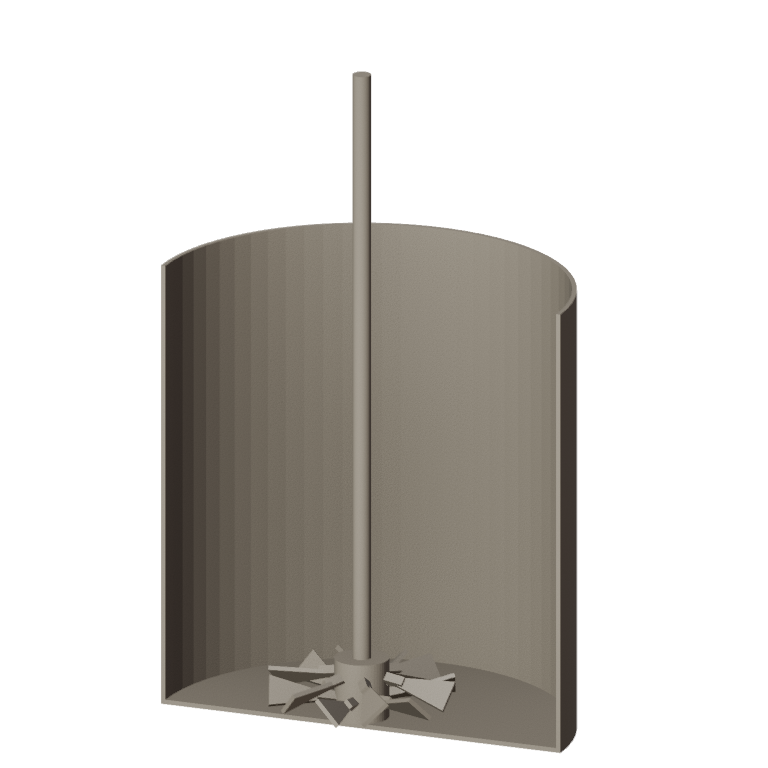
FreeCAD model of this build, not of the patent: the bucket cut away to show the knob on the rod's foot with its upper row of oars tilted down and pitched one way, and the lower row tilted up and pitched the other.
8
8
Dash and make butter
Dash and make butter
Let the heavy cream stand until it reaches about 15 °C, checked with the thermometer. Pour in 1 litre, fit the lid over the rod, and work the dasher up and down like a common dasher. Time until the butter comes. Pour off the buttermilk, add cold water, churn a little and pour off again until it runs clear; work in a pinch of salt and weigh the butter.
Materials for this step:
 Heavy Cream1000 ml
 Coarse Sea Salt1 piece
 Water1 piece
Tools needed:
 Leave-In Probe Thermometer
 Stopwatch
 Digital Kitchen Scale
 Stainless Steel Mixing Bowl (Large)
9
9
Oars that loosen, a dasher that thumps
Oars that loosen, a dasher that thumps
Reacting churn dasher troubleshooting.
Flow
Loading...
10
10
History and honest limits
History and honest limits
**Peter Van Antwerp** of Coeymans, Albany County, New York, received US 2,957, dated 16 February 1843. The knob was about three inches of the rod's lower end, enlarged; the paddles were "broad and flattened at their outer ends where they project into the cream, tapering from thence to their inner ends"; the centre hole could be filled with cement or putty and closed with cork "or other elastic substance" to keep the churn's bottom from being bruised. He claimed combining with the rod the two series of paddles arranged above each other and operating as described.
**Honest limits.** A printed knob and oars stand in for his wooden ones, and a bucket for his churn. FDM prints hold food in their layer lines, so wash well and replace when worn. Your times and weights are the result.
Materials
8- 1 piecePlaceholder
- 1 piecePlaceholder
- 1 piecePlaceholder
- 1 piecePlaceholder
- 1 piecePlaceholder
- 1000 mlPlaceholder
- 1 piecePlaceholder
- 1 piecePlaceholder
Tools Required
9- Placeholder
- Placeholder
- Placeholder
- 1 vendor sell this, none ship to you yetPlaceholder
- Placeholder
- Placeholder
- Placeholder
- Placeholder
- Placeholder
Design Files
1Related Blueprints
These blueprints share knowledge with this one — techniques, materials, or principles that connect them in the learning graph.


CC0 Public Domain
This blueprint is released under CC0. You are free to copy, modify, distribute, and use this work for any purpose, without asking permission.
Support the Maker by purchasing products through their Blueprint where they earn a Maker Commission set by Vendors, or create a new iteration of this Blueprint and include it as a connection in your own Blueprint to share revenue.