

Harvesting Guérande Salt — The Know-How of the Breton Salt Farmer
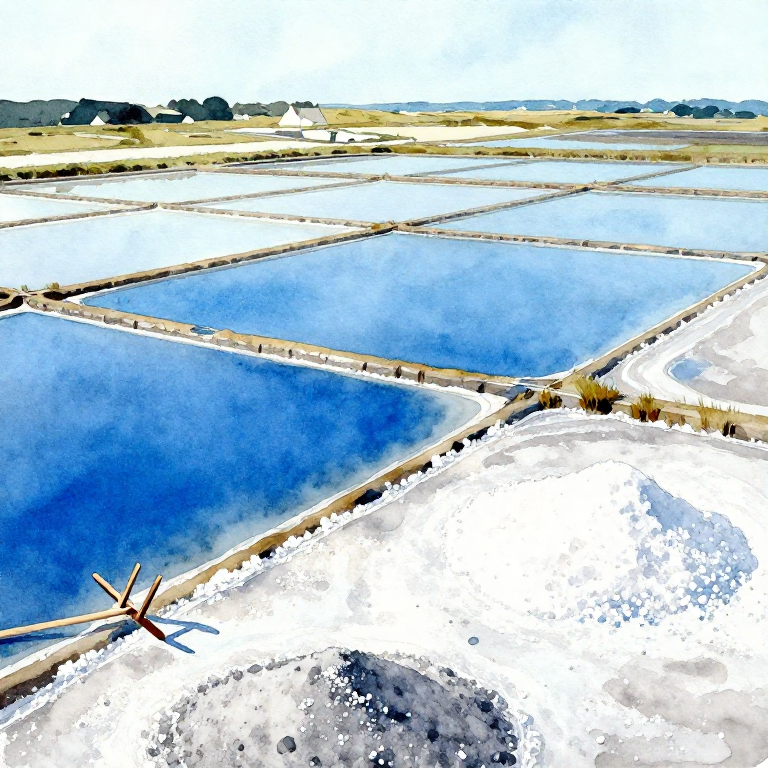
A complete guide to the traditional salt harvest in the salt marshes of Guérande, in Loire-Atlantique (Brittany). This ancestral tradition dates back more than 1,500 years. The paludier (saunier) uses an ingenious system of successive basins to concentrate seawater through natural evaporation: vasière (reservoir), cobier (heating basin), fards, adernes, then œillets (crystallization basins). Seawater goes from a salinity of 35 g/L to about 250 g/L before crystallization.
Two products are harvested: grey salt (coarse salt scraped from the bottom of the œillets) and fleur de sel (fine crystals delicately gathered from the surface). Fleur de sel represents only about 5% of the total harvest but sells for 10 to 20 times more than grey salt. An œillet produces between 50 and 80 kg of grey salt per season, plus 1 to 3 kg of fleur de sel. Guérande salt has held a IGP (Protected Geographical Indication) since 2012. The harvest season runs from June to September.
Instructions
Understanding the salt marsh system
Understanding the salt marsh system
The Guérande salt marshes extend over approximately 2,000 hectares between Le Croisic and Guérande, on the Guérande peninsula (Loire-Atlantique, Brittany). This system harnesses the natural evaporation of seawater through a series of shallow basins connected by channels. Seawater enters through a main channel (the étier) and successively passes through: the vasière (large storage reservoir), the cobier (first heating basin), the fards and adernes (intermediate concentration basins), and finally the œillets (small crystallization basins of about 70 m²). At each stage, the water loses volume through evaporation, increasing from 35 g/L to approximately 250 g/L in salinity in the œillets.
Seasonal preparation of the basins
Seasonal preparation of the basins
From March to May, before the harvest season, the salt farmer prepares his basins. After winter, the oeillets and the channels contain sediment, algae and debris. The salt farmer empties each basin and scrapes the clay bottom to level it perfectly. The bottom of the oeillets must be absolutely flat to ensure a uniform water depth (about 5 mm during the crystallization phase). The embankments (clay bridges between the basins) are inspected and repaired. The circulation channels are cleaned out. This restoration work takes about two months and determines the whole season.
Tools needed:
 Pelle plate de curage
 Brouette
 Argile de réparation pour talus
Water flow management in the channels
Water flow management in the channels
The salt farmer regulates the flow of seawater entering his pond system using small wooden or slate sluice gates (the "trapons"). Water enters through the étier during high tides and fills the vasière. The salt farmer opens or closes the trapons to control the passage of water from one pond to another. The residence time in each pond is crucial: the water must remain long enough for evaporation to increase the salt concentration. In the vasière, water stays for several days. In the cobiers, it concentrates to about 50-70 g/L. In the fards and adernes, it reaches 150-200 g/L. A salt farmer typically manages 50 to 80 œillets.
Tools needed:
 Trapon (vanne en bois)
Monitoring concentration and crystallization
Monitoring concentration and crystallization
The salt worker monitors the brine concentration in the basins (œillets) daily. When the salinity exceeds approximately 250 g/L (the saturation point of sodium chloride), the salt begins to crystallize. The water depth in the basin must not exceed 5 mm at this stage. The salt worker assesses the concentration visually (the water becomes iridescent, crystals appear) and by touch (the brine becomes viscous). Crystallization depends entirely on weather conditions: sunshine is needed for evaporation and a moderate east wind. Rain is the enemy: it dilutes the brine and can destroy several days of concentration.
Recognizing the conditions for fleur de sel
Recognizing the conditions for fleur de sel
Fleur de sel forms only under very specific conditions: a hot, sunny afternoon, a light and steady east wind, and low relative humidity. Under the effect of rapid surface evaporation, fine salt crystals form on the surface of the water, creating a delicate, fragile crust. If the wind is too strong, the crystals sink to the bottom and become grey salt. If the air is too humid, the crystals do not form. Fleur de sel is white (unlike grey salt) because it never touches the clay bottom. It represents only about 5% of the total production of a salt pan, i.e. 1 to 3 kg per season and per salt pan.
Harvesting the fleur de sel
Harvesting the fleur de sel
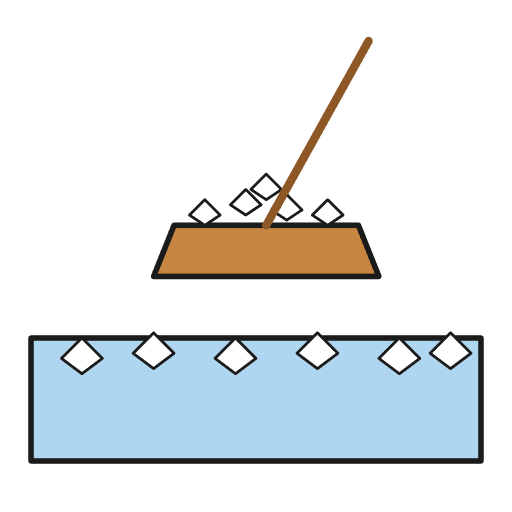
Fleur de sel is harvested in the late afternoon, once the crust of crystals has properly formed on the surface. The salt worker uses a fleur de sel lousse: a wooden tool with a long handle ending in a thin, flat board (about 30 cm wide). He gently skims the surface of the water to collect the fine film of crystals without touching the bottom. The movement must be very gentle and regular: too much force breaks the crystals and sends them to the bottom. The harvested fleur de sel is placed directly on the ladure (beaten-earth drying platform) next to the œillet. It has a moist, slightly crunchy texture, with a subtle violet scent.
Tools needed:
 Lousse à fleur de sel (écumoire plate en bois)
Harvest the grey salt (coarse sea salt)
Harvest the grey salt (coarse sea salt)
Grey salt crystallizes at the bottom of the salt pan (œillet), in contact with the clay that gives it its characteristic colour, from light grey to dark grey. The grey salt harvest takes place at the end of the day, after that of the fleur de sel. The salt worker uses a grey salt rake (las): a large wooden rake with a long handle (about 5 metres) ending in a wooden board 40 to 60 cm wide. He scrapes the bottom of the salt pan, pushing the salt towards the edge of the basin, forming a mound called a "mulon". One must scrape firmly but without digging into the clay at the bottom, which would tarnish the salt and damage the basin. Each scraping of a salt pan can yield 1 to 3 kg of grey salt per day in good season.
Tools needed:
 Lousse à sel gris (las, râteau en bois à long manche)
Draining and forming mulons
Draining and forming mulons
The harvested grey salt is pushed to the edge of the œillet, onto a raised area called the ladure. The salt drains there for several hours, losing the excess brine. Then the paludier forms mulons: conical salt heaps about 1 metre high. The mulons are arranged along the paths between the œillets. The salt continues to dry in the open air in the mulons for several days. The salt is never washed — this is what distinguishes it from industrial salt and gives it its richness in minerals (magnesium, potassium, calcium) and trace elements from the clay and seawater.
Tools needed:
 Pelle de mise en mulon
Initial drying on the ladures
Initial drying on the ladures
The fleur de sel is dried separately from the grey salt, directly on the ladures (raised packed-earth platforms along the œillets). It remains spread in a thin layer for 24 to 48 hours depending on weather conditions. The paludier turns it gently once or twice to ensure even drying. The grey salt, for its part, dries in the mulons for longer, from a few days to a week. The drying is entirely natural: no oven, no dehydrator. The residual moisture content of the fleur de sel is about 5 to 10%, which gives it its characteristic slightly moist texture.
Transfer to the salt store
Transfer to the salt store
Once sufficiently dry, the salt is transported to the salt store: a large storage building made of stone or wood located on the edge of the marshes. The grey salt is loaded by wheelbarrow from the mulons to the salt store. The fleur de sel is transported separately in buckets or food-grade plastic tubs. In the salt store, the salt continues to lose its moisture for several months. The grey salt is stored in large heaps on the ground. The fleur de sel is stored in separate tubs, sheltered from moisture. The salt store can hold the production of an entire season, i.e., several tonnes of salt per salt farmer.
Tools needed:
Brouette Bacs de transport alimentaire
Sorting and quality control
Sorting and quality control
Before being put on sale, the salt is sorted and checked. Grey salt is sieved to remove any debris (small pebbles, clay fragments, plant debris). Fleur de sel is visually inspected and sorted by hand: the crystals must be white, fine and regular. Any grey crystal (having touched the bottom) is reclassified as grey salt. Guérande salt has been benefiting since 2012 from a IGP (Protected Geographical Indication) that certifies its origin and its traditional harvesting method. The salt undergoes no chemical treatment, no addition of anti-caking additives, and no bleaching — it is sold as harvested.
Tools needed:
 Tamis à mailles moyennes
Packaging and labeling
Packaging and labeling
Salt is packaged in jute cloth bags, kraft paper or food-grade plastic sachets depending on its destination. Fleur de sel is generally packaged in small jars or sachets of 125 g, 250 g or 500 g. Grey salt is sold in bags of 1 kg, 5 kg or 25 kg. Each package bears the designation IGP "Sel de Guérande", the name of the salt maker or cooperative, the type of salt (coarse grey salt, fleur de sel), and the harvest vintage. Guérande salt can be kept indefinitely in a dry place away from light. Fleur de sel should be stored in a closed container to preserve its natural moisture and delicate aroma.
Tools needed:
 Balance de pesée
 Étiquettes IGP
 Sacs de conditionnement alimentaire
Tools Required
12- Placeholder
- Placeholder
- Placeholder
- Placeholder
- Placeholder
- Placeholder
- Placeholder
- Placeholder
- Placeholder
- Placeholder
This blueprint makes
CC0 Public Domain
This blueprint is released under CC0. You are free to copy, modify, distribute, and use this work for any purpose, without asking permission.
Support the Maker by purchasing products through their Blueprint where they earn a Maker Commission set by Vendors, or create a new iteration of this Blueprint and include it as a connection in your own Blueprint to share revenue.