ART
BEAUTY & WELLNESS
CRAFT
CULTURE & HISTORY
ENTERTAINMENT
ENVIRONMENT
FOOD & DRINKS
REVERSE ENGINEERING
SCIENCES
SPORTS
TECHNOLOGY
WEARABLES
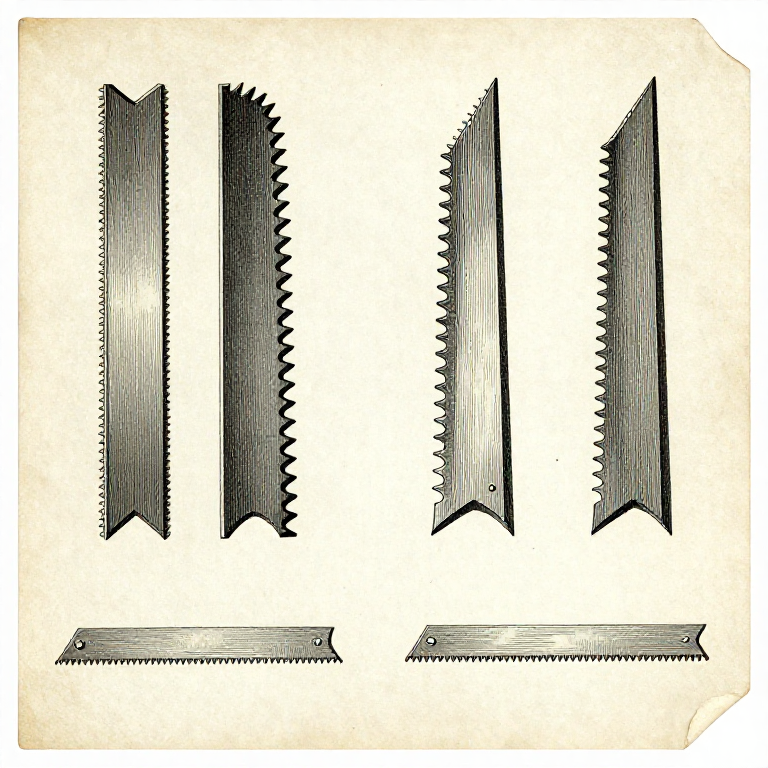


Rip and Crosscut: Two Saws Because Wood Has a Grain
Wood is a bundle of long fibres glued together. Cutting ALONG those fibres and cutting ACROSS them are genuinely different problems, and they need differently shaped teeth.
A RIP tooth is a tiny chisel, square across its front edge, and it pares the fibres away lengthwise like a plane. A CROSSCUT tooth is a tiny knife, bevelled to a point, and it severs the fibres on each side of the kerf before lifting out what is between them.
Use the wrong one and it still cuts — badly. A rip saw across the grain tears the fibres and leaves a ragged edge; a crosscut saw along the grain is slow and hard work. Knowing which is which is worth more than any amount of effort.
Beginner
2 hours
Instructions
1
1
Look at the front face of a tooth
Look at the front face of a tooth
Under a loupe, a rip tooth's front face is square across the blade — a flat chisel edge the full width of the tooth. A crosscut tooth's front face is bevelled, so the tooth comes to a point at one corner.
That pointed corner is a knife, and it is doing the job of the marking knife you would use before a hand-cut joint: scoring the fibres cleanly at the edge of the cut so they cannot tear out.
The other visible difference is RAKE — how far the front face leans back from vertical. A rip tooth is near vertical and bites aggressively; a crosscut tooth leans back, which makes it gentler and less inclined to snatch. That is why a rip saw grabs when you start it and a crosscut saw does not.
Tools needed:
 Rip Saw
 Crosscut Saw
 Magnifying Loupe
2
2
Cut the same board both ways and compare
Cut the same board both ways and compare
Take a scrap of softwood. Make a short cut across the grain and a short cut along it, with the same saw, and look at both edges.
Along the grain the saw runs easily and the edge is reasonably clean. Across it the same saw is slower, and if it is a rip saw the top edge of the cut will show torn fibres lifting out. Swap saws and repeat and the difference is unmistakable.
Ten minutes doing this teaches more than any description, and it also calibrates your hands: rip cutting and crosscutting FEEL different, and once you know the feel you can tell you have the wrong saw within three strokes.
Materials for this step:
 Dry Softwood Board2 pieces
Tools needed:
Rip SawCrosscut Saw Bench Hook
3
3
The specialist saws, and what each is for
The specialist saws, and what each is for
A TENON saw has a stiff brass or steel spine along its back, fine crosscut teeth and a short blade. The spine stops the thin blade flexing, which is what makes an accurate joint cut possible. A DOVETAIL saw is the same idea, smaller and finer.
A JAPANESE PULL SAW cuts on the pull stroke. Because the blade is in tension it can be far thinner, so the kerf is narrower and the cut cleaner — at the cost of a blade that kinks if you push hard. Many have rip teeth on one edge and crosscut on the other.
A HACKSAW is for metal and has a tensioned replaceable blade in a frame. A COPING or FRET saw has a very narrow blade in a deep frame for cutting curves. Each has its own rung or section in this batch, because the technique differs as much as the tool does.
Tools needed:
 Tenon Saw
 Dovetail Saw
 Japanese Pull Saw
 Coping Saw
4
4
Most modern saws are hardpoint, and that changes the advice
Most modern saws are hardpoint, and that changes the advice
A hardpoint saw has induction-hardened teeth: much harder than the blade body, so they stay sharp several times longer — and completely unsharpenable, because a file will not touch them.
They are cheap, they cut well, and when they go blunt they are thrown away. That is a genuine trade and not simply a decline in standards: a hardpoint saw outlasts several sharpenings of a traditional one and costs less than one professional sharpening.
But it means the sharpening rung at the end of this batch applies only to traditional saws with soft-steel teeth. Check before you reach for a saw file: hardpoint teeth are usually visibly darker or bluish, and a file skating across them without biting settles it in one stroke.
Tools needed:
 Hand Saw
 Saw FileMagnifying Loupe
Materials
1- 2 piecesPlaceholder
Related Blueprints
These blueprints share knowledge with this one — techniques, materials, or principles that connect them in the learning graph.
CC0 Public Domain
This blueprint is released under CC0. You are free to copy, modify, distribute, and use this work for any purpose, without asking permission.
Support the Maker by purchasing products through their Blueprint where they earn a Maker Commission set by Vendors, or create a new iteration of this Blueprint and include it as a connection in your own Blueprint to share revenue.