ART
BEAUTY & WELLNESS
CRAFT
CULTURE & HISTORY
ENTERTAINMENT
ENVIRONMENT
FOOD & DRINKS
REVERSE ENGINEERING
SCIENCES
SPORTS
TECHNOLOGY
WEARABLES
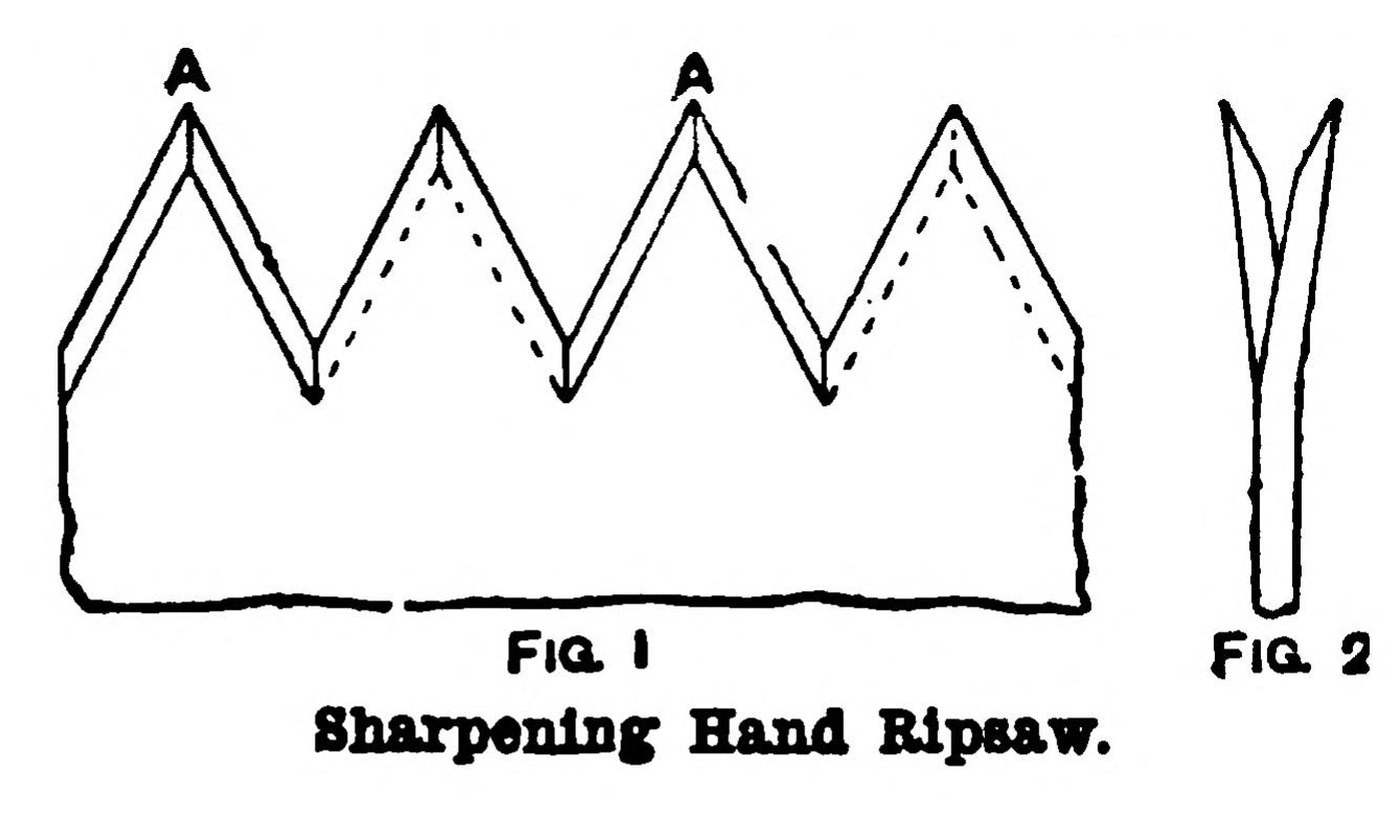


Rip Saw: Diamond-Pointed Teeth Bevelled from One Face (Cassell's Cyclopaedia, 1904)
A less common way to sharpen a hand rip saw, given in Cassell's Cyclopaedia of Mechanics (1904) as one that "answers well in actual practice". Both edges of each tooth are bevelled from the same face, so every tooth comes to a long point like a diamond-pointed wood chisel with a left and a right cutting edge, the teeth alternating from side to side of the blade. Set as usual, with the flat side of each pointed tooth turned outward. Teeth a little longer than an equilateral triangle, with a longer side slope, cut much more sweetly.
Tooth size, bevel angle and amount of set are not given; those are unknown here.
Source: P. N. Hasluck (ed.), Cassell's Cyclopaedia of Mechanics vol. V (1904), p. 122. Picture: its figs. 1 and 2.
Intermediate
An hour
Instructions
1
1
Read Cassell's
Read Cassell's
"... both edges of each tooth are bevelled from the same face, to form a long point at A (Fig. 1). In this way each successive tooth resembles a diamond-pointed wood chisel having a left and right cutting edge ..."
2
2
Clamp the saw
Clamp the saw
Clamp the hand saw in the vice with its teeth just above the jaws.
Materials for this step:
 Woodworking Saw1 hand saw
Tools needed:
 Bench Vise
3
3
File the long points
File the long points
File alternate teeth from one side of the blade, bevelling BOTH edges of each tooth from that same face so the tooth ends in a long point (A in Fig. 1). Turn the saw and file the other teeth the same way from the other face. Make the teeth slightly longer than an equilateral triangle and the side slope a little longer than usual, for a keener edge. The bevel angle and tooth size are not given (unknown).
Tools needed:
 Saw File
 Unknown Dimensions
4
4
Set the teeth
Set the teeth
Give the usual set: turn the flat side of each pointed tooth outward, alternately left and right (Fig. 2), the same amount on each side. The amount is not given (unknown).
Tools needed:
 Saw SetUnknown Dimensions
5
5
History and honest limits
History and honest limits
Cassell's notes this method was "not generally adopted"; the usual rip saw has upright fronts filed with a small bevel (p. 73, the other Rip Saw blueprint).
Tooth size, bevel angle and amount of set are not given; the saw is a hand saw refiled for ripping.
Materials
1- 1 hand sawPlaceholder
This blueprint makes

CC0 Public Domain
This blueprint is released under CC0. You are free to copy, modify, distribute, and use this work for any purpose, without asking permission.
Support the Maker by purchasing products through their Blueprint where they earn a Maker Commission set by Vendors, or create a new iteration of this Blueprint and include it as a connection in your own Blueprint to share revenue.