ART
BEAUTY & WELLNESS
CRAFT
CULTURE & HISTORY
ENTERTAINMENT
ENVIRONMENT
FOOD & DRINKS
REVERSE ENGINEERING
SCIENCES
SPORTS
TECHNOLOGY
WEARABLES
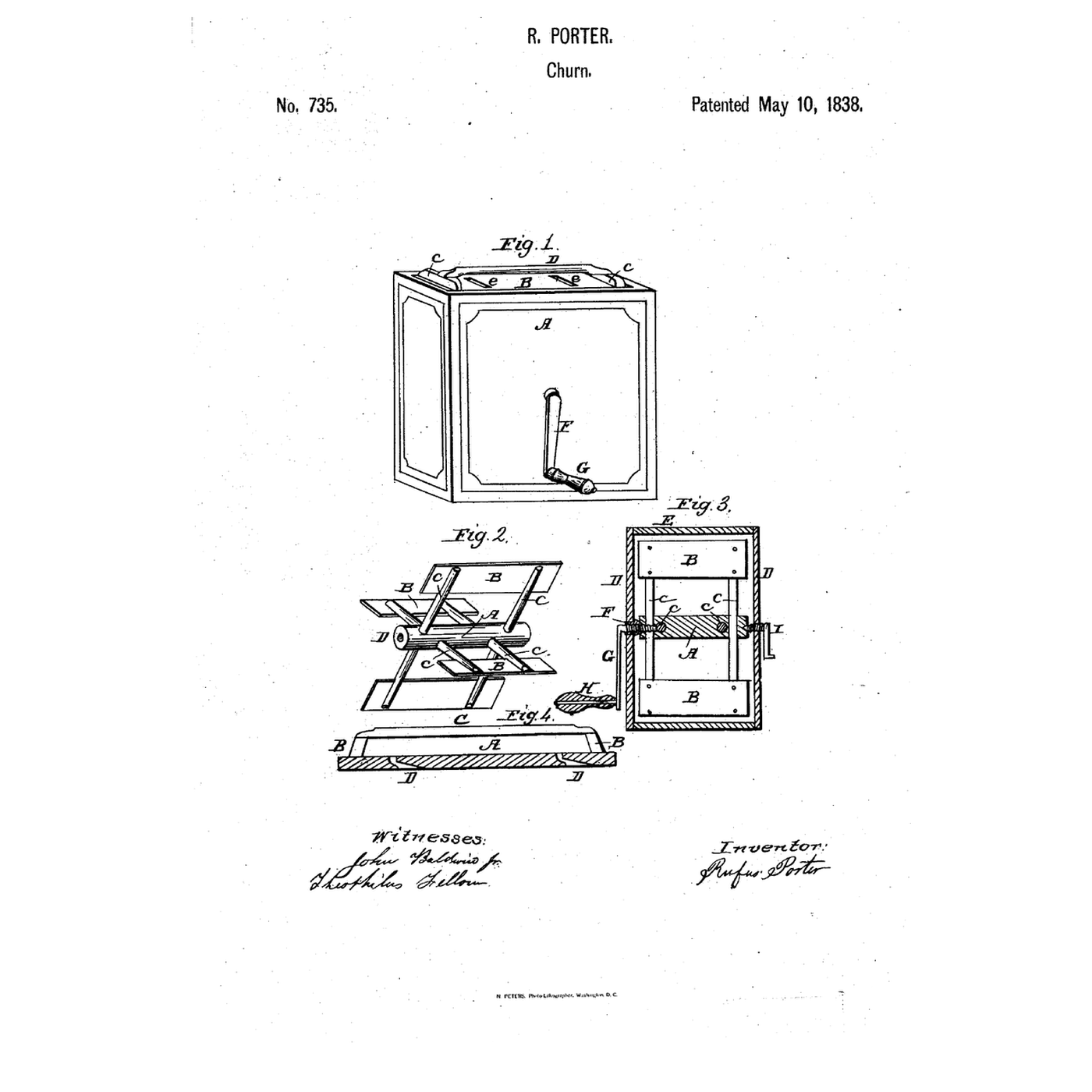


Rotary-Dasher Box Churn: Float Boards on Crossed Arms in a Curved Box
An up-and-down dash churn is slow, tiring work.
Rufus Porter of Billerica, Massachusetts, received US 735, dated 10 May 1838, for a churn: a box eighteen inches long with a bottom curved from end to end; a wooden shaft running between a hollow cone and a pointed centre screw; two parallel pairs of rods through the shaft at right angles, carrying float boards parallel with the shaft — "what is termed the rotary dasher" — turned by a crank whose twisted tenon is pressed into the shaft and comes out when the occasion requires.
This rung compares his churn's sweep with a tabletop one, then prints the dasher, builds the box, and makes butter.
Intermediate
About 5 hours, plus printing
Instructions
1
1
Butter yield and sweep
Butter yield and sweep
Loading Jupyter Notebook...
2
2
A board pushed through liquid before it
A board pushed through liquid before it
The embedded blueprint drives a boat with a flat paddle. Porter's float boards push through cream the same way, turning on a shaft.
3
3
Read US 735
Read US 735
"Four round bars or rods, sixteen inches long and one inch in diameter, pass through the shaft; two of these rods are parallel, and about five inches apart, each being one inch from one end of the shaft. The other two are parallel to each other, but at right angles with the first pair, and three inches apart; the four bars thus constituting eight arms."
4
4
Print the dasher
Print the dasher
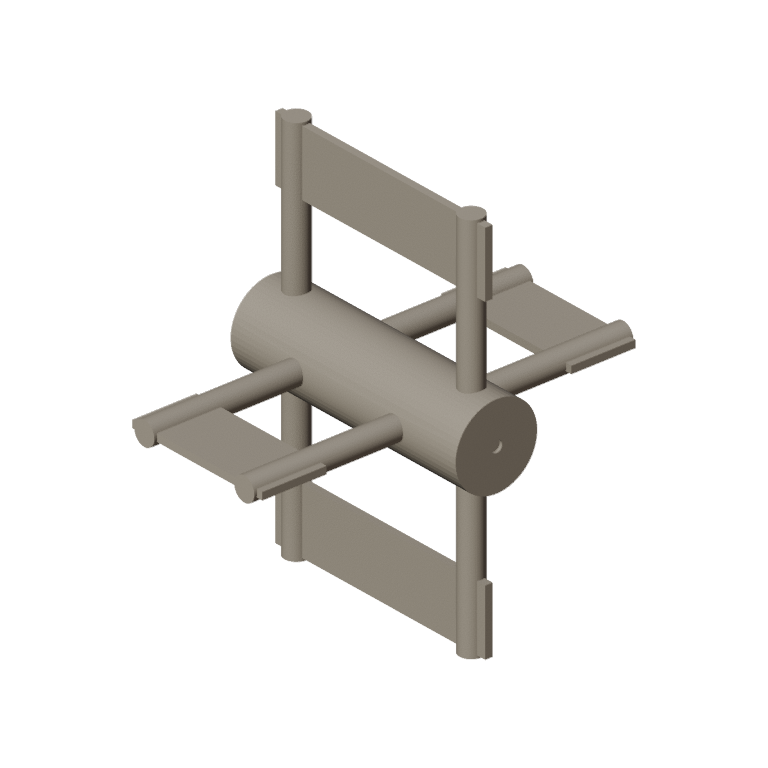
Print the rotary dasher: core, two parallel pairs of arms at right angles, and four float boards (/uploads/blueprints/rotary-dasher-box-churn-dasher.stl). Print in PLA at 0.2 mm layers, 30 % infill, 4 walls; wash before first use.
Materials for this step:
 PLA Filament1 piece
Tools needed:
 FDM 3D Printer
5
5
Use a box with a curved bottom
Use a box with a curved bottom
Take a food-safe storage box about 150 × 100 mm and 150 mm deep. Drill both ends on the dasher's axis, 85 mm up. Bed a plywood strip curved from end to end in its floor with silicone, as his curved bottom.
Materials for this step:
 HDPE Storage Container1 piece
 Plywood Sheet1 piece
 Silicone Sealant1 piece
Tools needed:
 Coping Saw
 Cordless Drill
 Drill Bit Set
6
6
Cone, centre screw and crank
Cone, centre screw and crank
File an M5 screw to a point and run it through one end as the centre screw into the dasher's end hole. Through the other end pass a 5 mm rod into the dasher's seat as the hollow-cone bearing, bent outside into a crank.
Materials for this step:
 Machine Screws1 piece
 Hex Nut1 piece
 Mild Steel Rod1 piece
Tools needed:
 Files (Hand File)
 Bench Vise
 Adjustable Spanner
7
7
The build in 3D
The build in 3D
FreeCAD model of this build, not of the patent: the box with its curved bottom cut away to show inside, the printed rotary dasher with two parallel arm pairs at right angles and four float boards, and the crank.
8
8
Make butter
Make butter
Let 500 ml of heavy cream stand until it reaches about 15 °C, checked with the thermometer. Pour it into the box, close the lid, and crank steadily; time until the butter comes. Pour off the buttermilk, add cold water, churn a few turns and pour off again until it runs clear; work in a pinch of salt and weigh the butter.
Materials for this step:
 Heavy Cream500 ml
 Coarse Sea Salt1 piece
 Water1 piece
Tools needed:
 Leave-In Probe Thermometer
 Stopwatch
 Digital Kitchen Scale
 Stainless Steel Mixing Bowl (Large)
9
9
A dasher that sticks, a box that leaks
A dasher that sticks, a box that leaks
Rotary-dasher box churn troubleshooting.
Flow
Loading...
10
10
History and honest limits
History and honest limits
**Rufus Porter** of Billerica, Massachusetts, received US 735, dated 10 May 1838. His box is eighteen inches long, ten wide and eighteen deep, of boards three-quarters of an inch thick; the bottom, three-eighths thick, is curved so its centre is three inches lower than its ends; a lid with ventilation apertures fits a rabbet; the float boards are eight inches long and three wide. He gave the dimensions of every part.
**Honest limits.** A storage box and a printed dasher at tabletop scale stand in for his. FDM prints hold food in their layer lines, so wash well and replace when worn. Your times and weights are the result.
Materials
10- 1 piecePlaceholder
- 1 piecePlaceholder
- 1 piecePlaceholder
- 1 piecePlaceholder
- 1 piecePlaceholder
- 1 piecePlaceholder
- 1 piecePlaceholder
- 500 mlPlaceholder
- 1 piecePlaceholder
- 1 piecePlaceholder
Tools Required
11- Placeholder
- Placeholder
- 1 vendor sell this, none ship to you yetPlaceholder
- Placeholder
- Placeholder
- Placeholder
- Placeholder
- Placeholder
- Placeholder
- Placeholder
- Placeholder
Design Files
1Related Blueprints
These blueprints share knowledge with this one — techniques, materials, or principles that connect them in the learning graph.



CC0 Public Domain
This blueprint is released under CC0. You are free to copy, modify, distribute, and use this work for any purpose, without asking permission.
Support the Maker by purchasing products through their Blueprint where they earn a Maker Commission set by Vendors, or create a new iteration of this Blueprint and include it as a connection in your own Blueprint to share revenue.