ART
BEAUTY & WELLNESS
CRAFT
CULTURE & HISTORY
ENTERTAINMENT
ENVIRONMENT
FOOD & DRINKS
REVERSE ENGINEERING
SCIENCES
SPORTS
TECHNOLOGY
WEARABLES
Hazardous


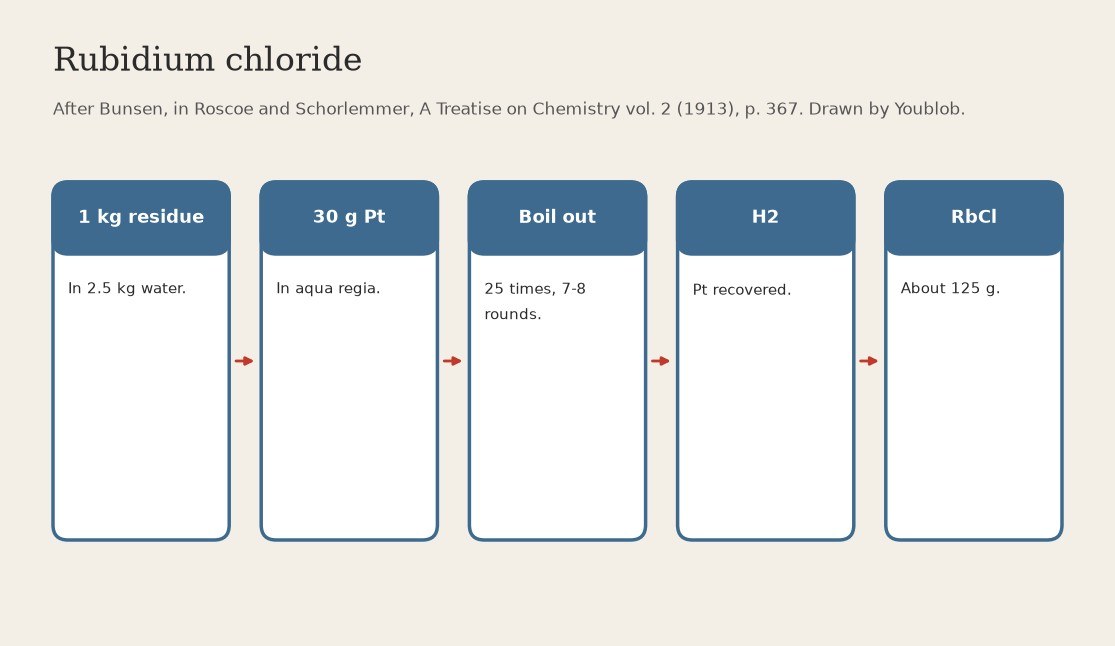
Rubidium Chloride: Lepidolite Lithia Residue Parted with Platinic Chloride (Bunsen, Roscoe 1913)
Rubidium's double chloride with platinum is less soluble than potassium's. Precipitating with platinic chloride and boiling out the potassium salt again and again concentrates the rubidium; hydrogen then takes the platinum back.
Result: about 125 g of rubidium chloride from 1 kg of residue, with 3–4 % potassium chloride and a little caesium chloride. The platinum is recovered.
Source: Roscoe and Schorlemmer, A Treatise on Chemistry vol. 2 (1913), p. 367, after Bunsen. Unknown: the lepidolite residue; no blueprint extracts lithium from lepidolite yet. Picture drawn by Youblob.
Advanced
2 weeks
Hazardous content
This blueprint contains hazardous procedures. Log in and enable hazardous content in your account settings to view the step-by-step instructions.
Sign inThis blueprint makes
CC0 Public Domain
This blueprint is released under CC0. You are free to copy, modify, distribute, and use this work for any purpose, without asking permission.
Support the Maker by purchasing products through their Blueprint where they earn a Maker Commission set by Vendors, or create a new iteration of this Blueprint and include it as a connection in your own Blueprint to share revenue.