ART
BEAUTY & WELLNESS
CRAFT
CULTURE & HISTORY
ENTERTAINMENT
ENVIRONMENT
FOOD & DRINKS
REVERSE ENGINEERING
SCIENCES
SPORTS
TECHNOLOGY
WEARABLES
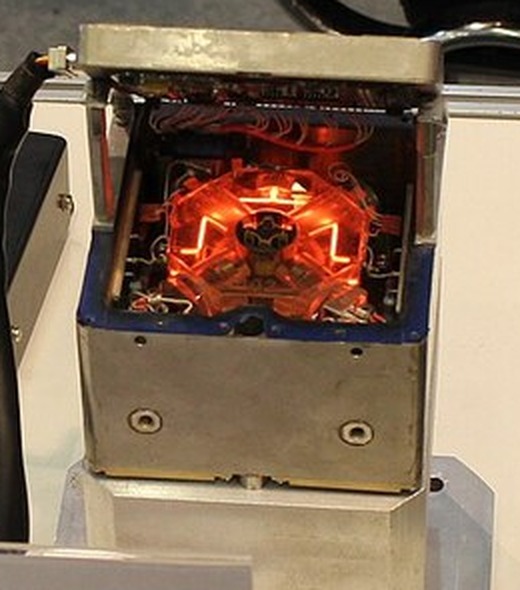


The Sagnac Interferometer
Georges Sagnac built it in 1913 hoping to prove the aether existed, which by then was a minority position, and instead produced the one interferometer that measures something no other instrument can get at without looking outside.
Split a beam and send the two halves round the SAME closed loop in opposite directions. If the loop is stationary the two paths are identical and the fringes sit still. If the loop is rotating, the beamsplitter has moved slightly by the time each beam returns — further away for the beam travelling with the rotation, nearer for the one going against — and the fringes shift in proportion to the rate.
What makes it extraordinary is what is absent from the formula. The shift depends on the enclosed AREA and the rotation rate, and on nothing else: not the shape of the loop, not what it is made of, not the refractive index, and not anything outside it. There is no reference and nothing to see. A sealed box can know it is turning.
A bench-sized loop sees a turntable and cannot possibly see the Earth. The fix is to enclose the area many times over — a kilometre of optical fibre wound on an eight-centimetre former gives four thousand turns, and that instrument detects the Earth's rotation. Ring laser and fibre optic gyroscopes have flown aircraft since the 1980s, and there is nothing inside them that moves.
Advanced
4 hours
Instructions
1
1
Close the loop
Close the loop
Rebuild the Michelson's optics as a square: beamsplitter at one corner, front-surface mirrors at the other three, so a beam entering the splitter goes right round and comes back. Both directions travel the same square.
Align by walking each mirror until the two counter-propagating beams overlap on the output card. Fringes appear when they do. Mount the whole board on a turntable, with the laser on the board so nothing crosses the rotating boundary.
Materials for this step:
 Beam Splitter Cube1 piece
 Front-Surface Mirror (50mm)3 pieces
 Quartz Sand (clean)8 kg
Tools needed:
 Laser Pointer
 Laser Safety Glasses
 Optical Bench Kit
 Digital Tachometer
2
2
Turn it and watch
Turn it and watch
Spin the turntable steadily and read the rate with the optical tachometer. Watch the fringe pattern with the photodiode and the scope rather than by eye — the shift for a bench loop is a fraction of a fringe.
Reverse the direction. The shift reverses too, and that sign change is the proof: vibration and thermal drift do not care which way you turn, and this does.
Tools needed:
Digital Tachometer Photodiode (BPW34)
 Digital Oscilloscope
3
3
Area, turns, and the gyroscope comparison
Area, turns, and the gyroscope comparison
Loading Jupyter Notebook...
Tools needed:
 Desktop Computer
4
4
Compendium: lock-in, and dithering out of it
Compendium: lock-in, and dithering out of it
THE FAULT THAT NEARLY KILLED THE RING LASER GYRO. In a ring LASER, the two directions are not passive beams but two lasing modes whose frequency difference is the output. Any tiny back-scatter from a mirror couples them, and coupled oscillators pull into step — so below some threshold rotation rate the frequency difference collapses to exactly zero and the instrument reads no rotation at all. This LOCK-IN is not noise; it is a dead band around the one measurement you most want to be accurate, slow drift.
The standard cure is almost comic: mechanically DITHER the whole laser block back and forth through a few hundred hertz so it is essentially never near zero rate, and subtract the known dither afterwards. A device whose whole selling point is having no moving parts is given one deliberately, and that is why a ring laser gyro can be heard whining. A fibre optic gyro avoids the problem entirely by staying passive — no lasing in the loop, so nothing to lock — which is why it won the cheaper end of the market.
Materials
3- 1 piecePlaceholder
- 3 piecesPlaceholder
- 8 kgPlaceholder
Tools Required
7- Placeholder
- Placeholder
- Placeholder
- Placeholder
- Placeholder
- 1 vendor sell this, none ship to you yetPlaceholder
- Placeholder
Related Blueprints
These blueprints share knowledge with this one — techniques, materials, or principles that connect them in the learning graph.



CC0 Public Domain
This blueprint is released under CC0. You are free to copy, modify, distribute, and use this work for any purpose, without asking permission.
Support the Maker by purchasing products through their Blueprint where they earn a Maker Commission set by Vendors, or create a new iteration of this Blueprint and include it as a connection in your own Blueprint to share revenue.