ART
BEAUTY & WELLNESS
CRAFT
CULTURE & HISTORY
ENTERTAINMENT
ENVIRONMENT
FOOD & DRINKS
REVERSE ENGINEERING
SCIENCES
SPORTS
TECHNOLOGY
WEARABLES
Hazardous


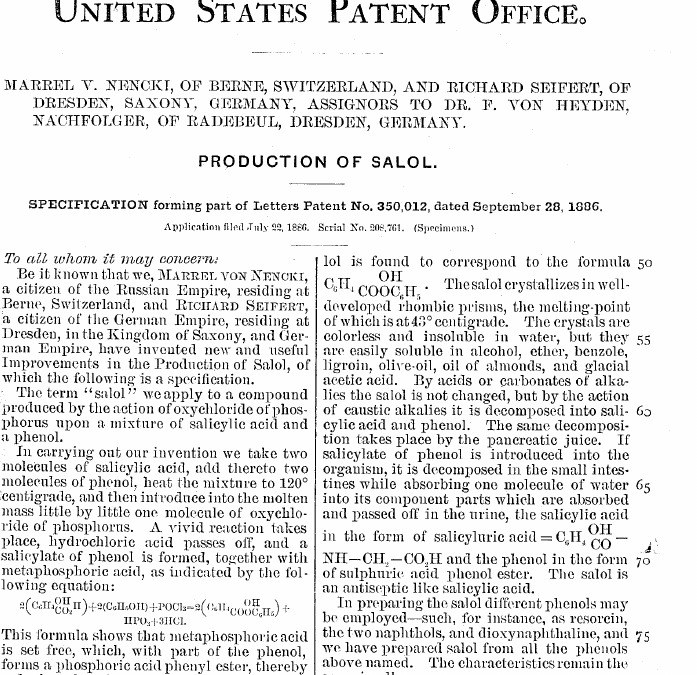
Salol: Salicylic Acid and Phenol Melted with Phosphorus Oxychloride (Nencki and Seifert, 1886)
Salol, phenyl salicylate, is the ester of salicylic acid and phenol: colourless crystals that melt at 43 C, insoluble in water.
M. von Nencki and R. Seifert patented its making in 1886: melt two parts salicylic acid with two parts phenol (by molecules), heat to 120 C and add one part phosphorus oxychloride little by little. Hydrogen chloride escapes and salol forms; water separates it from the melt, soda washes it and alcohol recrystallises it.
The scale and the glassware are ours. Their second route, from sodium salicylate, is a separate blueprint.
Source: US 350,012 (1886). Picture: their specification, p. 1.
Advanced
Half a day
Hazardous content
This blueprint contains hazardous procedures. Log in and enable hazardous content in your account settings to view the step-by-step instructions.
Sign inThis blueprint makes
CC0 Public Domain
This blueprint is released under CC0. You are free to copy, modify, distribute, and use this work for any purpose, without asking permission.
Support the Maker by purchasing products through their Blueprint where they earn a Maker Commission set by Vendors, or create a new iteration of this Blueprint and include it as a connection in your own Blueprint to share revenue.