Collaboration
ART
BEAUTY & WELLNESS
CRAFT
CULTURE & HISTORY
ENTERTAINMENT
ENVIRONMENT
FOOD & DRINKS
REVERSE ENGINEERING
SCIENCES
SPORTS
TECHNOLOGY
WEARABLES
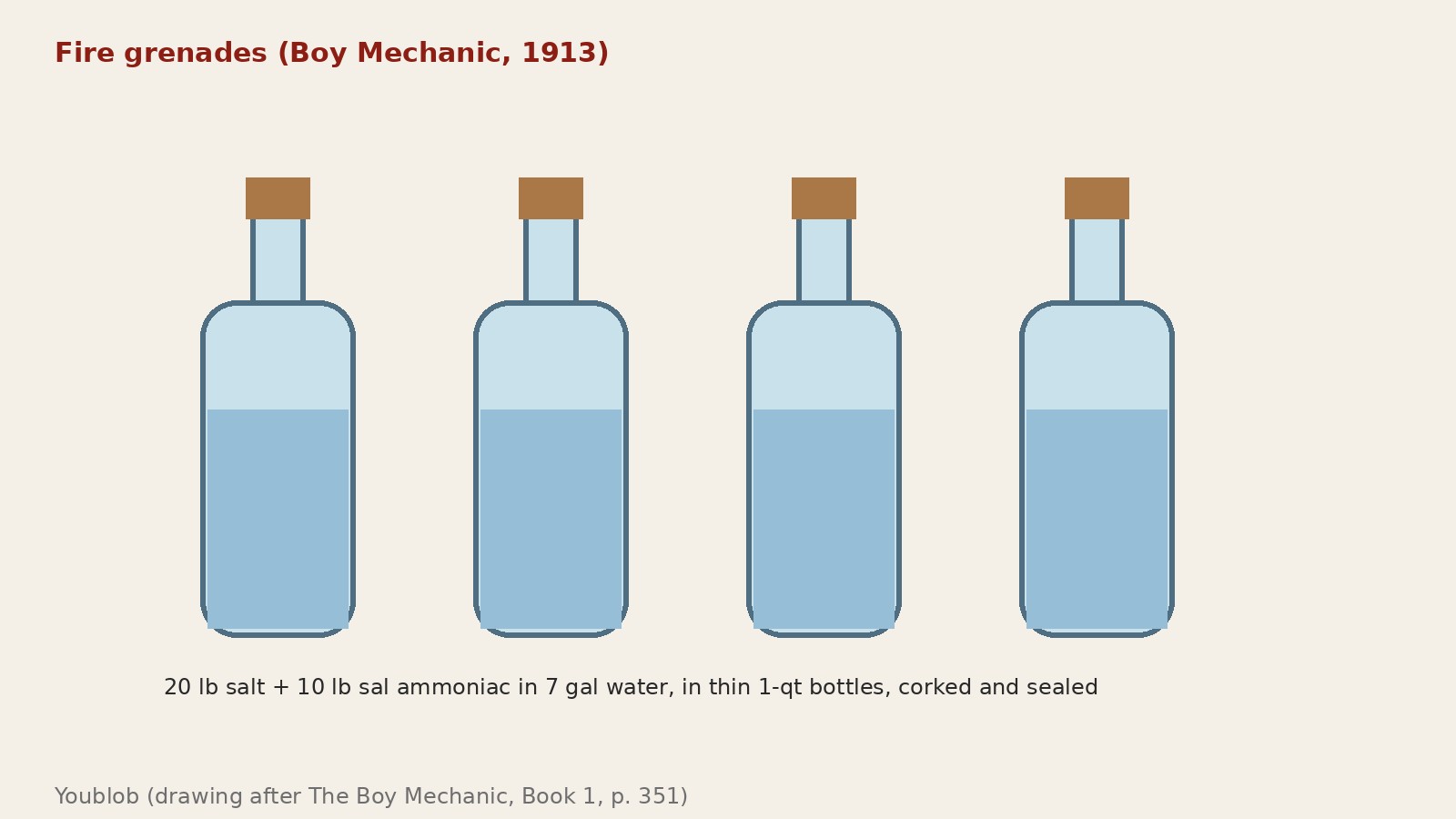


Fire Grenades: Salt and Sal Ammoniac Solution in Thin Glass Bottles (Boy Mechanic, 1913)
The old 'fire grenade': a strong solution of common salt and sal ammoniac sealed in thin quart bottles, thrown into the flames to break and drench them. A historical method; keep a modern rated extinguisher as well.
Beginner
An hour
Instructions
1
1
His batch
His batch
Loading Jupyter Notebook...
2
2
Read the Boy Mechanic
Read the Boy Mechanic
"Dissolve 20 lb. of common salt and 10 lb. of sal ammoniac in 7 gal. of water."
3
3
Make the solution
Make the solution
Dissolve 20 lb (9.1 kg) of common salt and 10 lb (4.5 kg) of sal ammoniac (ammonium chloride) in 7 gal (26.5 l) of water.
Materials for this step:
 Salt1 piece
 Ammonium Chloride (NH4Cl)1 piece
 Water1 piece
Tools needed:
 20-Liter Bucket
4
4
Fill the bottles
Fill the bottles
Fill thin glass bottles of about a quart, cork them tightly and seal the corks so nothing evaporates.
Materials for this step:
 Glass Bottle (Clear)1 piece
 Corks1 piece
 Beeswax1 piece
5
5
Use
Use
At a fire, throw a bottle into or near the flames so it breaks, or break off the neck and scatter the liquid on the fire. Several may be needed.
6
6
Troubleshooting
Troubleshooting
Fire grenade troubleshooting.
Flow
Loading...
7
7
History and honest limits
History and honest limits
From **The Boy Mechanic, Book 1** (Popular Mechanics, 1913), p. 351 (checked on the archive.org scan boymechanic0000unse_n5a8). This is the period method as printed; it is not tested to any modern fire rating. Metric figures and wax sealing are ours.
Materials
6- 1 piecePlaceholder
- 1 piecePlaceholder
- 1 piecePlaceholder
- 1 piecePlaceholder
- 1 piecePlaceholder
- 1 piecePlaceholder
Tools Required
1- Placeholder
This blueprint makes
CC0 Public Domain
This blueprint is released under CC0. You are free to copy, modify, distribute, and use this work for any purpose, without asking permission.
Support the Maker by purchasing products through their Blueprint where they earn a Maker Commission set by Vendors, or create a new iteration of this Blueprint and include it as a connection in your own Blueprint to share revenue.