ART
BEAUTY & WELLNESS
CRAFT
CULTURE & HISTORY
ENTERTAINMENT
ENVIRONMENT
FOOD & DRINKS
REVERSE ENGINEERING
SCIENCES
SPORTS
TECHNOLOGY
WEARABLES
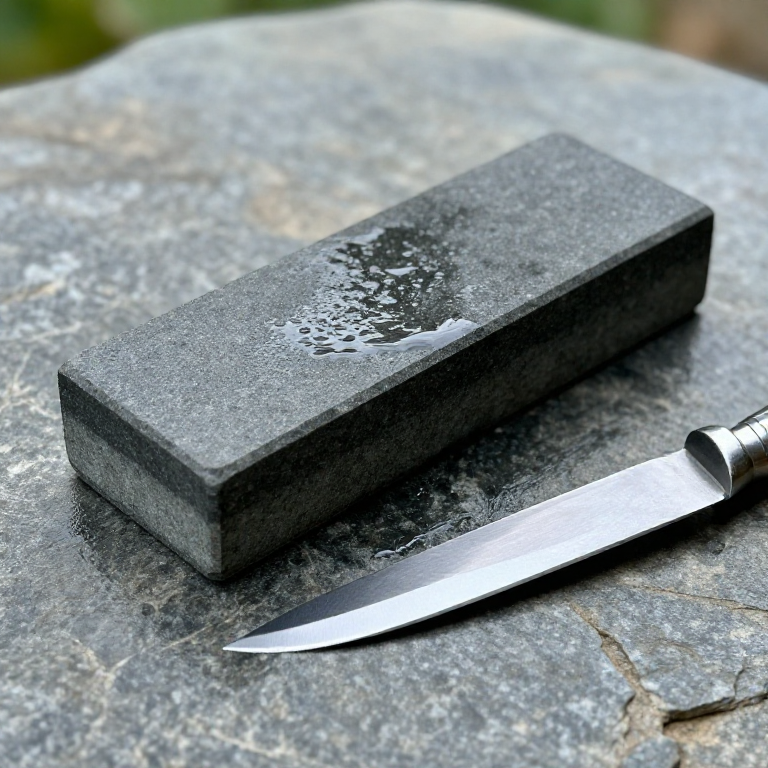


Sandstone Whetstone
Before bonded abrasives, edges were sharpened on natural stone, and fine sandstone was the commonest. A piece is shaped to a block and one face is ground dead flat by rubbing it on a flat slab with sand and water. Used wet, its quartz grains cut steel. Sandstone cuts fast but coarse: finish an edge on a finer stone.
Beginner
Half a day
Instructions
1
1
Choose the stone
Choose the stone
Pick a piece of fine, even-grained sandstone without cracks or soft layers, a little bigger than the block you want.
Materials for this step:
 Sandstone (Abrasive)2 kg
2
2
Shape a block
Shape a block
Wearing glasses, trim it to a rough block about 200 by 60 by 30 mm with the chisels and hammer.
Tools needed:
 Stone Carving Chisels
 Stone Carving Hammer
 Safety Glasses
3
3
Flatten the face
Flatten the face
Sprinkle sand and water on a large flat stone and rub the stone's face on it in figure-eights until the straightedge shows no light under it.
Materials for this step:
 Sand0.5 kg
 Water2 liters
Tools needed:
 Large Flat Stone
 Straightedge
4
4
Test it
Test it
Soak it in water and hone a dull knife on it: the edge should come up keen but coarse.
Materials for this step:
Water2 litersTools needed:
 Bowl
BowlTools Required
6- Placeholder
- Placeholder
- Placeholder
- Placeholder
- Placeholder
- Placeholder
This blueprint makes

CC0 Public Domain
This blueprint is released under CC0. You are free to copy, modify, distribute, and use this work for any purpose, without asking permission.
Support the Maker by purchasing products through their Blueprint where they earn a Maker Commission set by Vendors, or create a new iteration of this Blueprint and include it as a connection in your own Blueprint to share revenue.