Collaboration
ART
BEAUTY & WELLNESS
CRAFT
CULTURE & HISTORY
ENTERTAINMENT
ENVIRONMENT
FOOD & DRINKS
REVERSE ENGINEERING
SCIENCES
SPORTS
TECHNOLOGY
WEARABLES
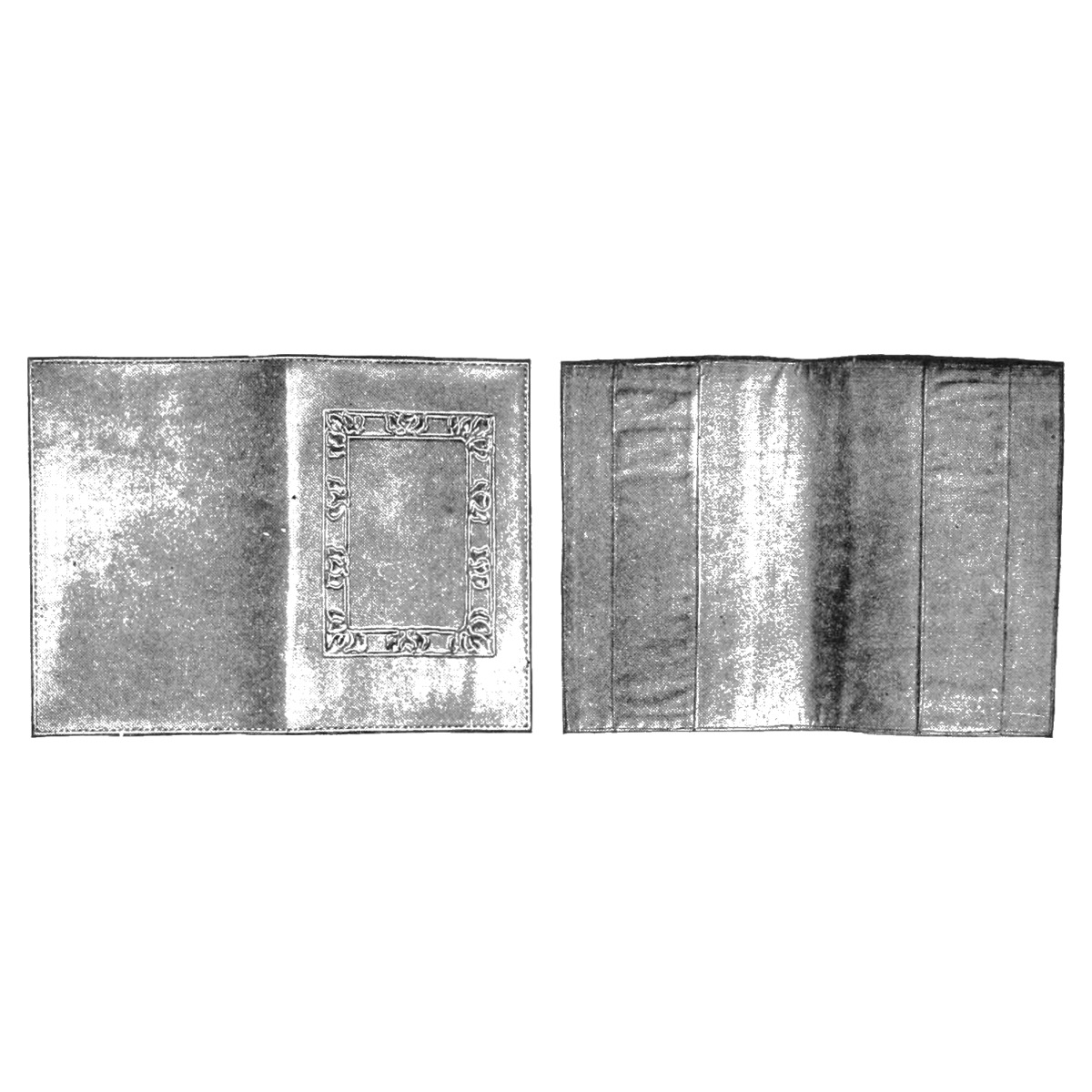


Tooled Leather Magazine Cover: Silk-Lined, With Strips to Hold the Magazine (Boy Mechanic, 1915)
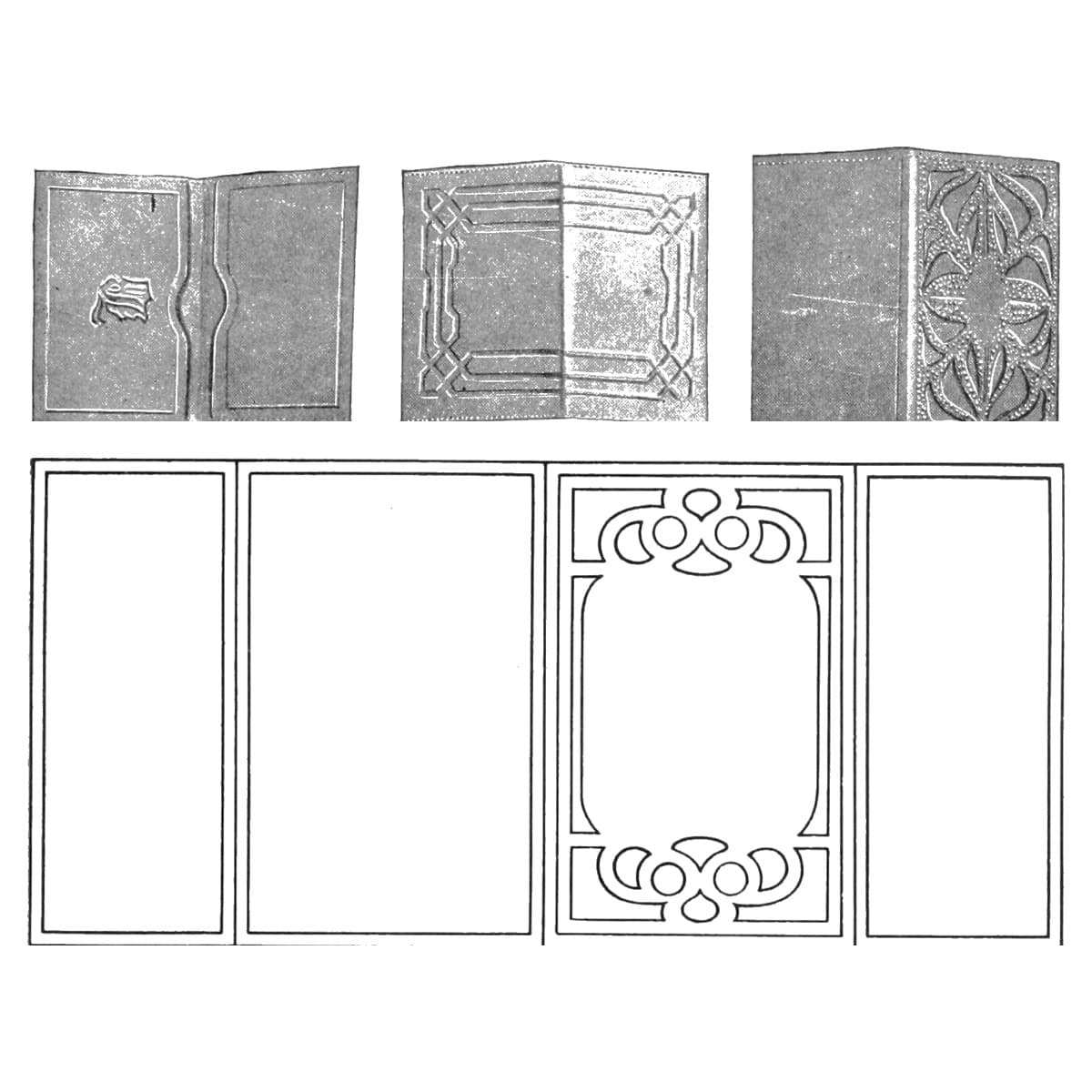
Mary C. Scovel's magazine cover (The Boy Mechanic, Book 2, 1915): an 11 by 15 in sheet of calfskin with a tooled border design on the front, lined with heavy silk, and two silk strips inside into which the magazine's covers slip.
Beginner
About 4 hours
Instructions
1
1
Her sizes, and the design panel
Her sizes, and the design panel
Loading Jupyter Notebook...
2
2
Read The Boy Mechanic, Book 2
Read The Boy Mechanic, Book 2
Her outfit: "two special tools costing 50 cents each, one with a narrow edge for lining patterns, and one with broad ends for tooling; and a piece of tin, plate glass, or very smooth hard wood, which should not be smaller than 9 by 12 in. A soft sponge, a triangle, a rule, tracing paper and a hard pencil are also needed." Russian calfskin is best for tooling and stamping.
3
3
Damp the leather and transfer the design
Damp the leather and transfer the design
Draw the whole design for the cover: a border design bounded by rectangular lines, 5-1/4 in wide, 1 in from the front edge, 1-1/2 in from the top and 2-1/4 in from the bottom (leather 11 by 15 in, narrow edges folded together) on tracing paper. Wet the leather on the wrong (unfinished) side with a soft sponge: pat it to moisten, not soak, it; too wet and the tool sticks and leaves an uneven background. Pin the design firmly on the leather, tack the leather down on its outer margin to the glass or board, and go over every line with a hard pencil, with firm, even pressure. Lift the paper and go over the lines with the narrow lining tool, with a strong, firm stroke. A line design can stop here.
Materials for this step:
 Calf Leather1 piece
Tools needed:
 Sponge
 Tracing Paper
 Pencil
 Drawing Pins (Thumbtacks, box of 50)
 Glass Sheet
 Leather Modeling Tool
4
4
Tool or stamp the background
Tool or stamp the background
Leave at least 1/8 in between the edge of the pattern and the design. To tool, press the background down with the broad end in even, long strokes; if it will not go down, the leather is too dry, so take it off and damp the back again. Keep the edges sharp between pressed and raised parts. To stamp instead, strike a small carpenter's nail set lightly with a wooden mallet in rows of circles; too hard a blow cuts the leather.
Tools needed:
Leather Modeling Tool Nail Set
 Wooden MalletSponge
5
5
Line and fit the strips
Line and fit the strips
Line the inside with heavy silk, allowing 1/4 in to turn in on all four sides. Lay two strips of the lining, 2-1/2 in wide and 11 in long, 1-1/2 in from each side over the lining. Stitch lining, strips and leather together about 1/8 in from the edge all round. The magazine's covers slip between the cover and the strips. Stitch on a sewing machine with a long stitch, a large needle and silk as heavy as the needle takes; try it on a scrap first, and put tissue paper over the leather if the foot marks it. Without a machine, prick holes with an awl and sew with needle and silk, running or over-and-over; going over-and-over to the end and back gives an X stitch.
Materials for this step:
 Silk Fabric1 piece
 Silk Thread1 piece
Tools needed:
 Scissors
 Ruler
 Sewing Machine
 Awl
 Two Harness Needles
6
6
Troubleshooting
Troubleshooting
Magazine cover troubleshooting.
Flow
Loading...
7
7
History and honest limits
History and honest limits
From Mary C. Scovel, "Arts-Crafts Leather Work", in **The Boy Mechanic, Book 2**, Popular Mechanics, 1915 (Project Gutenberg 44585; checked on the archive.org scan boymechanicbook200chic2, pp. 432-441), Part II. She does not give the leather; Russian calf is her choice for tooled work. The tools and metric figures are ours.
Materials
3- 1 piecePlaceholder
- 1 piecePlaceholder
- 1 piecePlaceholder
Tools Required
13- Placeholder
- Placeholder
- 1 vendor sell this, none ship to you yetPlaceholder
- Placeholder
- Placeholder
- Placeholder
- Placeholder
- Placeholder
- Placeholder
- Placeholder
- Placeholder
- Placeholder
- Placeholder
This blueprint makes

Related Blueprints
These blueprints share knowledge with this one — techniques, materials, or principles that connect them in the learning graph.
CC0 Public Domain
This blueprint is released under CC0. You are free to copy, modify, distribute, and use this work for any purpose, without asking permission.
Support the Maker by purchasing products through their Blueprint where they earn a Maker Commission set by Vendors, or create a new iteration of this Blueprint and include it as a connection in your own Blueprint to share revenue.