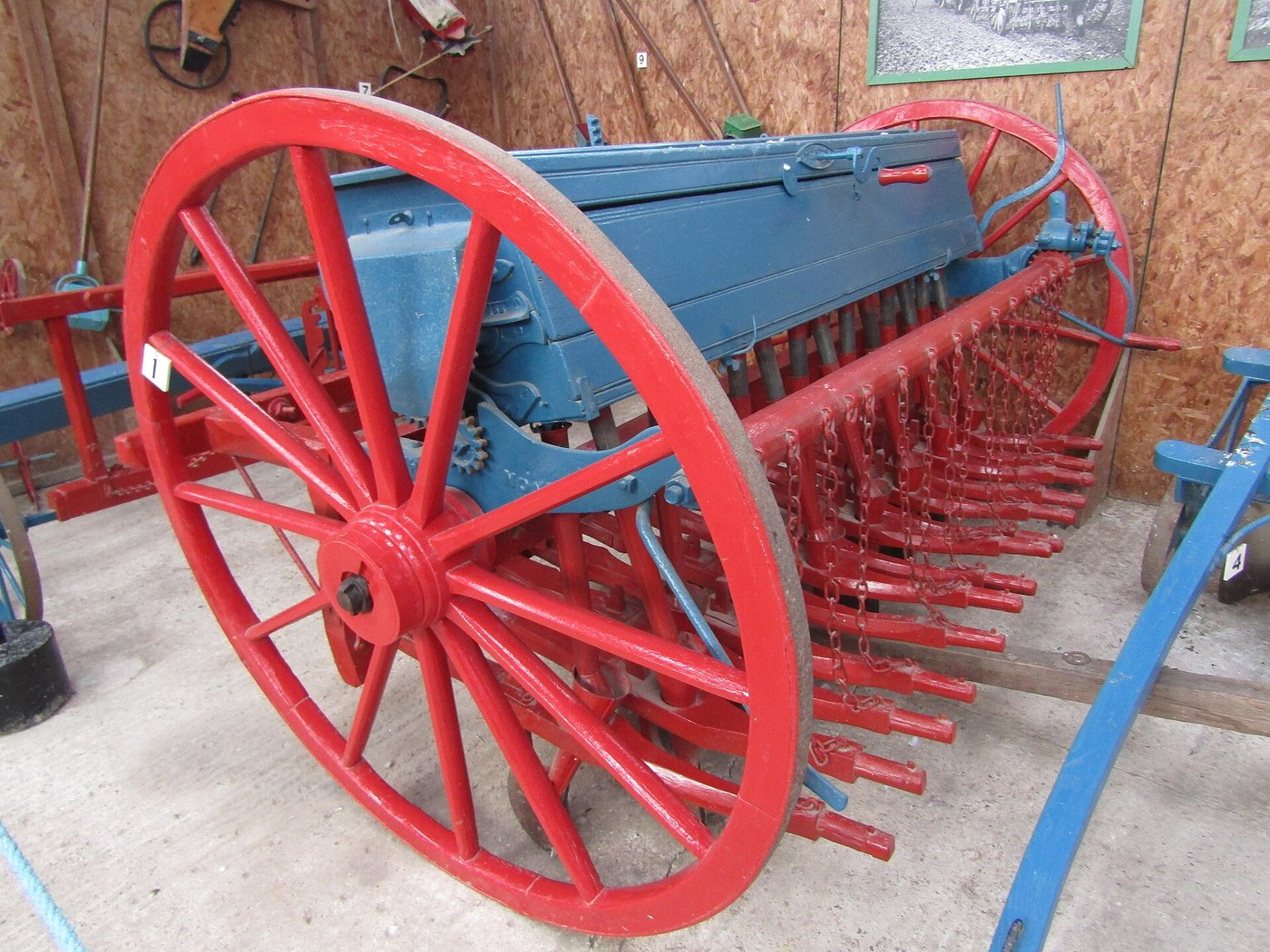


Seed Drill
Instructions
Measure the waste you are fixing
Measure the waste you are fixing
Do the old method first so the comparison is yours, not a claim.
- Count out 100 seeds.
- Scatter them by hand over a marked tray of soil.
- Count how many land on bare surface, how many clump, how many fall outside the marked area.
Materials for this step:
 Sesame Seeds (Raw)1 packet
Build the hopper and metering wheel
Build the hopper and metering wheel
The metering wheel is the whole invention. Everything else is a frame to hold it.
- Make a hopper that funnels seed down to one small opening.
- Fit a dowel below the opening with shallow notches cut around it.
- Size the notches to the seed — each notch should carry a few seeds, not a handful.
Materials for this step:
 Pine Dowel Rod Set1 set
 Plywood Sheet (1/8 inch, 12x12)1 pack
Add the coulter and the tube
Add the coulter and the tube
Open the ground ahead of the seed, and deliver the seed into the opening.
- Fix a narrow blade or wedge ahead of the metering wheel to cut a shallow furrow.
- Run a tube from the metering wheel down into that furrow.
- Trail a light chain or brush behind to close the soil over the seed.
Calibrate seeds per metre
Calibrate seeds per metre
A drill you have not calibrated is guesswork with extra steps.
- Mark one metre on the bench.
- Roll the drill that distance over a tray, catching everything it delivers.
- Count the seeds and divide by the distance.
- Change the notch size or the wheel diameter and repeat.
Tools needed:
 Steel Ruler
Sow in rows and compare
Sow in rows and compare
Run both methods side by side and let the plants report.
- Drill one tray in rows; broadcast a second tray with the same seed count.
- Water both the same and keep them together.
- Count emerged seedlings after a week and compare spacing.
History and context
History and context
Jethro Tull (1674-1741) was a Berkshire farmer, trained in law, who built a seed drill around 1701 — the mechanism is said to have been suggested to him by the pipes of a church organ. He published Horse-Hoeing Husbandry in 1731, arguing for drilling in rows and hoeing between them.
He did not invent the seed drill and it matters that we say so. Seed funnels attached to ploughs are documented in Mesopotamia around 1500 BC. Chinese multi-tube iron seed drills are attested from about the second century BC and were in routine use for well over a thousand years before Tull. Italian writers describe drilling machines in the sixteenth and seventeenth centuries. Tull's genuine contribution was a practical machine plus effective advocacy in a country and a century where it could spread.
His theory was wrong, and instructively so. Tull believed plants took up fine soil particles directly as food, so that pulverising the soil by repeated hoeing could replace manure. That is false — plants take up dissolved mineral nutrients — and he argued against manuring on the strength of it. The practice he promoted (row sowing, mechanical weeding) worked well; the explanation he gave for why it worked did not. Good results are not proof of a correct mechanism.
What followed: drills spread slowly through the eighteenth century and became general in the nineteenth, when factory-made versions with proper metering became affordable. The principle in every modern precision planter — meter the seed against distance travelled, place it at a controlled depth, close the soil — is the one on this bench.
Materials
3- 1 packetPlaceholder
- Placeholder
- 1 packPlaceholder
CC0 Public Domain
This blueprint is released under CC0. You are free to copy, modify, distribute, and use this work for any purpose, without asking permission.
Support the Maker by purchasing products through their Blueprint where they earn a Maker Commission set by Vendors, or create a new iteration of this Blueprint and include it as a connection in your own Blueprint to share revenue.