Collaboration
ART
BEAUTY & WELLNESS
CRAFT
CULTURE & HISTORY
ENTERTAINMENT
ENVIRONMENT
FOOD & DRINKS
REVERSE ENGINEERING
SCIENCES
SPORTS
TECHNOLOGY
WEARABLES
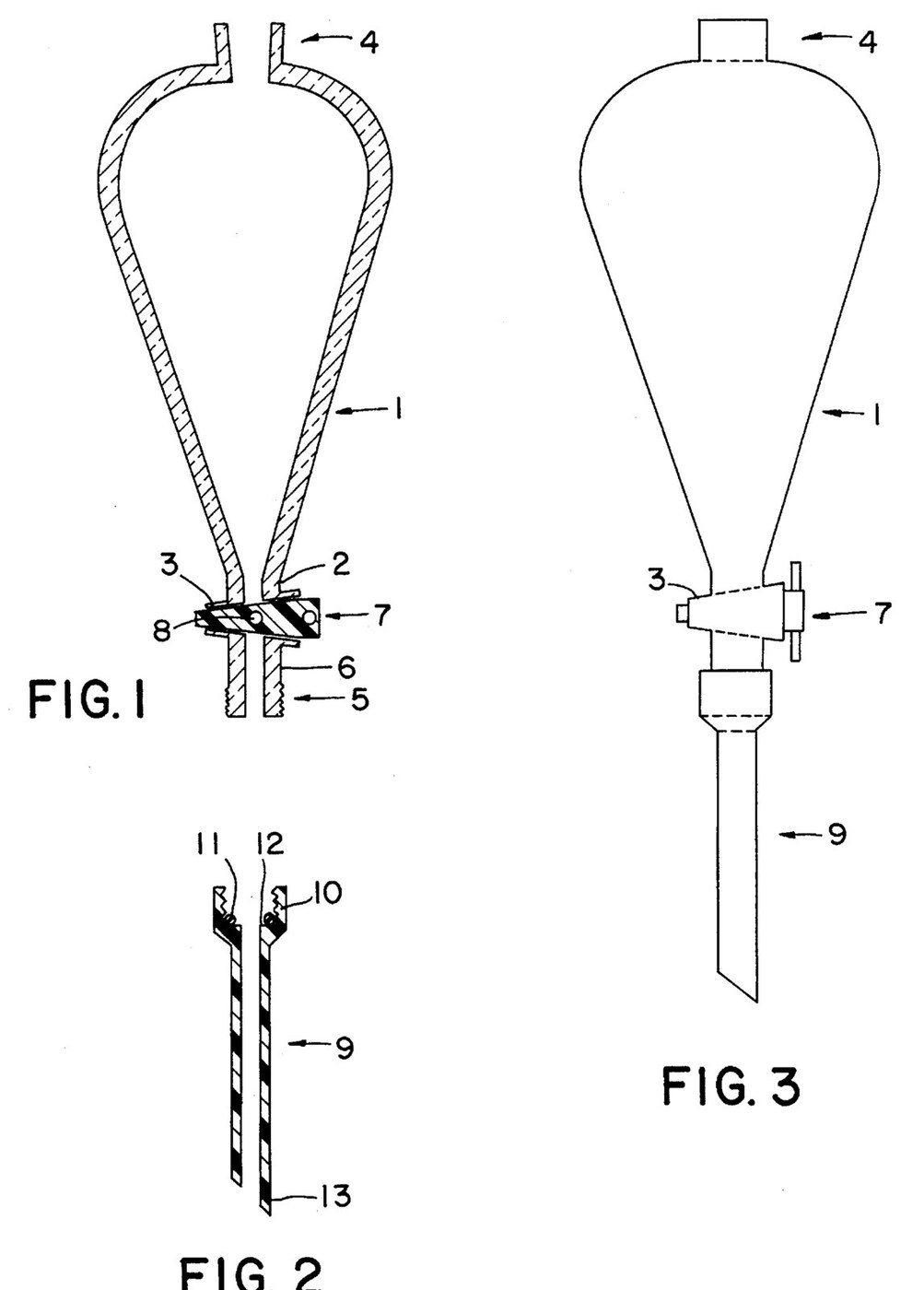


Separating Funnel: Glass Stopcock with a Screw-On Plastic Stem (Demers, US 5,580,528)
A separating funnel holds two liquids that do not mix, so the lower layer can be run off through a tap at the bottom. J. P. Demers (US 5,580,528, 1996) fuses a bought glass stopcock to the bottom of a pear-shaped glass vessel and screws a flexible plastic stem onto it, because the usual glass stem breaks just below the stopcock.
The glass stopcock body stays clear, so you can watch the boundary between the two liquids as it reaches the tap.
Source: J. P. Demers, US Patent 5,580,528 (filed 1995, granted 1996). Picture: its Figs. 1-3.
Advanced
Unknown
Instructions
1
1
Read Demers
Read Demers
"The stresses resulting from such impacts usually fracture the glass just below the stopcock, or else chip off the end of the stem ... When the fracture is close to the stopcock, repair is impossible without replacing the stopcock".
2
2
Blow the vessel
Blow the vessel
Blow a glass vessel, pear-shaped (or spherical or cylindrical), with a neck at the top for pouring in the liquids and an opening at the bottom. Glass, size and how it is blown are not given; the patent leaves this to a scientific glassblower.
Materials for this step:
 Unknown Glass1 vessel
Tools needed:
 Bench Glassblowing Torch
 Unknown Forming Method
 Unknown Dimensions
3
3
Fuse on the stopcock
Fuse on the stopcock
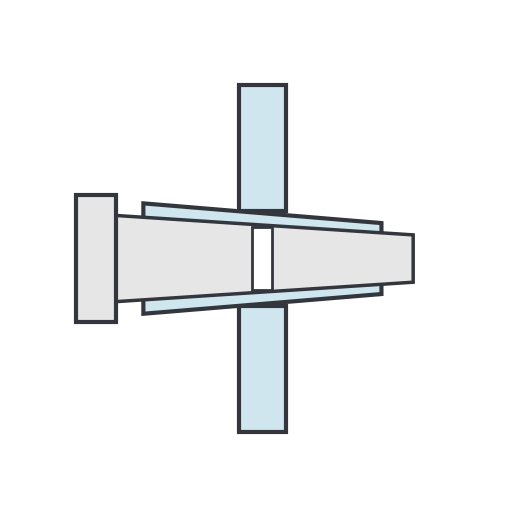
Take a glass-bodied stopcock (bought: the patent calls them articles of commerce, with a glass or PTFE plug) and fuse its upper stem to the bottom of the vessel so the vessel opens straight into the stem. Form a male thread on the end of its lower stem (how is not given).
Materials for this step:
 Glass Stopcock1 plug of glass or PTFE
Tools needed:
Bench Glassblowing TorchUnknown Forming Method4
4
Make the plastic stem
Make the plastic stem
Make a stem of moderately flexible plastic tube with a female thread in its upper end and an inner shoulder where the end of the glass thread meets it. Lay an O-ring on the shoulder when the funnel will hold reactive or toxic liquids or work under pressure or vacuum. Cut the lower end at about 45 degrees as a drip tip. The plastic is not given.
Materials for this step:
 Unknown Material1 flexible plastic stem
 O-Ring1 piece
Tools needed:
Unknown Forming MethodUnknown Dimensions5
5
Assemble and use
Assemble and use
Screw the plastic stem onto the glass thread. Close the stopcock, pour the two liquids in at the neck, shake and let them separate, then turn the plug to line its bore up with the stems and run the lower layer off, watching the boundary through the glass stopcock. Unscrew the stem to clear a blocked stopcock.
Materials
4- 1 vesselPlaceholder
- 1 plug of glass or PTFEPlaceholder
- 1 flexible plastic stemPlaceholder
- 1 piecePlaceholder
This blueprint makes

CC0 Public Domain
This blueprint is released under CC0. You are free to copy, modify, distribute, and use this work for any purpose, without asking permission.
Support the Maker by purchasing products through their Blueprint where they earn a Maker Commission set by Vendors, or create a new iteration of this Blueprint and include it as a connection in your own Blueprint to share revenue.